
In the cosmetics industry, talking about environmental impact is no longer enough. Brands now need to measure it, compare it and demonstrate it. Between consumer expectations, retailer requirements and corporate sustainability strategies, having a clear and reliable indicator has become essential. In this context, beCPG integrates the Green Impact Index (GII) directly into its PLM.
A simple framework for complex topics
The Green Impact Index (GII) is an evaluation method that measures the environmental and societal impact of a cosmetic product (see: greenimpactindex). It is already used by many players in the industry.
It assigns a score from A to D based on several dimensions:
- life cycle analysis (LCA)
- physico-chemical characteristics
- environmental performance
- costs
- societal aspects
beCPG enables companies to replicate the logic of the Green Impact Index directly within the PLM. An evaluation criteria list can be created to reflect the GII structure: carbon impact, packaging, formulation, transport, societal aspects, etc.
Each criterion can include:
- weightings defined by the methodology
- associated sub-criteria
- calculation rules required to determine the score
This allows companies to work within beCPG using an evaluation framework aligned with the Green Impact Index.
Automated calculations based on your data
The main benefit is automation. Criteria can be calculated directly from data already available in the PLM:
- ingredient and formulation data
- packaging characteristics
- supplier information
- eco-scores or LCA data
When a formula changes, or when packaging or suppliers are updated, the score is automatically recalculated without manual input. Teams can easily simulate different scenarios and immediately assess the impact of technical decisions.
Implementation of the Green Impact Index
In beCPG, the structure follows a clear hierarchy, with parent criteria and sub-criteria, in line with the GII methodology. This evaluation is then available in “Score list” within the relevant product records.
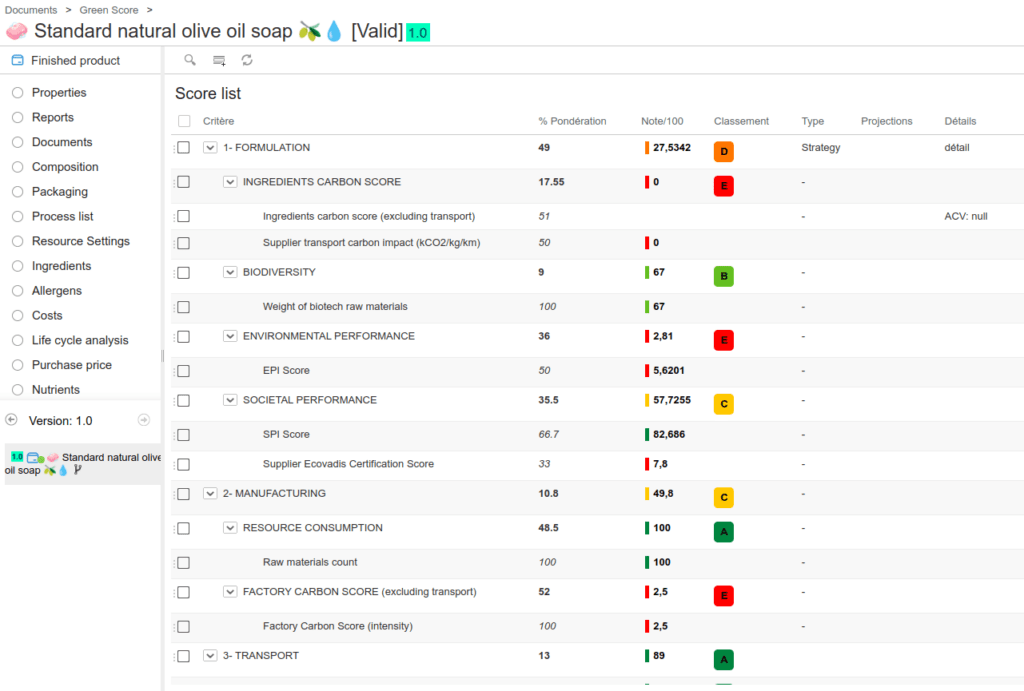
In this view, the overall score is built from major sections. Each section includes sub-criteria that explain the result, such as the carbon score of ingredients or the CSR rating of a supplier. The calculation takes into account defined weightings, allowing companies to reflect their own priorities.
Companies benefit from a solid foundation to:
- track progress over time
- structure their sustainability strategy
- justify decisions to retailers
- design more responsible products
Beyond the Green Impact Index, beCPG also integrates various environmental datasets and reference systems such as Agribalyse, societal scores, and the EPI (Environmental Performance Index). These data sources enhance the analysis and improve the reliability of evaluations.
The PLM thus becomes a true decision-making tool to integrate environmental considerations at the heart of product development.
Looking to implement a Green Impact Index evaluation in beCPG?
Our teams can support you in replicating your framework, automating calculations and integrating it into your existing processes. Contact us to learn more!
