How to calculate and reduce the cost of a recipe
Updated October 2026.
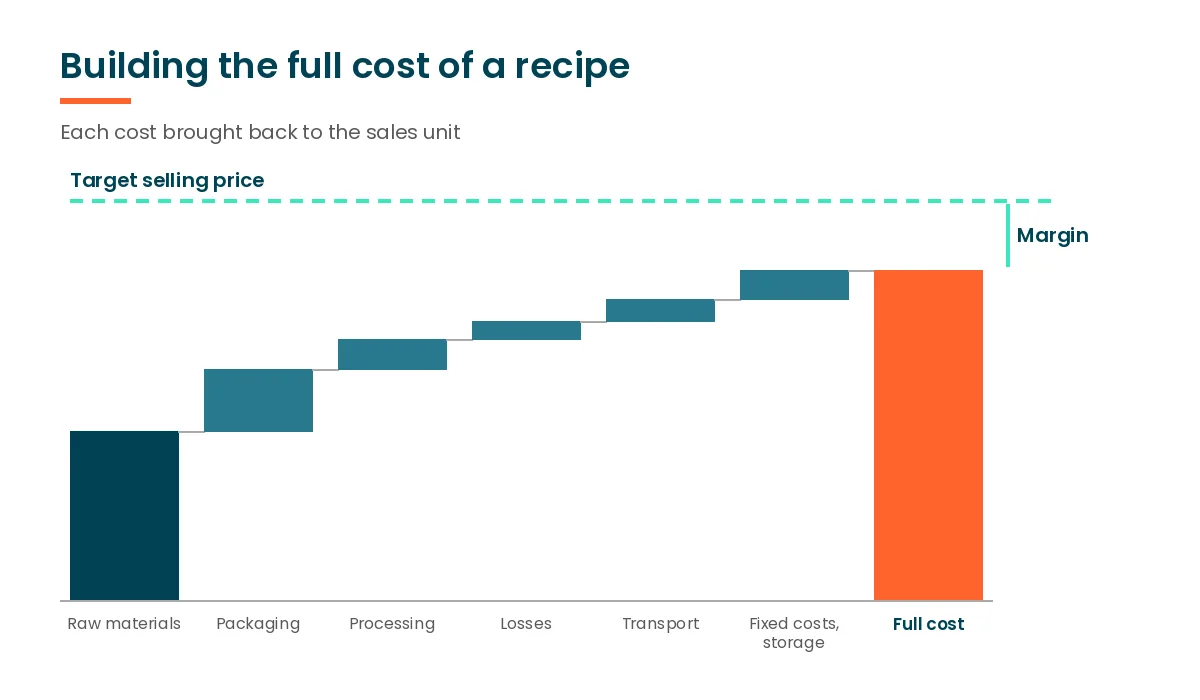
The cost of a recipe is not the sum of its raw material prices. Packaging, processing, losses, transport and fixed costs often make the difference between a profitable product and a product that loses money at every sale. Here is how to calculate the full cost, then how to reduce it without breaking your nutritional or regulatory targets.
1. Use the right purchase price
A raw material rarely has one price. It depends on the supplier, the origin, the plant, the quantity bought and the date. Keep a purchase price list with these criteria, a preference rank and effective dates; the cost used in the recipe is then the one that applies to your plant and your period. Keep several scenarios side by side: this year, last year, next year.
2. Add packaging per sales unit
Packaging is bought per level and must be brought back to the sales unit. Example: a primary packaging at €0.12, a case at €1.32 for 10 units and a pallet at €16.92 for 250 units cost 0.12 + 0.132 + 0.0677 = €0.32 per unit.
3. Add processing, losses and the other costs
- Processing: a line at €20 per hour producing 2,000 units per hour costs €0.01 per unit;
- losses and yields: a 5% process loss means buying 5% more raw material;
- transport, from the supplier to the plant and from the plant to the customer;
- fixed costs such as analyses, and storage.
Compare the result with your target selling price: the margin of each product is visible before launch, not after the first invoice.
A worked example
Illustrative figures for one sales unit:
| Cost component | Per unit |
|---|---|
| Raw materials | €0.85 |
| Packaging (3 levels) | €0.32 |
| Processing | €0.01 |
| Losses (5% of raw materials) | €0.04 |
| Transport | €0.05 |
| Fixed costs and storage | €0.03 |
| Full cost | €1.30 |
| Target selling price | €1.60 |
| Margin | €0.30 (19%) |
Here, a 10% increase on raw materials costs €0.085 per unit, more than a quarter of the margin: a good reason to simulate it before it happens.
4. See where the cost comes from
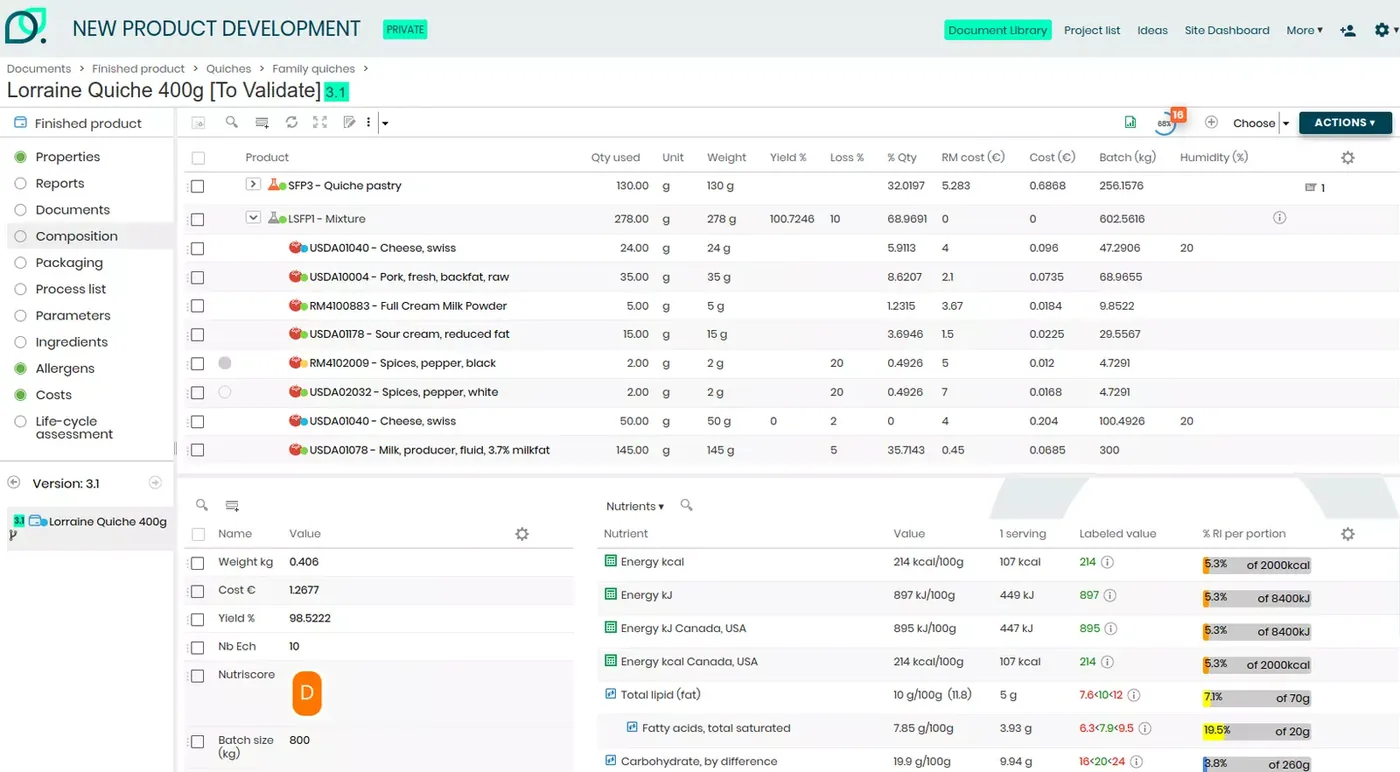
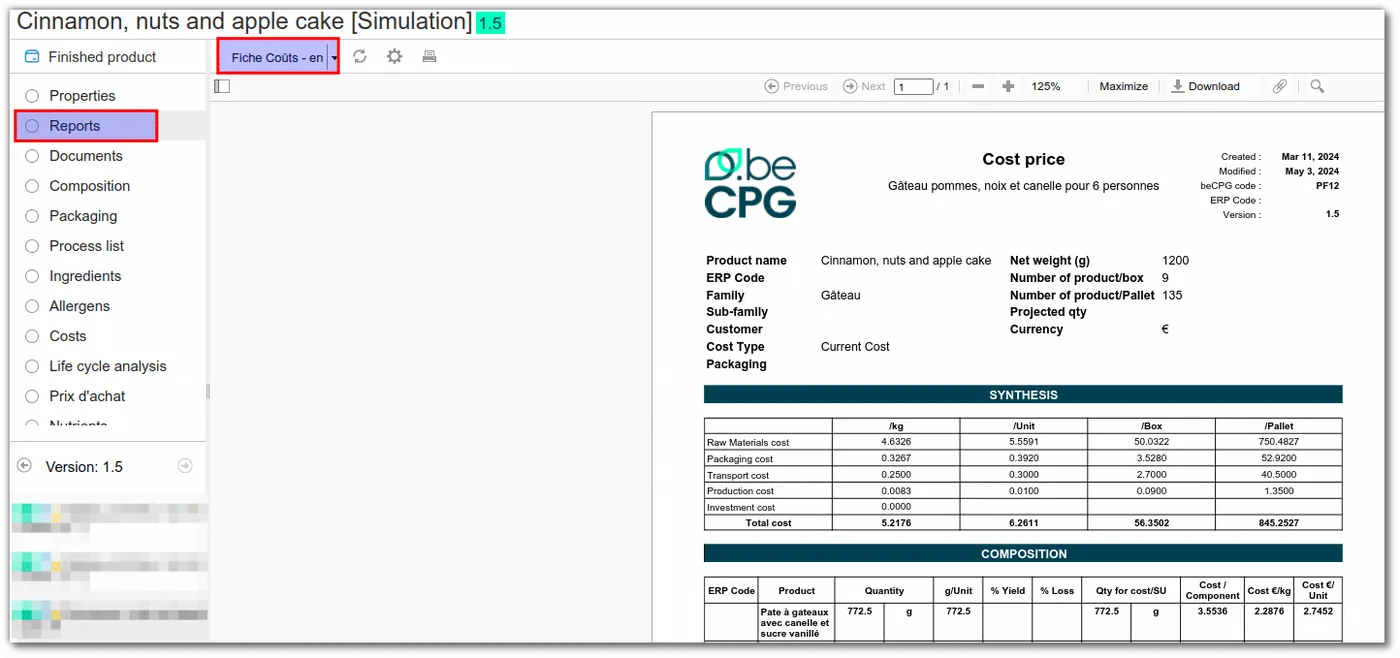
A detail by component, or a column with the share of each component in the total cost, shows where to act: often two or three ingredients make most of the cost.
5. Reduce the cost under constraints
Lowering the cost by hand, one ingredient at a time, quickly breaks something else: the Nutri-Score, an allergen, a claim, a maximum dose. Optimization under constraints calculates the quantities that minimize the cost while respecting your limits on composition, nutrients, allergens, ingredients and physico-chemical data. If a target cannot be met exactly, a tolerance can be allowed and the result says so.
In beCPG you can also ask Chef AI: “Reduce the cost of this recipe without lowering the Nutri-Score.” It runs the same optimization and proposes a recipe that your R&D team validates.
6. Simulate a price change on the whole range
When a raw material or a packaging price changes, simulate it first: the new price, the difference on each product, several scenarios. A change order then lists every product concerned and applies the change with new versions.
| Cost component | Where it comes from |
|---|---|
| Raw materials | Purchase price list, by supplier, plant and period |
| Packaging | Price per level, brought back to the sales unit |
| Processing | Hourly cost and throughput of the line |
| Losses | Yields and process losses of the recipe |
| Transport, fixed costs, storage | Your own rules, per product or per family |

Frequently asked questions
What is the difference between a formulated cost and a manual cost?
A formulated cost is calculated from the raw materials and packaging of the recipe. A manual cost is entered directly on the finished or semi-finished product, for example for a bought-in item.
How do I take yields and losses into account?
Enter the yields and process losses on the recipe: the quantities of raw materials needed, and therefore the cost, are increased accordingly. Losses count in the cost, not in the nutrition.
Which formulation software should I use to optimize formulation costs?
Look for a tool that calculates the full cost from your recipes, keeps purchase prices by supplier, plant and period, simulates price changes on the whole range, and finds the least-cost formula under your nutritional and regulatory constraints. beCPG does all four.
Can I compare costs between plants or suppliers?
Yes, when purchase prices are kept with their plant and supplier: the cost of the same recipe is then calculated for each plant, and two suppliers can be compared on the whole range.
How often should costs be updated?
Each time a purchase price changes, with scenarios for the current year, the previous year and the next one. Recalculation is automatic when the prices are in the PLM.
See also
beCPG calculates the full cost of every recipe and finds the least-cost formula under your constraints. Discover formulation and costs in beCPG.