Product portfolioProject managementQuality
How to measure and improve the completeness of your product data
Updated October 2026.
A product can be complete for your production plant and incomplete for a retailer, a GS1 data pool or your website. Data quality is not a general impression: it is measured, use by use. Here is a method in five steps.
1. Define “complete” for each use
List the fields each recipient needs, and only those. A retailer expects a legal name, barcodes for the consumer unit, case and pallet, storage conditions and shelf life; a GDSN data pool has its own mandatory attributes; your ERP needs logistics data; your website needs marketing texts and images. In beCPG, each list is a catalog of mandatory fields: customer, GDSN, website, ERP, and for cosmetics a catalog of regulatory data.
2. Measure completeness on every product
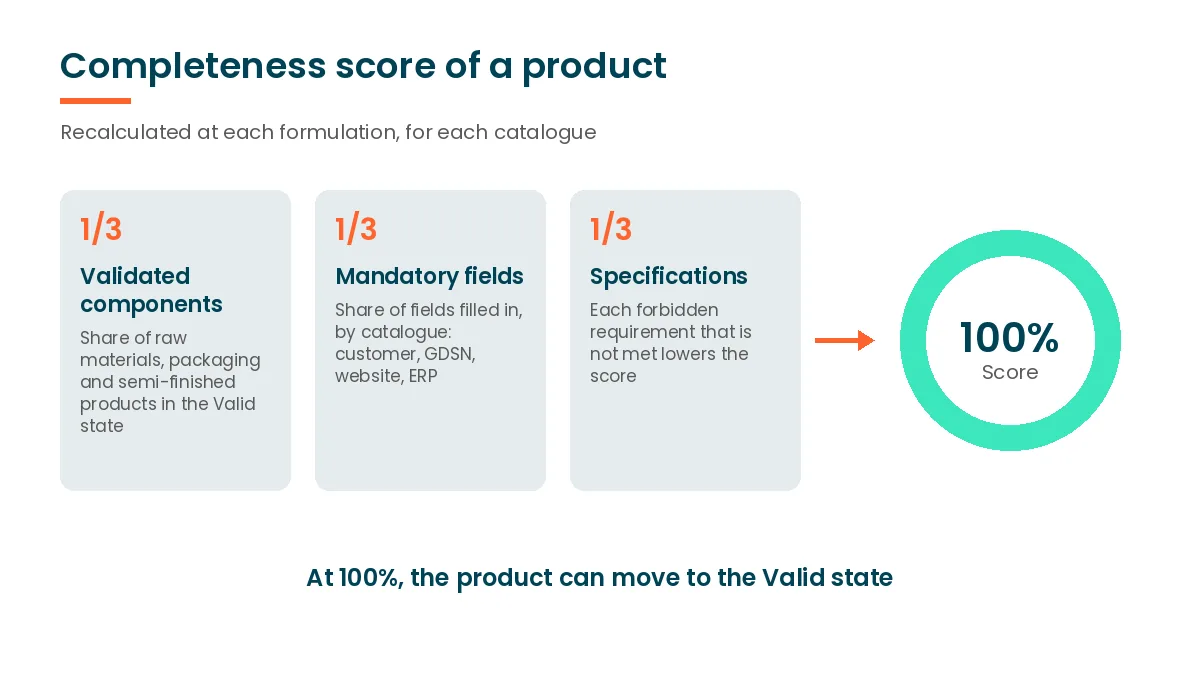
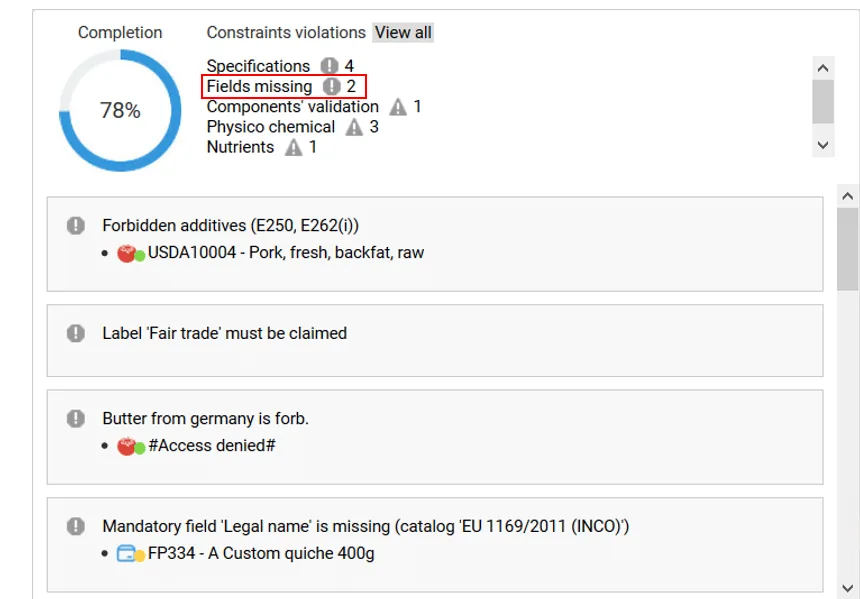
A completeness score tells you, for each product and each catalog, what share of the required fields is filled in, and lists the missing ones. In beCPG the score is recalculated each time the product is formulated and shown on every list of the record. It combines three criteria of equal weight:
- the share of components that are themselves validated;
- the share of mandatory fields filled in, from your catalogs;
- compliance with the specifications: each forbidden requirement that is not met lowers the score.
A multilingual field where only one language is missing is flagged separately, so translations are not forgotten.
3. Fix the data at the source
Most gaps come from raw materials and packaging. Ask suppliers to enter their data themselves in a supplier portal, where AI reads their technical data sheets and proposes the values with a confidence level. Completeness is then measured on the supplier side too, before the data reaches your products.
4. Use bulk tools, then AI, under control
- Bulk editing, saved searches and Excel exports to fill the same field on many products;
- AI suggestions for names, descriptions, families, marketing and organoleptic data, translations and spelling, each one validated before it is saved;
- artwork control: AI compares the artwork proof with the product data before printing.
5. Make completeness a gate, and keep it up
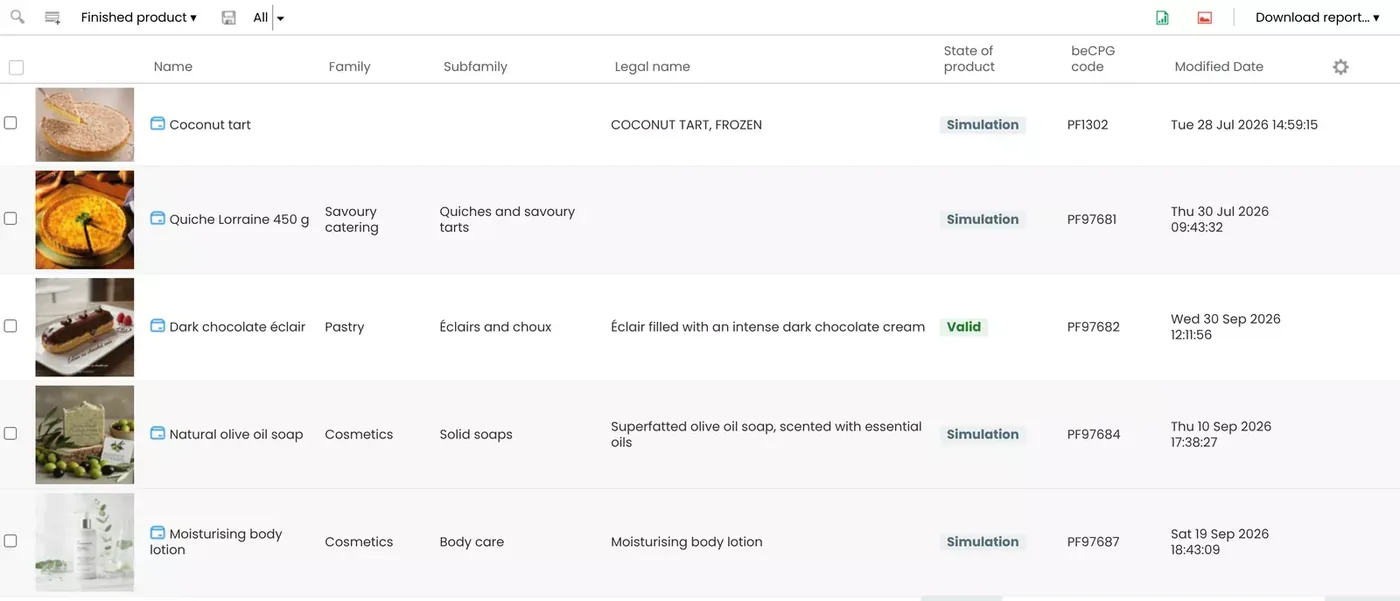
Only publish a product to a customer, a data pool or your website when its catalog is complete: in beCPG, a product can move to the “Valid” state at 100%. Then keep the data alive: notifications on documents not updated for a given time, a daily email of modified products, and a review cycle for supplier data.
| Indicator | What it tells you |
|---|---|
| Completeness by catalog | Which recipient you can serve today |
| Missing fields by product | What to fix, and who should fix it |
| Expired documents | Which data is no longer backed by a valid document |
| Products by state | How much of your range is validated |
Example: what each catalog asks for
| Catalog | Typical mandatory fields |
|---|---|
| Retailer | Legal name, barcodes of the consumer unit, case and pallet, storage conditions, shelf life, ingredients, allergens, nutrition |
| GDSN data pool | GS1 attributes: GTIN, classification, net content, dimensions and weights, packaging levels |
| Website | Marketing name and description, images, claims, ingredient list in each language |
| ERP | Codes, units, logistics data, plant, purchase and sales data |
| Regulatory data (cosmetics) | INCI list, restricted substances, safety and regulatory information of the file |
Frequently asked questions
What is the difference between completeness and data quality?
Completeness says whether the required fields are filled in. Quality also asks whether the values are right and up to date: validated components, specifications met and documents still valid. A good score combines both.
How often should product data be reviewed?
At each change of recipe, supplier or packaging, and on a regular cycle for supplier data, for example every twelve months, so that the review workload is spread over the year.
Who should fill in the missing fields?
The team that owns the information: R&D for the composition, quality for the specifications, marketing for the texts, logistics for the barcodes and dimensions, suppliers for their raw materials. The list of missing fields tells each of them what to do.
Can AI fill in the missing fields?
It can propose values read in a supplier document, texts, translations or classifications. Each proposal is validated before it is saved, and regulated values such as nutrition or allergens stay calculated from the recipe.
Do I need a PIM to manage completeness?
Not necessarily. When the PLM manages catalogs by recipient and publishes the data, one tool is often enough; a PIM remains useful for very large e-commerce catalogs. See our guide PIM or PLM.
See also
- PIM or PLM in food and cosmetics: what is the difference, and do you need both?
- Supplier portal for raw material data: questions and answers
beCPG measures completeness by catalog and publishes product data to GS1 data pools, websites and your ERP. Discover the beCPG product repository.