Cosmetics & HPCProduct portfolio
Product Information File (PIF) for cosmetics: what it contains and how to build it
Updated October 2026.
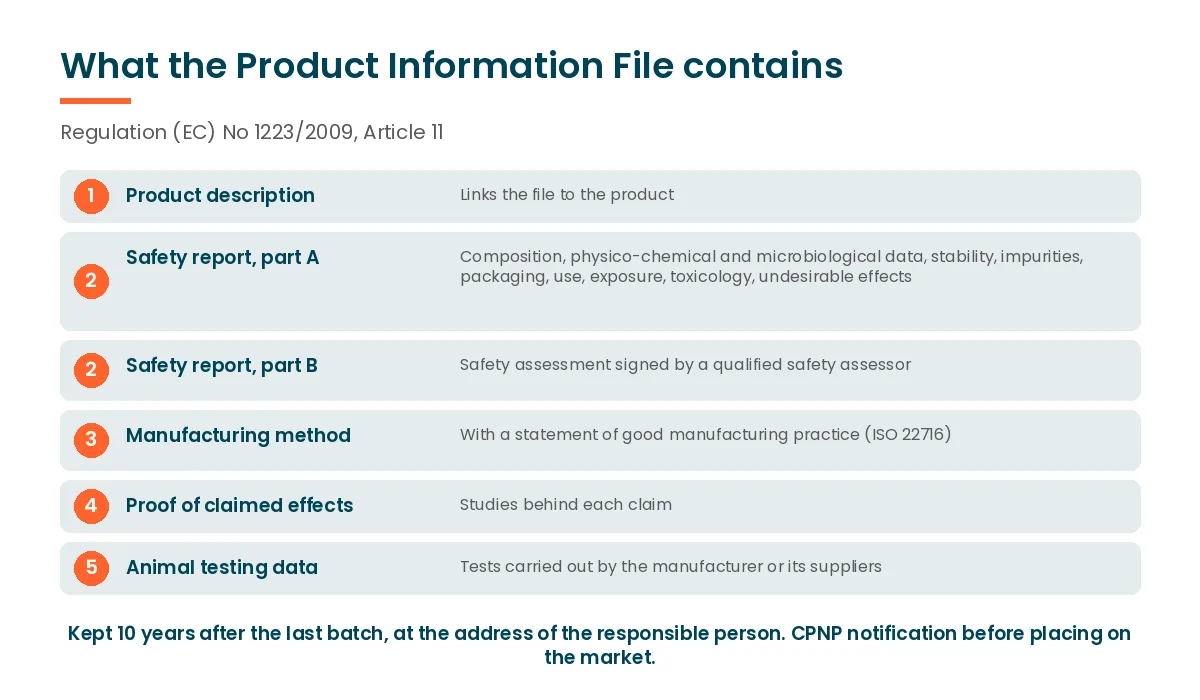
The Product Information File (PIF) is the file the responsible person keeps for every cosmetic product placed on the European Union market. It must be accessible to the authorities for ten years after the last batch is placed on the market. Under Article 11 of Regulation (EC) No 1223/2009, it contains five elements: the product description, the safety report, the manufacturing method with a good manufacturing practice statement, the proof of the claimed effects and the animal testing data.
It is the file the authorities ask for during an inspection. If you sell in the EU from the United States or elsewhere, your responsible person, who must be established in the EU, keeps it. Here is what it contains, who provides each section, and how to build it without starting from scratch for each product.
What the PIF must contain
Article 11 of the regulation lists the content of the file:
- a description of the product, so that the file can be linked to it;
- the cosmetic product safety report (CPSR), in two parts: part A, the safety information (quantitative and qualitative composition, physical, chemical and microbiological characteristics, stability, impurities, packaging, normal use, exposure, toxicological profile of the substances, undesirable effects), and part B, the safety assessment signed by a qualified safety assessor;
- the manufacturing method and a statement of compliance with good manufacturing practice (ISO 22716);
- the proof of the claimed effects;
- the data on animal testing carried out by the manufacturer or its suppliers.
The PIF must be accessible to the authorities at the address of the responsible person shown on the label, for ten years after the last batch is placed on the market. The product is also notified on the CPNP portal before it is placed on the market. For the United Kingdom, a UK responsible person and the SCPN notification apply.
Section by section: who provides what
The safety report follows Annex I of the regulation: Part A gathers the safety information, Part B holds the assessment. The table below lists each section of the PIF, its content, who usually provides it and where the data lives in beCPG:
| PIF section | Content | Who provides it | In beCPG |
|---|---|---|---|
| Art. 11(a) Product description | What links the file to the product without ambiguity | Responsible person | Finished product record |
| Annex I, A.1 Composition | Quantitative and qualitative composition, chemical name, INCI, CAS, function; for a fragrance, name, code and supplier | R&D, suppliers | Formula, calculated INCI list, PIF report |
| A.2 Physical/chemical characteristics and stability | Characteristics of the substances and the product, stability under foreseeable storage conditions | R&D, quality | Control plan and quality inspections (stability tests) |
| A.3 Microbiological quality | Microbiological specifications, preservation challenge test results | Quality, laboratory | Product documents |
| A.4 Impurities, traces, packaging | Purity of the substances, traces of prohibited substances, packaging characteristics | Suppliers, purchasing | Raw material documents, ingredients marked as impurities, packaging bill of materials |
| A.5 to A.7 Use and exposure | Foreseeable use, exposure to the product and to each substance | Marketing, safety assessor | Formula; the assessor establishes the exposure |
| A.8 Toxicological profile | Profile of each substance, margin of safety based on the NOAEL | Suppliers, safety assessor | Toxicological data per ingredient, toxicology calculation with margin of safety |
| A.9 Undesirable effects | Known undesirable and serious undesirable effects | Cosmetovigilance, consumer service | Customer complaint module |
| A.10 Other information | Studies on human volunteers, other risk assessments | R&D, laboratories | Product documents |
| Annex I, Part B Assessment | Conclusion, labeled warnings, reasoning, assessor's credentials and signature | Qualified safety assessor | Written outside the PLM, from the Part A data |
| Art. 11(c) Manufacturing and GMP | Manufacturing method, statement of compliance with good manufacturing practice | Production, quality | Process list: steps, lines, instructions |
| Art. 11(d) Proof of claimed effects | Studies behind each claim, where the nature of the product justifies it | R&D, marketing | Product claims, studies in the documents |
| Art. 11(e) Animal testing | Animal tests by the manufacturer or its suppliers, including for third countries | Manufacturer, suppliers | Raw material documents and certificates |
Why the PIF is hard to keep up to date
Most of the file comes from data spread across teams: the formula in R&D, the raw material documents from suppliers, the stability tests in quality, the packaging in purchasing. When a raw material or a regulation changes, the file must change too, for every product concerned.
A method in five steps
1. Keep the formula as the single source
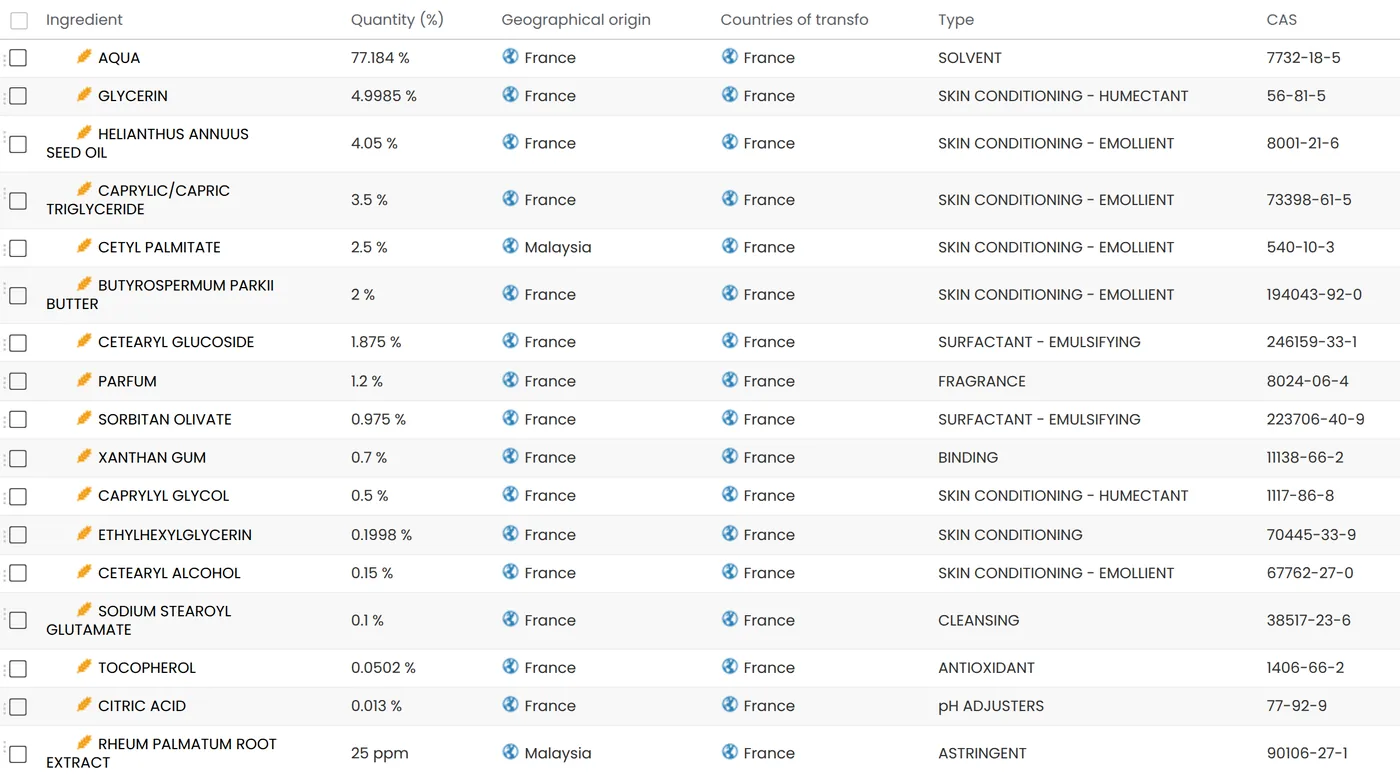
The quantitative and qualitative composition, the INCI list and the substances with their CAS numbers should come from the formula, calculated, not retyped.
2. Collect raw material documents from the suppliers
Technical data sheets, safety data sheets, certificates (COSMOS, Ecocert, no animal testing), allergen and impurity statements, with their validity dates. A supplier portal avoids chasing them by email.
3. Calculate the toxicology and the regulatory checks
Margin of safety for each substance according to the use (leave-on or rinse-off, adult or baby, body or lips), fragrance allergens above the labeling thresholds, IFRA limits, CLP classification, SVHC, and restricted or forbidden ingredients for each target market.
4. Attach stability tests and claims evidence
Stability and compatibility tests with the packaging, challenge tests, and the studies behind each claim, linked to the product and its version.
5. Generate the file, and regenerate it when something changes
When the data is centralized, the PLM can generate a report that gathers the information needed to compile the PIF and make it easier to keep up to date. The safety assessment is still performed by a qualified safety assessor.
The PIF in beCPG
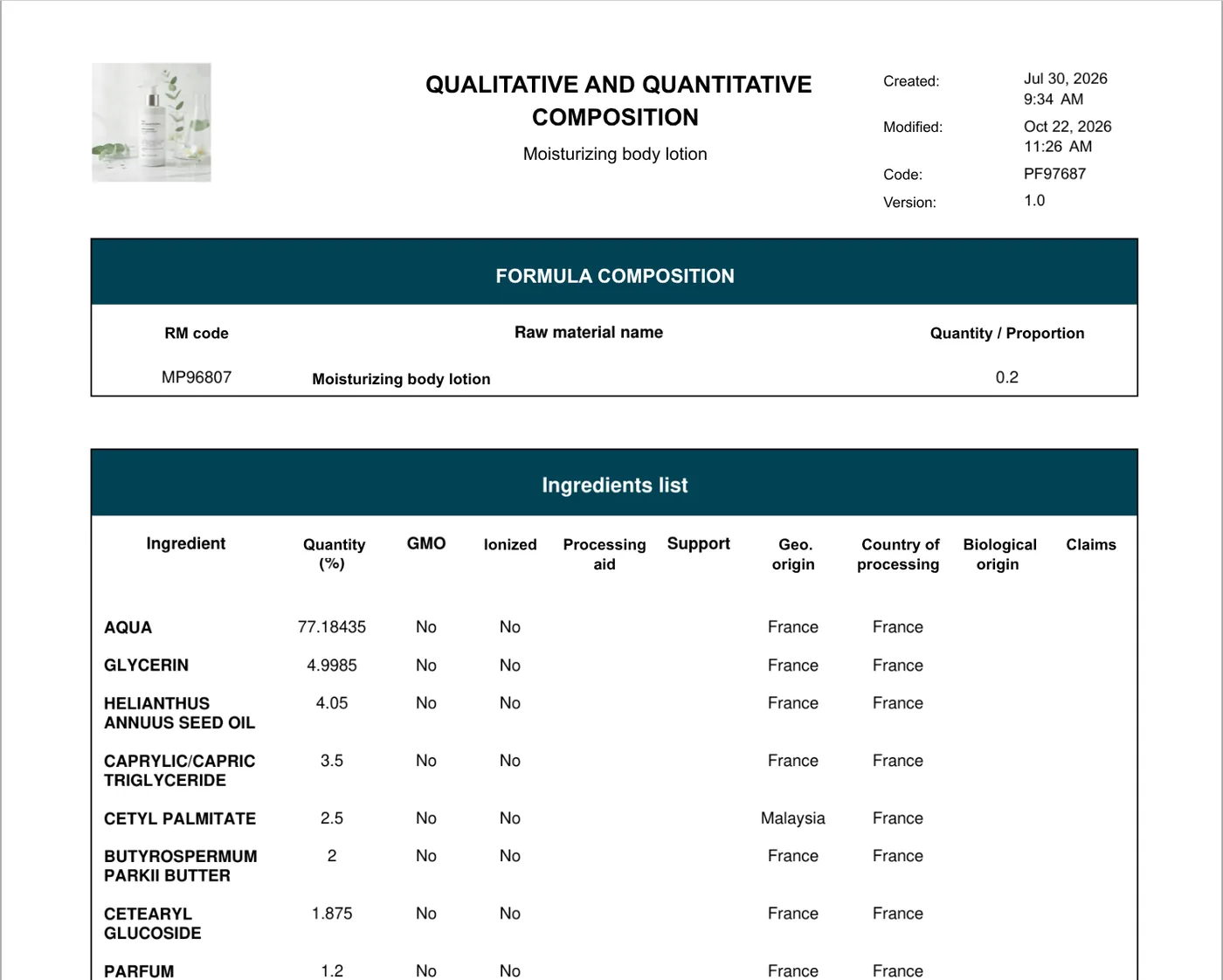
beCPG keeps the formula, the INCI list, the toxicological data of the ingredients, the supplier documents and the stability tests managed in the quality module in one place. It calculates toxicology taking the margin of safety into account, as well as IFRA, CLP and compliance by country. Since version 26.1, a PIF report gathers this data, with the quantitative and qualitative formula. The regulatory calculations are made by the beCPG engines, not by AI, and the safety assessment remains the work of the assessor. Discover beCPG for cosmetics.
Sources
- Regulation (EC) No 1223/2009 on cosmetic products: Article 10 (safety assessment), Article 11 (product information file) and Annex I (cosmetic product safety report)
- Commission Implementing Decision 2013/674/EU: guidelines on Annex I
Frequently asked questions
Who must keep the PIF?
The responsible person: the manufacturer established in the EU, the importer, or a person they designate. The PIF must be accessible to the authorities at the address of the responsible person shown on the label.
In which language must the PIF be written?
In a language that the competent authorities of the Member State where the file is kept can easily understand. English is often accepted, but check with the authority concerned.
How long must the PIF be kept?
Ten years after the last batch of the product has been placed on the market.
What is the difference between the PIF and the CPNP notification?
The CPNP notification informs the authorities and poison centers before the product is placed on the market. The PIF is the complete file, kept available for inspection.
Can the PIF be generated automatically?
The data of the file can be gathered automatically into a report from the formula, the ingredients and the tests. The safety assessment (part B) remains the work of the qualified safety assessor.