Supplier portal for raw material data: questions and answers
Updated October 2026.
A supplier portal promises to stop retyping technical data sheets. Before choosing one, quality and purchasing teams ask very concrete questions. Here are the ones we answered most recently for a food manufacturer, with our answers for the beCPG supplier portal.
AI reading of technical data sheets
What does the AI extract from a technical data sheet?
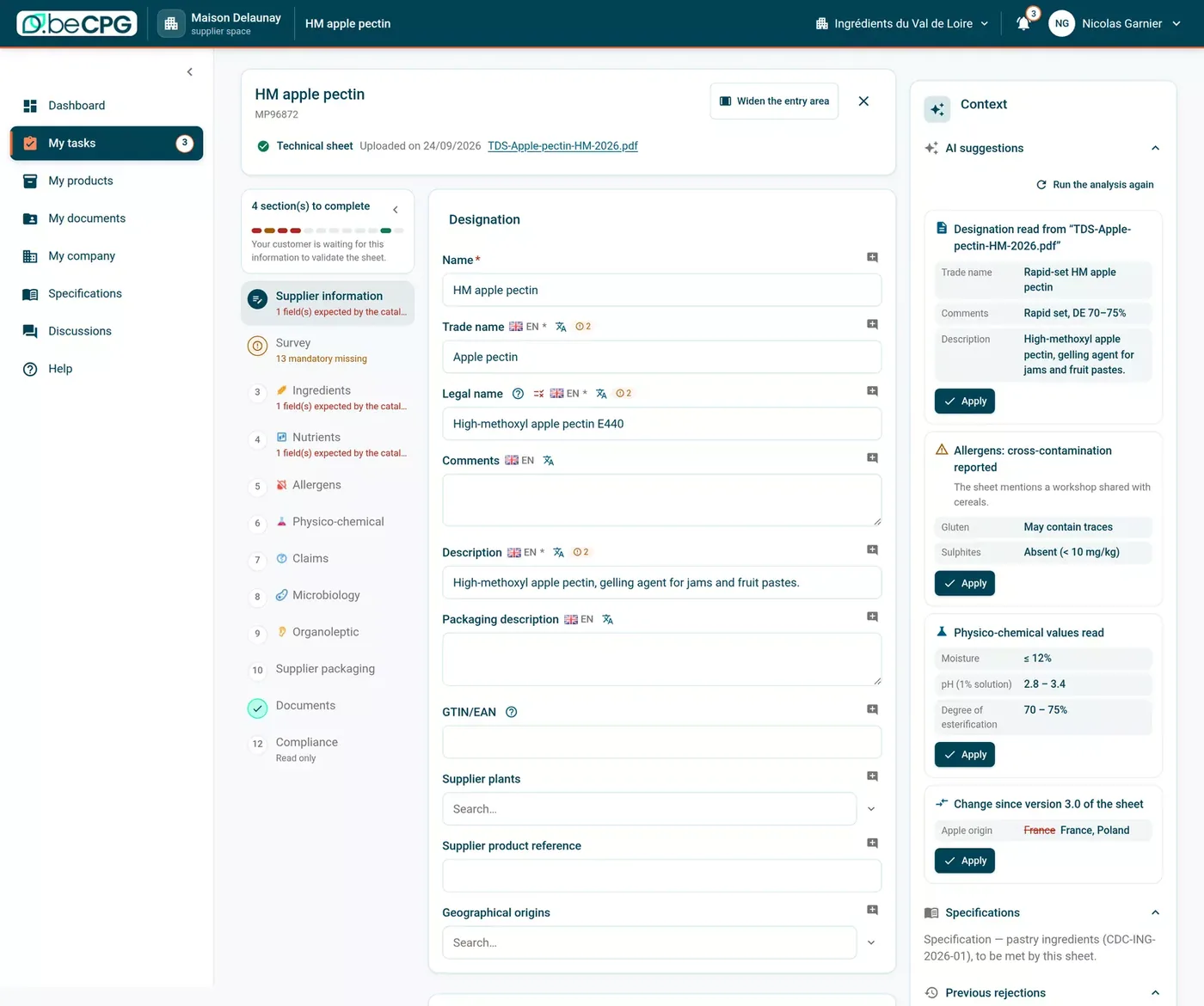
The product names (commercial name, legal name, description), the ingredients, the nutrients per 100 g, the allergens including cross-contact, and the physico-chemical, microbiological and organoleptic data. Each value is a proposal with a confidence level: the supplier applies it, then your quality team validates. Nothing is saved without a human action.
What is the extraction rate?
It depends on the documents: native or scanned PDF, nutrient tables, multilingual layouts, number of pages. Rather than an average figure, measure it on three to five of your own data sheets during the demonstration: fields proposed, fields right, corrections needed.
Which fields remain to be entered by hand?
Those that are not on a data sheet: answers to your questionnaire, the origin of each ingredient when the sheet does not give it, the GTIN, the supplier reference, the plant and the supplier packaging. The AI proposes nothing that a document does not support, and the compliance step lists what is missing before the supplier can finish.
Can several documents be read at once?
Yes. The data sheet fills in the form, and the other documents are read too. For each document type you decide what the AI checks: that an item of information is present, or that it matches the product record. On an IFS certificate, for example, it reads the standard, the expiry date and the certified site.
When a document is replaced, how do we see what changed?
Field by field: the old value struck through, the new value and an Apply button. Your quality team can also compare a product with its previous version, compare two versions of a document, and see in the activity history who changed which field and when.
The supplier’s side
Does each supplier need an account?
Yes, one named account per contact, created in one click from the supplier record or in bulk by import. Named accounts keep a trace of who declared what, allow electronic signature and protect your specifications. The supplier resets their password alone.
Can a supplier only send documents?
Yes. The “My documents” page lists the documents expected, mandatory or not, expired or to renew. The supplier uploads or renews a document without opening a form.
Can you send back only the fields you refuse?
Yes. Your quality team validates the correct sections, which become read-only for the supplier, and comments each refused field. The supplier answers in the same place. For a finer split, the project template can be cut into separate tasks (nutrition, allergens, documents) validated independently.
Does the supplier validate line by line?
No. Data is saved as it is typed, several lines can be edited at once and AI proposals are applied block by block. One final step, “Finish”, stays blocked while mandatory information is missing, and can be followed by the electronic signature of the supplier report.
A supplier has several plants: can each product have its own contact?
Yes. Each contact is linked to a plant, and the task goes to the contact of the product’s plant. You can also choose the contact when sending.
One product, several suppliers
How do you manage several suppliers for the same raw material?
One record per supplier (the croissant of supplier A, the croissant of supplier B), linked to a generic product, your commercial reference. Each supplier fills in their own record. beCPG calculates allergens, nutrients and ingredients of the generic product from the worst case.
Can two suppliers be compared?
Yes. A product can be compared with up to four others in a report, list by list: ingredients and origins, allergens, nutrients, physico-chemical data, claims and certifications.
When one supplier replaces another, what happens to the history?
The former supplier’s record is archived, not deleted, with its versions, documents and signatures. The replacement goes through a change order: a simulation first shows, product by product, the new or resolved alerts, then the change is applied in bulk. Customer specifications are checked again.
Setting up and keeping data up to date
How do you migrate from another tool?
Export to Excel or CSV, mapping to the beCPG model validated with you, import templates (raw materials, suppliers, compositions, nutrients, allergens, documents), test import and acceptance, then production import. Data sheets and certificates are imported in bulk and attached to the products; the AI can then complete the records from these PDFs, as proposals to validate.
How do you review thousands of references every year?
A recurring rule starts each month the update projects of the references concerned, for example those validated more than twelve months ago, so the workload is spread over the year. Each supplier only sees their own products, the AI pre-fills from the new data sheet, and the monitoring space shows progress, delays and reminders.
What happens when a certificate expires?
Each document type has its validity rule: a duration from upload, or a date read on the certificate. Expiries are flagged in the supplier portal, in your monitoring space and by email, with a renewal button for the supplier.
Which indicators are available as standard?
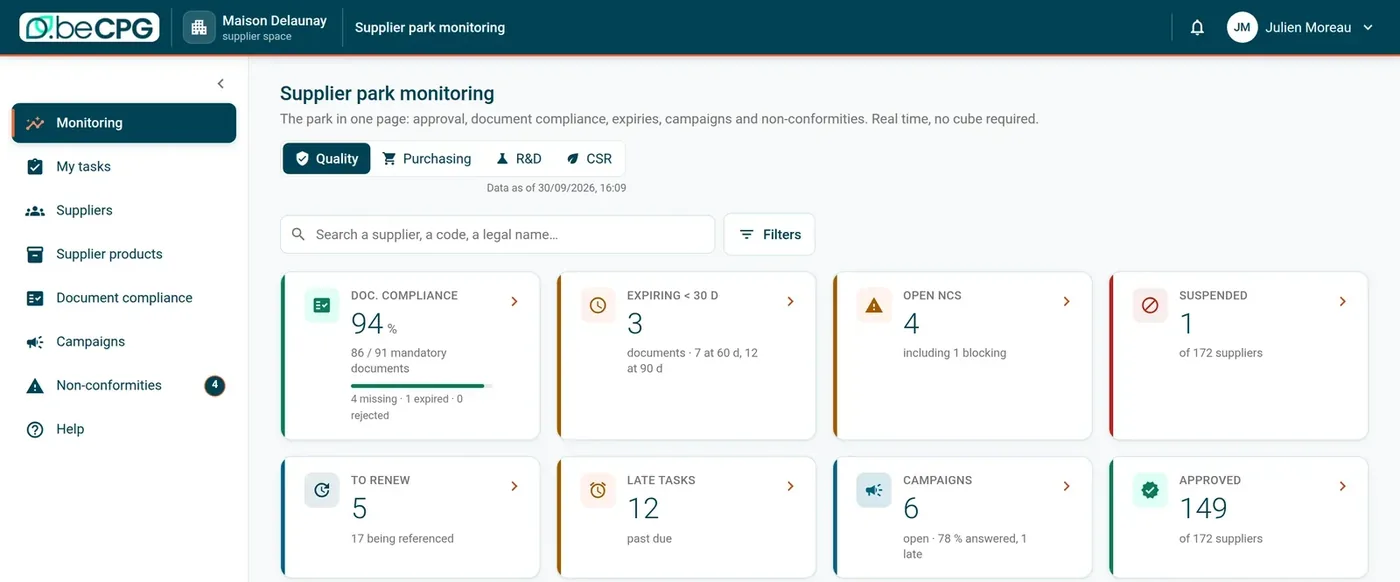
Completeness by product and by catalog of mandatory fields, documents provided, missing, expired or refused, documents expiring within 30, 60 and 90 days, open non-conformities, approval status calculated in real time, late tasks and response rates of campaigns, and a supplier risk score with your own weightings.
Why a portal integrated with the PLM?
Because what the supplier enters is the PLM record itself: it feeds formulation, labeling, specifications and technical data sheets directly, with the same permissions and audit trail, without a second tool or an interface to maintain.
See also
- How to run a sourcing project for raw materials and packaging
- The beCPG supplier portal
- Supplier technical sheets received as PDFs: using their content with AI
Bring three of your supplier data sheets to a demo: we will show you what the AI proposes on them. Discover the beCPG supplier portal.