Cosmetics & HPCFood & Agro-industriesProduct portfolio
PIM or PLM in food and cosmetics: what is the difference, and do you need both?
Updated October 2026.
Food and cosmetics manufacturers often hear the same advice: “you need a PIM”, then “and a master data tool”. Yet most of the product information they publish (ingredient list, allergens, nutrition facts, INCI list, claims) is created long before, during product development, in the PLM. This guide explains what each tool does, and why one tool is often enough.
PLM, PIM and master data in one sentence each
- PLM (Product Lifecycle Management) manages the definition of the product and its development: formula, raw materials, packaging, specifications, regulatory data, projects and approvals.
- PIM (Product Information Management) manages the publication of product information to sales channels: retailers, e-commerce websites, catalogues, GS1 data pools. A DAM (Digital Asset Management) often comes with it for photos and media.
- Master data (MDM) tools consolidate reference data (items, codes, units) shared by the ERP and the other systems.
The differences at a glance
| PLM | PIM | |
|---|---|---|
| Main question | What is the product, and is it compliant? | How is the product presented, channel by channel? |
| Main users | R&D, Quality, Regulatory, Purchasing, Packaging | Marketing, e-commerce, Sales |
| Data | Formula, specifications, nutrition, allergens, costs, packaging, documents | Marketing texts, images, channel attributes, translations |
| Output | Labels, technical data sheets, specifications, regulatory data | Product pages, catalogues, retailer and data pool feeds |
In practice, the two lists overlap a lot: the product data a PIM publishes is, for its most important part, the data the PLM already holds.
In food and cosmetics, the published data is calculated
In most industries, the PIM is the master of the product information. In food and cosmetics, the most sensitive part of that information is regulated and calculated: the ingredient list and the allergens come from the recipe, the nutrition facts from the formula and the yields, the INCI list from the cosmetic formula. It must be identical on the pack, on the website and in the data pools.
Typed a second time in another tool, every change of recipe creates a risk of difference between the label and the website. Regulated data should be calculated once and published, never retyped.
Two tools: what it really costs
- two licences, two implementation projects and two teams to train;
- an interface to build, monitor and update at every change of either tool;
- two data models to keep aligned, and a rule for each field: which tool is the master?
- synchronisation rules to define and monitor, so that both tools show the same data.
For a large group with many brands, channels and a direct-to-consumer business, this cost can be justified. For a small or mid-sized manufacturer, the benefit rarely covers it. The same reasoning applies to a separate master data tool on top of the PLM and the ERP.
The CIO of the ALPM group (Lœul et Piriot) summed it up when choosing beCPG: “Until now, software handled one single problem (formulation, workflow, master data or project management). The best-of-breed approach, one tool for one problem, is long to implement and complex for users. It rarely provides a rapid return on investment.”
Three possible set-ups
1. One tool: a PLM used as a PIM
The PLM holds all the product data, technical and commercial, checks its completeness for each channel and publishes it to the website, retailers and GS1 data pools. This is the simplest set-up for most small and mid-sized manufacturers, and some of them simply call their PLM “the PIM”.
2. A PLM connected to an existing PIM
If you already have a PIM, or run many channels with rich marketing content, keep it: the PLM becomes the source of technical and regulated data and feeds the PIM, which adds the marketing content. PIM and PLM complement each other well when the channels and the marketing content justify it; beCPG is then integrated with the PIM in place.
3. A PIM alone
It suits distributors, who receive finished product data from their suppliers: a PIM is very good at distributing that information. A manufacturer who formulates also needs to calculate the label upstream, in a PLM rather than in spreadsheets.
Five questions to decide
- Do you formulate your products, or do you buy them finished?
- Do you already have a PIM, and does it work?
- How many sales channels do you publish to, and do they need rich marketing content?
- How often do your recipes change, and how many products does a change affect?
- Who is responsible for the accuracy of the label: R&D and Quality, or Marketing?
In beCPG
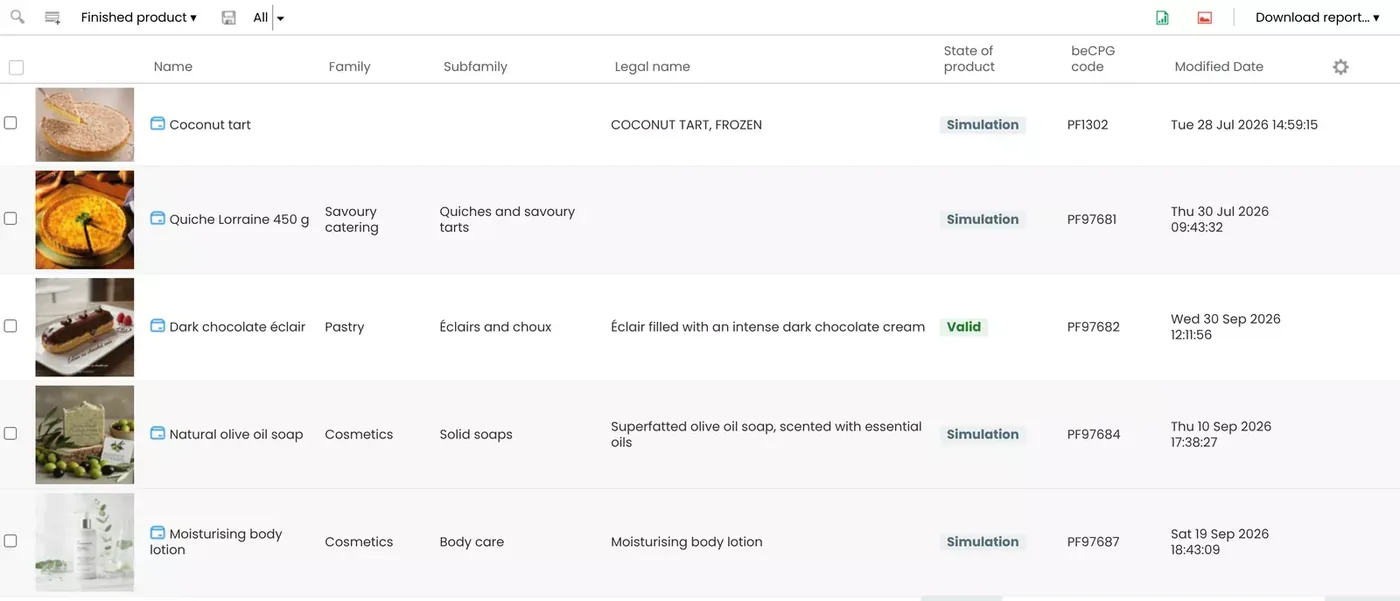
beCPG is a PLM that can be used as a PIM, on the same data:
- product, marketing, packaging and commercial information next to the formula, the nutrition and the allergens;
- media management (DAM): photos, images and videos with the product, automatic resizing, sharing and annotation;
- product collections and ranges, a completeness score for each use (customer, GDSN, website, ERP), exports for printed catalogues;
- GS1 GDSN data sent to data pools such as Equadis, @GP, Agena A3PIM, Synkka, Validoo or Atrify, a Salsify connector, the REST API and CSV exports to feed your website and your ERP.
If you already have a PIM, beCPG is integrated with it through publication channels and the REST API. Discover the product repository of beCPG PLM.
Frequently asked questions
What is the difference between PDM, PIM and PLM?
PDM (Product Data Management) manages the technical data of a product: composition, specifications, documents. PLM includes the PDM and adds the development of the product: projects, formulation, regulatory checks and approvals. PIM prepares the product information for the sales channels. In beCPG, the three work on the same data.
Do I need a PIM to publish to GS1 data pools?
No. A PLM with a GS1 GDSN connector can send product data directly to the data pools your retailers use. See our guide to GS1 product data.
Can a PLM replace a PIM?
For most small and mid-sized food and cosmetics manufacturers, yes: the PLM holds the data, checks its completeness per channel and publishes it. A dedicated PIM is mainly justified for large groups with many channels and very rich marketing content.
Which tool should hold the ingredient list and the allergens?
The PLM, because they are calculated from the recipe. Any other tool receives them and publishes them as they are.