Food & Agro-industriesFormulationQuality
EU food labeling under Regulation (EU) No 1169/2011: a practical guide
Updated October 2026.
Regulation (EU) No 1169/2011 on the provision of food information to consumers, often called “FIC” or “INCO”, sets what a prepacked food label must say in the European Union. It has applied since 13 December 2014, and the nutrition declaration since 13 December 2016. This guide goes through the mandatory particulars, the rules that cause most label errors, and what can be calculated from the recipe.
The 12 mandatory particulars (Article 9)
- the name of the food;
- the list of ingredients;
- allergens, emphasized in the list of ingredients;
- the quantity of certain ingredients (QUID);
- the net quantity;
- the date of minimum durability or the “use by” date;
- special storage conditions or conditions of use;
- the name and address of the food business operator;
- the country of origin or place of provenance, where required;
- instructions for use, where needed;
- the alcoholic strength, above 1.2 % by volume;
- the nutrition declaration.
Presentation counts too: the mandatory particulars must be printed with an x-height of at least 1.2 mm (0.9 mm when the largest surface is under 80 cm²), in a language easily understood where the food is sold. The name, the net quantity and, where applicable, the alcoholic strength must appear in the same field of vision.
The list of ingredients
- ingredients in descending order of weight at the time of use, with compound ingredients detailed;
- additives designated by their category name followed by their name or E number;
- the 14 allergens of Annex II emphasized in the list, for example in bold;
- the QUID: the percentage of an ingredient named in the name of the food, emphasized on the label or essential to characterize it (Article 22).
These rules depend on the whole recipe, down to the sub-ingredients of each raw material. That is where manual labels go wrong: a supplier changes a compound ingredient, and the list, the allergens and the QUID are no longer right.
The nutrition declaration
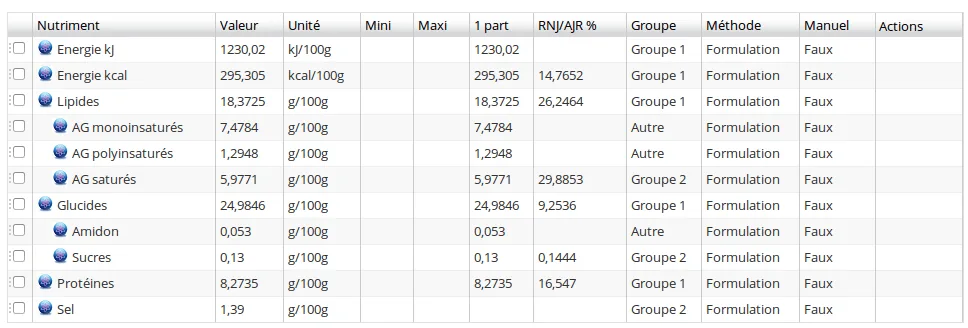
The mandatory declaration gives the energy (kJ and kcal), fat, saturates, carbohydrate, sugars, protein and salt, per 100 g or 100 ml; values per portion can be added. Values may come from analysis or from calculation on the recipe, and must stay within the tolerances set by the European Commission guidance.
Origin, distance selling and recent rules
- Origin of the primary ingredient: since 1 April 2020 (Implementing Regulation (EU) 2018/775), when the origin of a food is given and differs from that of its primary ingredient, the origin of that ingredient must be stated.
- Distance selling: all mandatory particulars except the date must be available before the purchase is concluded (Article 14).
- Wines: since 8 December 2023, the ingredient list and nutrition declaration are required; they may be given electronically, except energy and allergens.
- Revision: front-of-pack labeling, origin and date marking are under study by the Commission; no proposal has been adopted.
What a PLM calculates, and what it does not
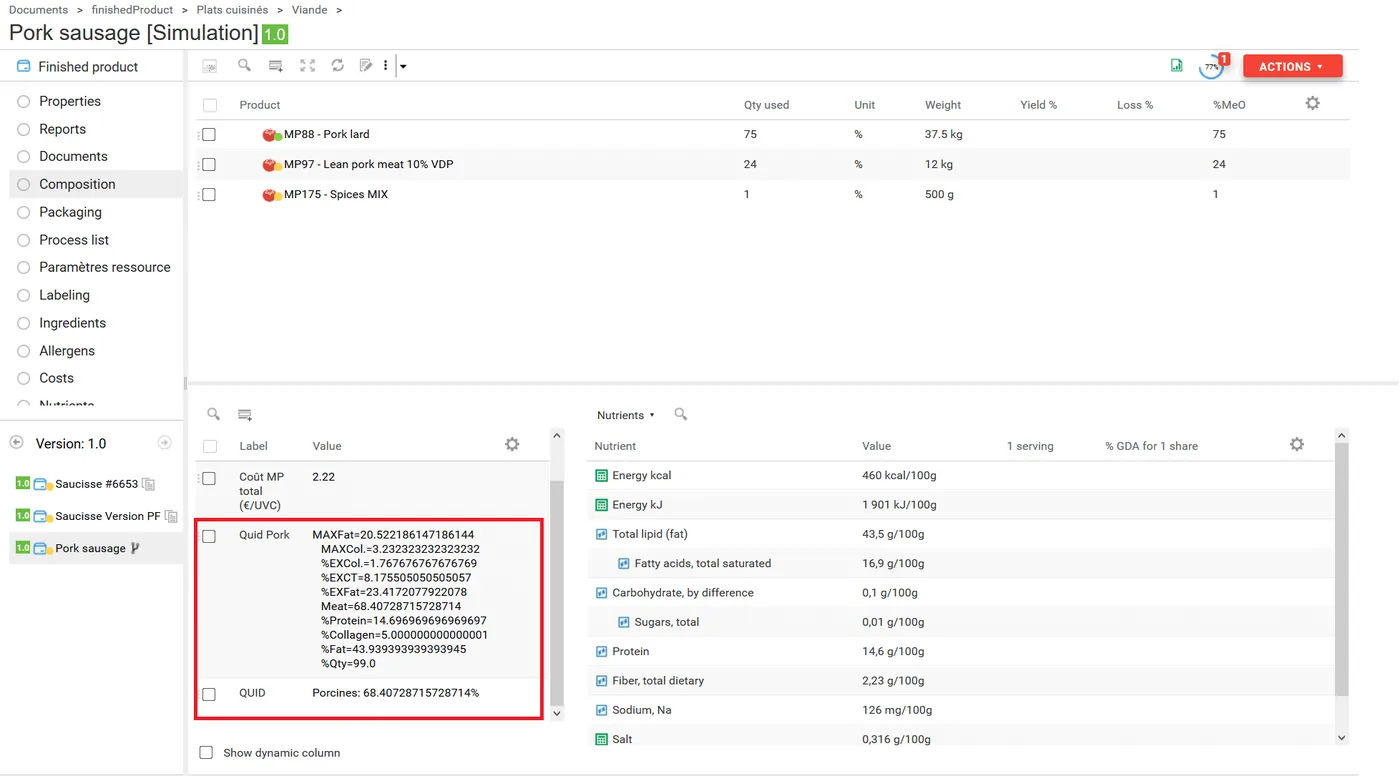
In beCPG, the list of ingredients is generated from the recipe, level by level, with labeling rules per product range and language: rename, group, declare a compound ingredient or not, omit processing aids, show percentages. Allergens are emphasized, the QUID is calculated, including meat with fat and connective tissue excess, and the nutrition declaration is calculated with the EU rounding and tolerances. When a raw material changes, the labels of every product that uses it are recalculated.
The other particulars (name, date, storage, operator, net quantity) are product data that you enter or that the AI suggests for you to validate; beCPG keeps them with the product and puts them in the technical sheets, but does not calculate them. Final label proofs are still checked by a person.
Frequently asked questions
Is “may contain” mandatory?
No. Precautionary allergen labeling is voluntary information: it must not mislead and must be based on a real risk of cross-contact. Several reference frameworks propose action levels.
When is a QUID required?
When the ingredient appears in the name of the food, is emphasized by words or pictures, or is essential to characterize the food, with some exceptions listed in Annex VIII.
Can the nutrition declaration be calculated rather than analyzed?
Yes. It can be calculated from the known values of the ingredients, as long as the declared values respect the tolerances when the product is analyzed.
Official texts: Regulation (EU) No 1169/2011 and the European Commission page.
Go further: discover regulatory compliance and formulation in beCPG, and our guides to the Nutri-Score, US Nutrition Facts and regulatory compliance of a formula. Download the beCPG brochure.