
Food & Agro-industriesFormulationQualityTechnical data sheets
Canadian Nutrition Facts table and front-of-package symbol: a guide

Updated October 2026.
In Canada, nutrition labeling is set by the Food and Drug Regulations and checked by the Canadian Food Inspection Agency (CFIA). A prepackaged food carries a Nutrition Facts table, in English and French, and since 1 January 2026, when it is high in saturated fat, sugars or sodium, a front-of-package nutrition symbol. This guide explains both, and how to calculate them.
The Nutrition Facts table since the 2016 reform
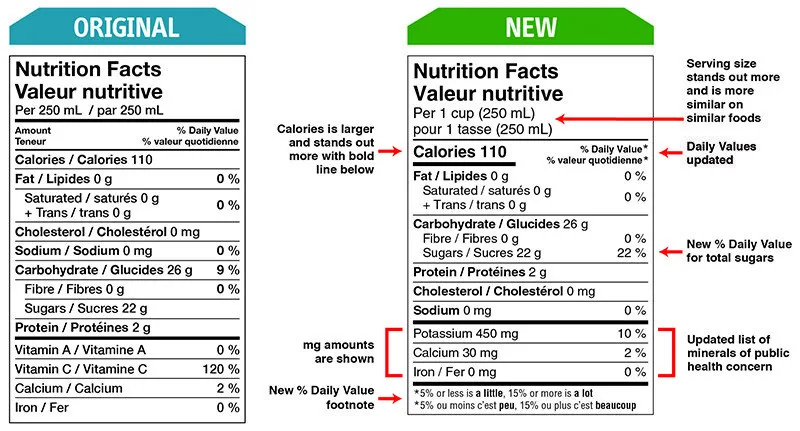
The amendments published on 14 December 2016 changed the table. Their transition period ended on 14 December 2021; the CFIA then gave priority to education until 14 December 2022. The main changes:
- serving sizes based on reference amounts, more consistent between similar foods, in a household measure and in metric units (table of reference amounts);
- calories in larger type, with a bold line below;
- a % daily value for total sugars, based on 100 g;
- potassium mandatory; vitamins A and C optional; calcium, iron and potassium shown in mg and in % DV (table of daily values);
- saturated and trans fat share one % daily value;
- a footnote: “5% or less is a little, 15% or more is a lot”.
The front-of-package nutrition symbol
Published on 20 July 2022, the rules on the front-of-package symbol apply since 1 January 2026. A black-and-white magnifying glass with “High in / Élevé en” must appear on prepackaged foods that meet or exceed a threshold for saturated fat, sugars or sodium:
- 15% of the daily value per reference amount or serving, for most foods;
- 10% when the reference amount is 30 g or 30 mL or less;
- 30% for main dishes with a reference amount of 200 g or more (170 g for foods intended only for children aged 1 to 4).
Some foods are exempt, for example raw single-ingredient meat, poultry and fish, fresh or frozen fruit and vegetables, 2% and whole milk, eggs, most cheeses and yogurts, vegetable oils and nuts, butter, sugar, salt, honey and maple syrup, or very small packages. Foods for infants under one year must not carry the symbol. Health Canada page.
Supplemented foods (drinks or bars with added vitamins, minerals or caffeine, for example) follow their own rules from the same date: a “Supplemented Food Facts” table and a caution identifier.
What data you need
The Canadian table is close to the US label, but not identical: no added sugars, a % DV for total sugars, one % DV for saturated and trans fat, no mandatory vitamin D. Compared with the European declaration, trans fat, cholesterol, fiber, potassium, calcium and iron must be added, and energy is in calories.
| Nutrient | Canada | United States (FDA) | European Union (1169/2011) |
|---|---|---|---|
| Energy | M (calories) | M (calories) | M (kJ and kcal) |
| Fat | M | M | M |
| Saturated fat | M (with trans) | M | M |
| Trans fat | M (with saturated) | M | |
| Cholesterol | M | M | |
| Sodium | M | M | salt |
| Carbohydrate | M | M | M |
| Dietary fiber | M | M | o |
| Total sugars | M (with % DV) | M | M |
| Added sugars | M | ||
| Protein | M | M | M |
| Vitamin D | o | M | o |
| Calcium | M | M | o |
| Iron | M | M | o |
| Potassium | M | M | o |
| Vitamins A and C | o | o | o |
M: mandatory; o: optional (mandatory when added or when a claim is made); empty: not declared.
Values are given per serving, then rounded with the Canadian rules, which are close to the US ones. The CFIA checks them against analysis with a nutrient-by-nutrient compliance test: for example, naturally occurring nutrients must not be more than 20% below the declared value, and calories, fat, sugars or sodium not more than 20% above. CFIA: Nutrition Facts table.
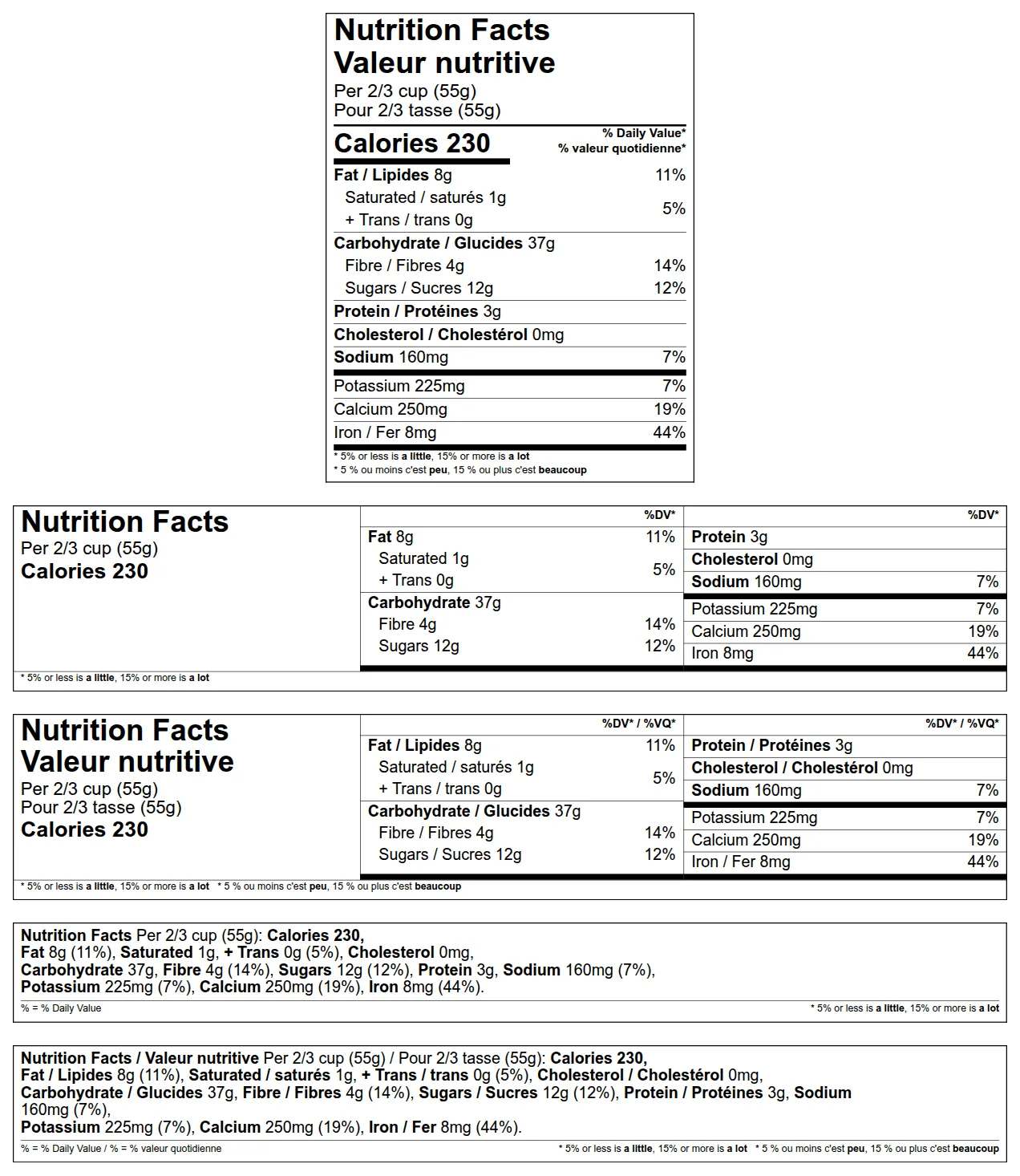
As in the United States, several layouts coexist (standard, tabular, linear, dual column, bilingual or not), and the packaging decides: the panel follows from the product, not from the artwork proof.
How beCPG produces the table and checks the symbol
- Calculation: formulation calculates the values per 100 g and per serving from the recipe, applies the Canadian rounding rules and daily values, and shows the CFIA tolerances next to each labeled value.
- Table: since version 26.1, the table is generated in the technical sheet as a vector image, in the standard, tabular, linear and dual-column formats, in English, in French or bilingual, and as a “Supplemented Food Facts” table with the added ingredients flagged.
- Symbol: beCPG indicates whether the “High in” symbol is required, from the saturated fat, sugars and sodium of the product and the threshold that applies. Exemptions remain a decision of your regulatory team.
To sell in the United States as well, see our guide to the US Nutrition Facts label.
Frequently asked questions
Can I use the US Nutrition Facts label in Canada?
No. The Canadian table is bilingual, has its own daily values and rounding, a % DV for sugars and one % DV for saturated and trans fat. The two labels must be generated separately from the same recipe.
Does my product need the “High in” symbol?
Compare its saturated fat, sugars and sodium per reference amount with the threshold of its category (15%, 10% or 30% of the daily value), then check the exemptions. One nutrient over the threshold is enough.
Is the old table format still accepted?
No. The transition to the table of the 2016 reform ended on 14 December 2021.
Going further
See our guide how to check the regulatory compliance of a formula, and how beCPG handles regulatory compliance and formulation. Download the beCPG brochure.