PLM implementation

A PLM project you can plan

Implementing a PLM is first a business project: your teams must find their products, recipes, specifications and documents in the software, with their own rules, before they rely on it every day.

beCPG is both the publisher and the implementer of its PLM. The consultants who run your workshops know the food and cosmetics industries, and the same team supports you after go-live.

Our method is designed to deliver value early, keep the scope under control and make your teams autonomous.

3 to 12

months to go-live in most projects

12

new projects started every year

100+

food and cosmetics customers

15+

years of PLM projects in food and cosmetics

Agile, by batch

The project is split into batches. Each batch goes through the definition of its content, functional workshops, configuration, delivery on your test environment and your approval: the equivalent of an agile sprint, anchored on a business scope.

We can also follow your own project methodology.

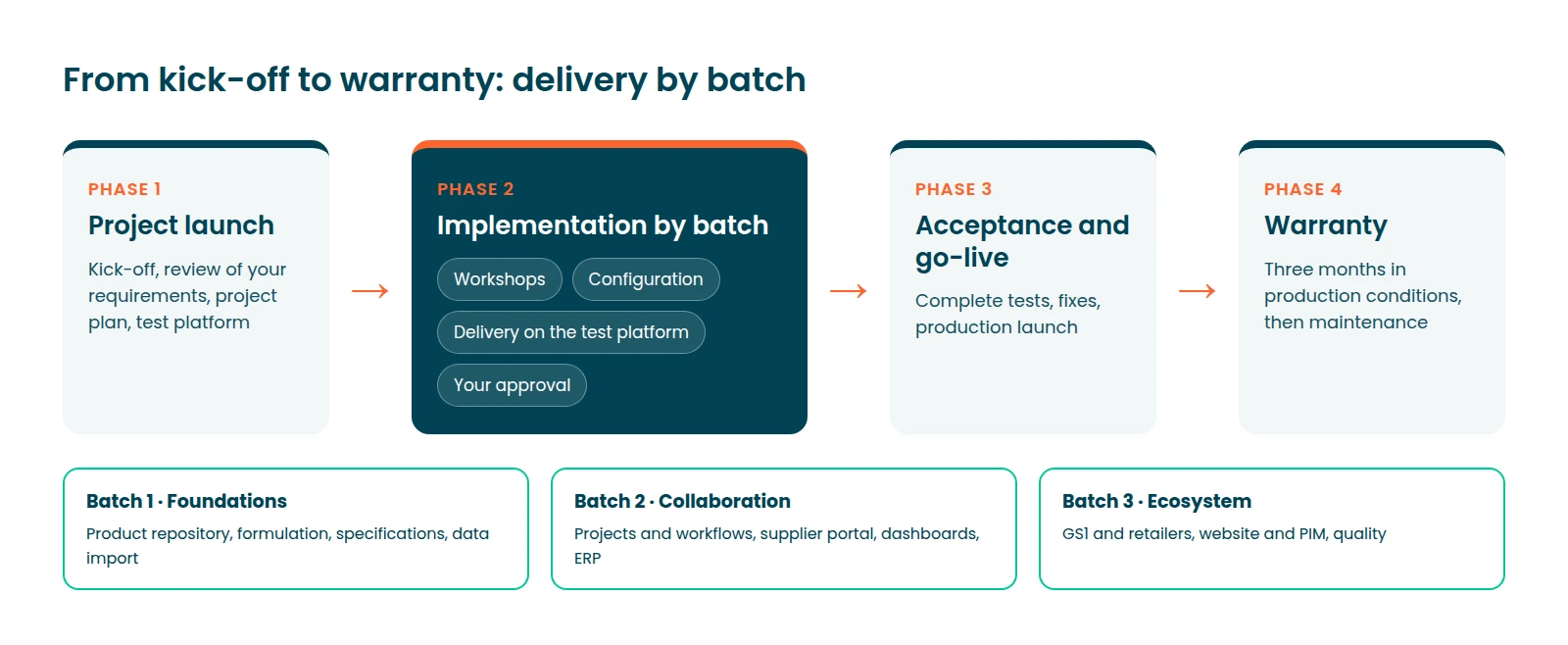
1. Project launch

Kick-off meeting, review of your requirements and of our proposal, discovery of your current tools and of the systems involved. Deliverables: a detailed project plan and a test platform ready to use.

2. Implementation by batch

Workshops, written specifications when the batch requires it, configuration and developments with unit tests, delivery on the test platform. You approve each batch before the next one relies on it.

3. Acceptance testing and go-live

Complete functional tests on the test platform, fixes delivered and tested again until acceptance, then production launch.

4. Warranty

Three months in production conditions after acceptance, with updated project documentation. Maintenance then takes over.

beCPG PLM implementation method: project launch, implementation by batch, acceptance and go-live, warranty

Workshops on your own products

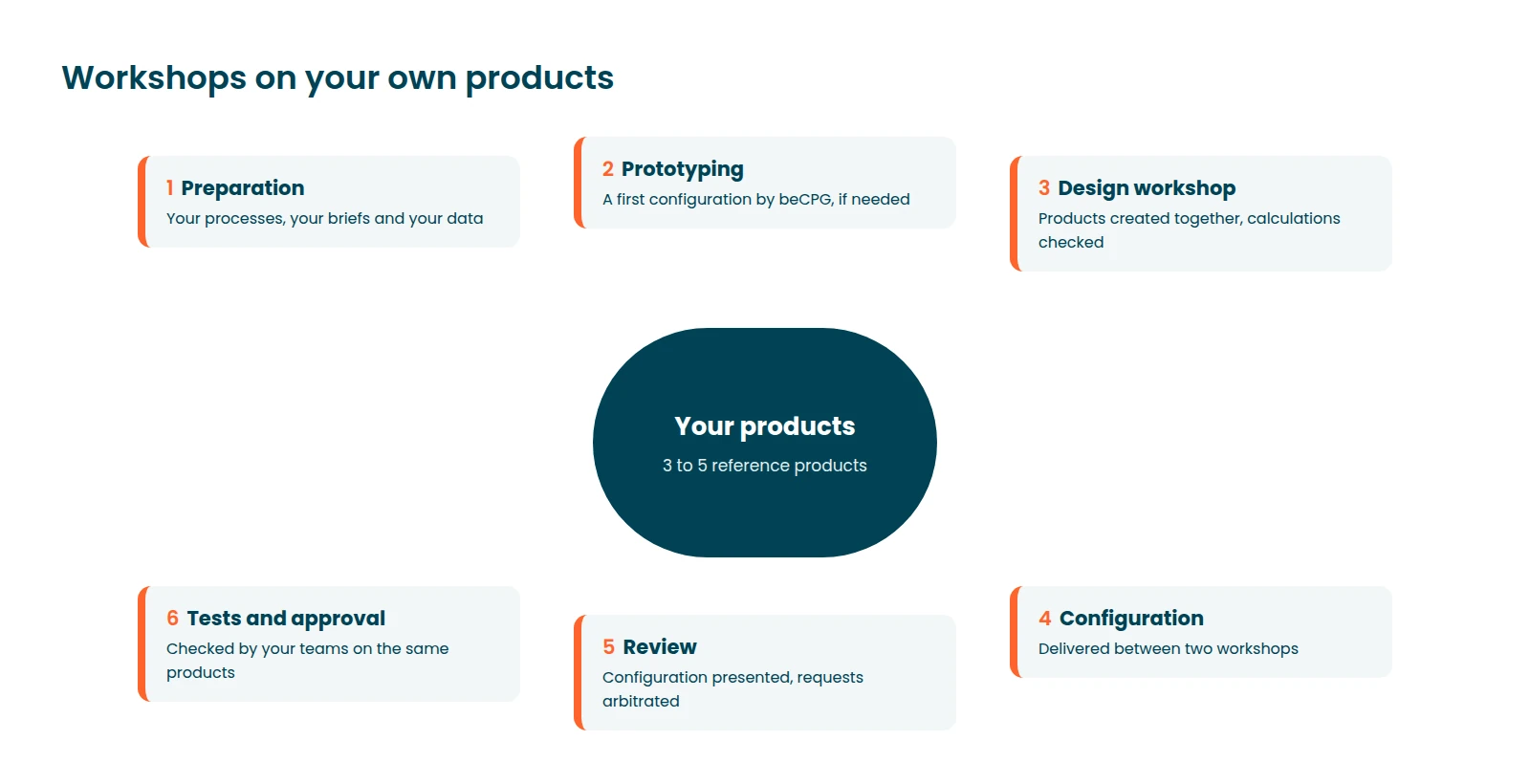
From the first workshop, we work on 3 to 5 of your reference products, with their raw materials, packaging and documents:

  • Your key users create the products in beCPG with our consultants.
  • Together, we check the calculations: nutrition, ingredient list, allergens, origins, costs.
  • We identify the configuration to do and write a workshop report.
  • The configuration is delivered between two workshops and presented at the start of the next one.
  • Your teams check the result on the same products.

Workshops are held in your offices, usually two to three days a month, with remote sessions in between, in English or in French.

A typical scope

Adapted to your priorities, a project usually follows this order:

Batch 1: the foundations

Product repository, document management, formulation (nutrition, allergens, ingredients, costs, claims, scores), product specifications and data import.

Batch 2: collaboration

Project management and workflows, supplier portal, dashboards and ERP interface.

Batch 3: the ecosystem

GS1 and retailer catalogs, website and PIM, quality management.

beCPG implementation workshops on 3 to 5 of your reference products, from preparation to approval

Built for multi-site groups

For a group, the effort depends on the number of processes and specifications to harmonize, not on the number of sites or products.

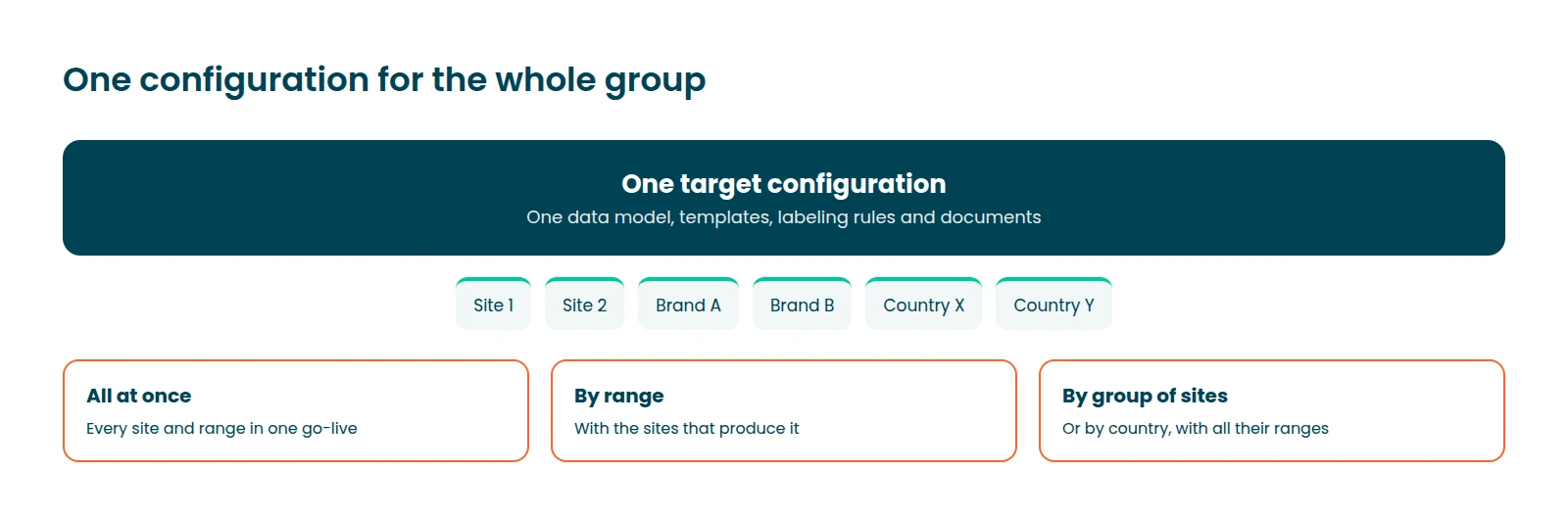
The target configuration is agreed once and applies everywhere: one data model, one set of product templates, labeling rules and specification documents. Each site, brand or country sees its own products, suppliers and documents through permissions, not through a configuration of its own.

Adding a site is an onboarding exercise (users, permissions, data), not a new project. The roll-out can follow the pattern that suits you:

  • All sites and ranges at once: the shortest route to one version of the truth.
  • By range, with the sites that produce it.
  • By group of sites or by country, with all their ranges.

Data can be loaded in one migration or site by site, independently of the functional go-live. Mass operations are designed for large portfolios: one of our customers manages 60,000 formulas and 30,000 raw materials in beCPG.

One beCPG configuration for the whole group, rolled out all at once, by range or by group of sites

Governance and transparency

  • Weekly project committee (30 minutes) to follow ongoing actions.
  • Steering committee every 4 to 6 weeks: progress by functionality, risks, next actions, change requests and decisions.
  • A shared project portal: planning, requests, bugs, specifications and documentation are visible to your team at all times.
  • Roles defined before the start in a responsibility matrix: requirements, configuration, data import, tests, training and change management.

Key success factors

More than 15 years of PLM projects point to the same factors, which we manage with you:

  • A prioritized, precise and stable scope.
  • The availability of your business and IT teams.
  • Business teams quickly autonomous: around 90% of the settings are available to your administrators.
  • Data, business rules and processes structured before they are configured.
  • Clear data ownership between departments.
  • Change management.
  • A planned, owned data import and cleansing.

After go-live

  • The consultants who implemented your project also support it, through a ticketing portal, email and video conference, in English and in French.
  • One major and three minor versions a year, delivered in the standard product: regulatory changes and new features benefit all customers.
  • Three major versions supported in parallel, about three years to plan each upgrade.
  • Training for users, administrators, system administrators and developers, and online documentation.
  • Extensions after go-live (new processes, reports or connectors) are handled as separate phases.

With your integrator

beCPG runs its projects directly, without subcontracting. When you want a local partner alongside us, we work with system integrators such as CGI, T-Systems and Cronoplus, or with the integrator of your choice.

beCPG is open source: its code is accessible, and your data can be exported at any time.

Frequently asked questions

How long does a PLM implementation take?

Most beCPG projects go live in 3 to 12 months, depending on the scope, the number of interfaces and the availability of your teams. A first batch (repository, formulation, specifications) can be in production within a few months, before projects, supplier portal and interfaces. For a small team starting with the standard configuration, setting up the SaaS environment takes about an hour of work (one command creates it, one file loads the initial data and another one creates the user accounts), and it is usually ready within a few days of your order.

Can we deploy site by site or country by country?

Yes. The configuration is built once for the whole group, then rolled out all at once, by range, by group of sites or by country. Data can be migrated in one go or site by site.

Who migrates our existing data?

beCPG provides import templates and tools, and loads the data with you. Your teams own the content and its cleansing; the import plan is agreed at the start of the project.

Can we configure beCPG ourselves after go-live?

Yes. Around 90% of the settings (lists, forms, reports, project templates, labeling rules) are available to your administrators, who are trained during the project.

Can we try beCPG before starting a project?

Yes. You can start a 30-day free trial, or ask for a demo on your own products.

Another question about your products, your markets or your systems? A PLM expert answers you, with a demo on your own products.

They have deployed beCPG

Plan your PLM project

Tell us about your products, sites and systems: we will propose a scope and a timeline.

beCPG
Privacy Overview

This website uses cookies so that we can provide you with the best user experience possible. Cookie information is stored in your browser and performs functions such as recognising you when you return to our website and helping our team to understand which sections of the website you find most interesting and useful.