Regulatory compliance software

Will this product pass, where, and why?

Your sales team has an opportunity in a new market. Your regulatory affairs manager has a week of reading ahead, and no guarantee the answer will still be valid next quarter.

beCPG answers from the product sheet. Choose the countries and the intended use, formulate, and read the result, with the regulation behind it.

A verdict per market, in the product

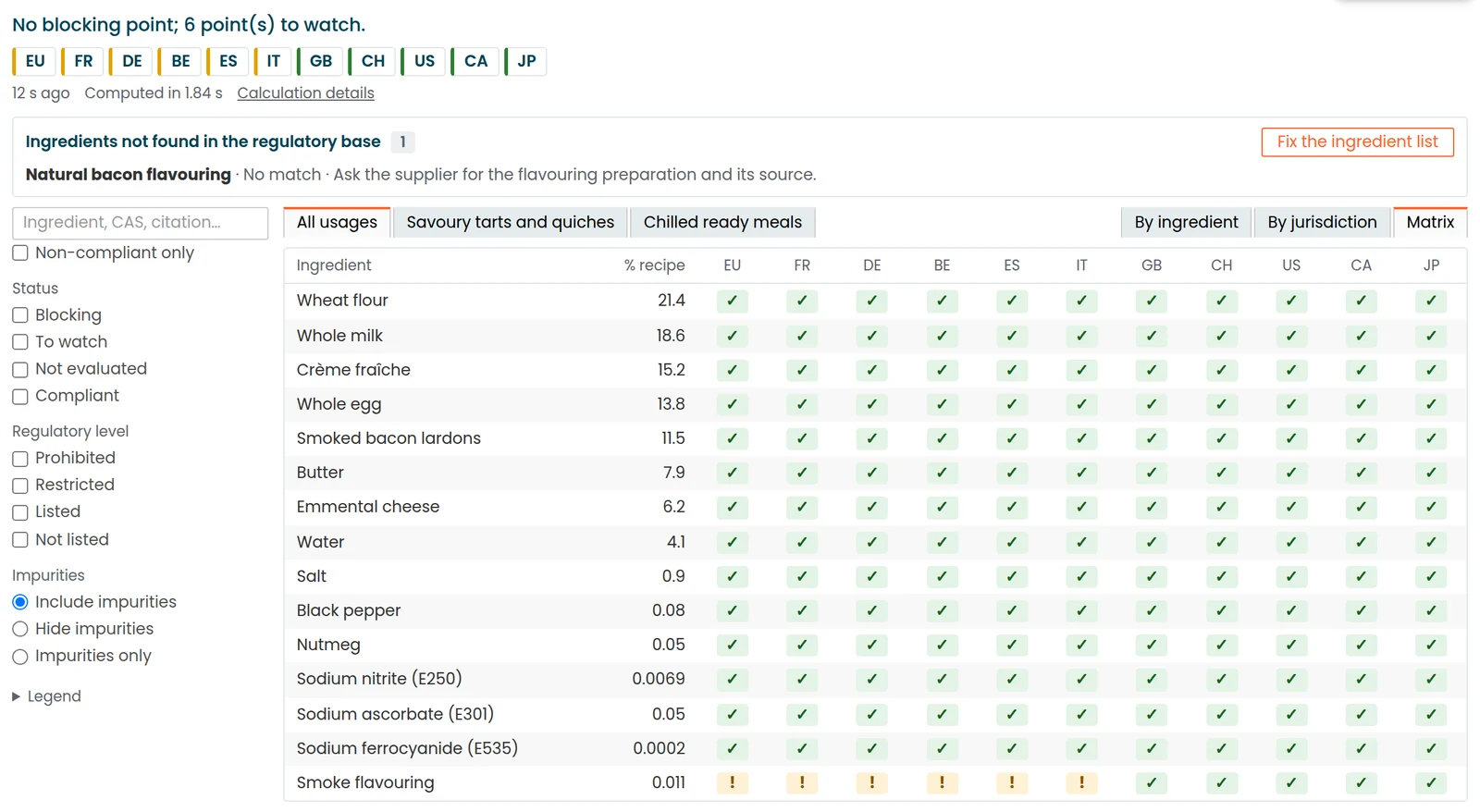
The regulatory view of the product sheet recalculates the compliance of every ingredient when you open it, in a few seconds.

beCPG regulatory view: compliance matrix of a recipe by ingredient and by jurisdiction
  • The verdict for each jurisdiction evaluated: compliant, to watch or blocking.
  • By intended use: the same recipe can pass as a savoury tart and not as a chilled ready meal.
  • Ingredients missing from the regulatory base, with a link to fix the ingredient list.
  • Three ways to read it: by ingredient, by jurisdiction or as a matrix, with filters on status and regulatory level.
  • A gauge shows how close each restricted substance is to its limit.
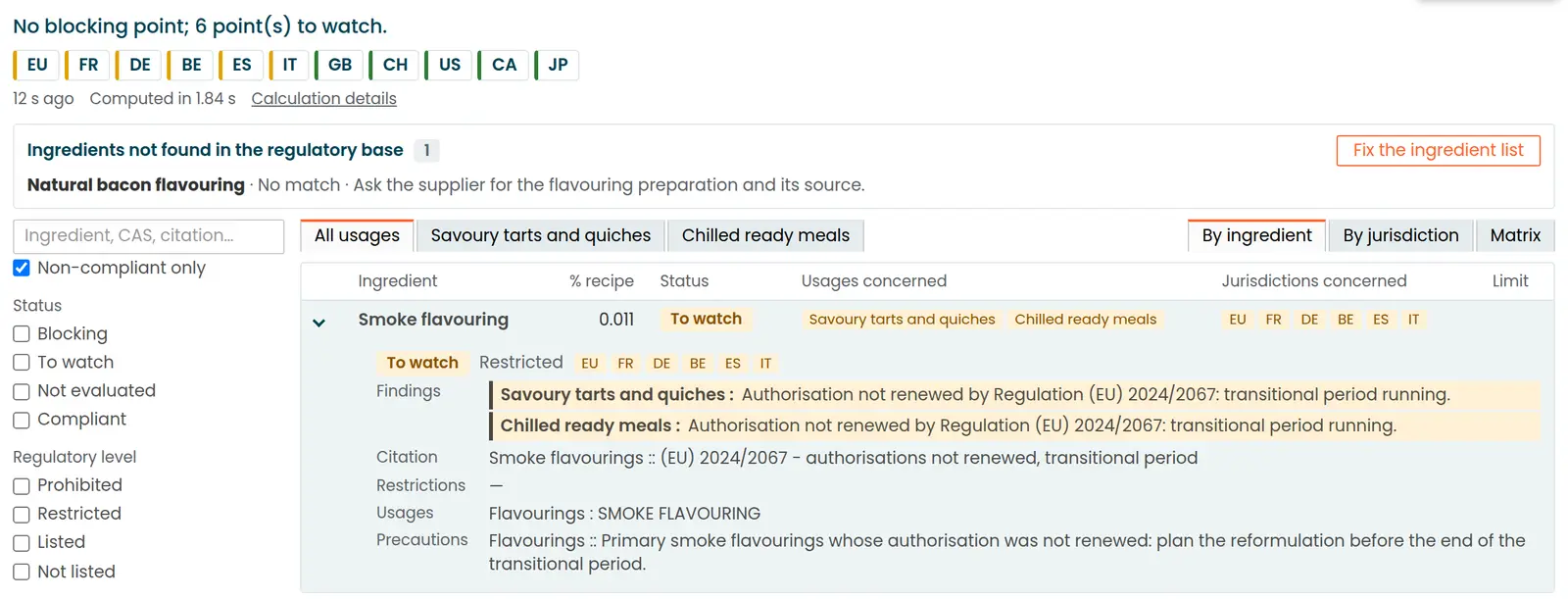
beCPG regulatory view: status of an ingredient, usages concerned and regulatory citation

The reason, not just the verdict

For every ingredient concerned, beCPG gives its regulatory status, the usages and countries concerned, the applicable limit, the precautions and the exact regulatory citation the decision is based on.

When a substance is capped, you see the maximum usable dosage: often the difference between reformulating and shipping.

The compliance status and the validation date are kept per market, and country reports list the restrictions of each ingredient: what you need to prove compliance to a customer or an auditor.

Coverage by sector

Regulatory checks combine the beCPG Regulatory Database and the labeling rules of the formulation engine.

Food and beverage

  • Labeling in more than 75 countries: nutrition facts, ingredient list, allergens and nutrition claims, calculated from the recipe, including the European Union, the United Kingdom, the United States, Canada, Australia, China, Japan and the Gulf states.
  • Food additives checked against EU Regulation 1333/2008 with the beCPG Regulatory Database, per food category.
  • Nutrition claims checked against the tolerances of each regulation, so that a claim only passes if the formulated value holds.
  • Precautionary allergen labeling: action limits calculated from reference doses (VITAL program).

Cosmetics and personal care

  • beCPG Regulatory Database: 13 zones and more than 40 countries, nearly 94% of the global market, by country and by intended use: European Union (CosIng), Switzerland, United Kingdom, United States (FDA, California Proposition 65), Canada (Cosmetic Ingredient Hotlist), China (NMPA), Japan, South Korea, Taiwan, Brazil (ANVISA), Mexico, Australia and New Zealand, Eurasian Economic Union, Gulf states (GSO) and ASEAN.
  • IFRA Standards and fragrance allergens.
  • Product types taken into account: rinse-off or leave-on, sensitive application areas (eyes, lips, mucous membranes), products for babies and children.
  • CLP classification, toxicology and SVHC substances.

A regulatory base you can audit

  • Monitored at the source: official texts (EUR-Lex, FDA, NMPA, EFSA…) are checked every month, and every change is detected.
  • Structured with AI, validated by experts: AI extracts the requirements from the texts; beCPG regulatory experts check them before any use.
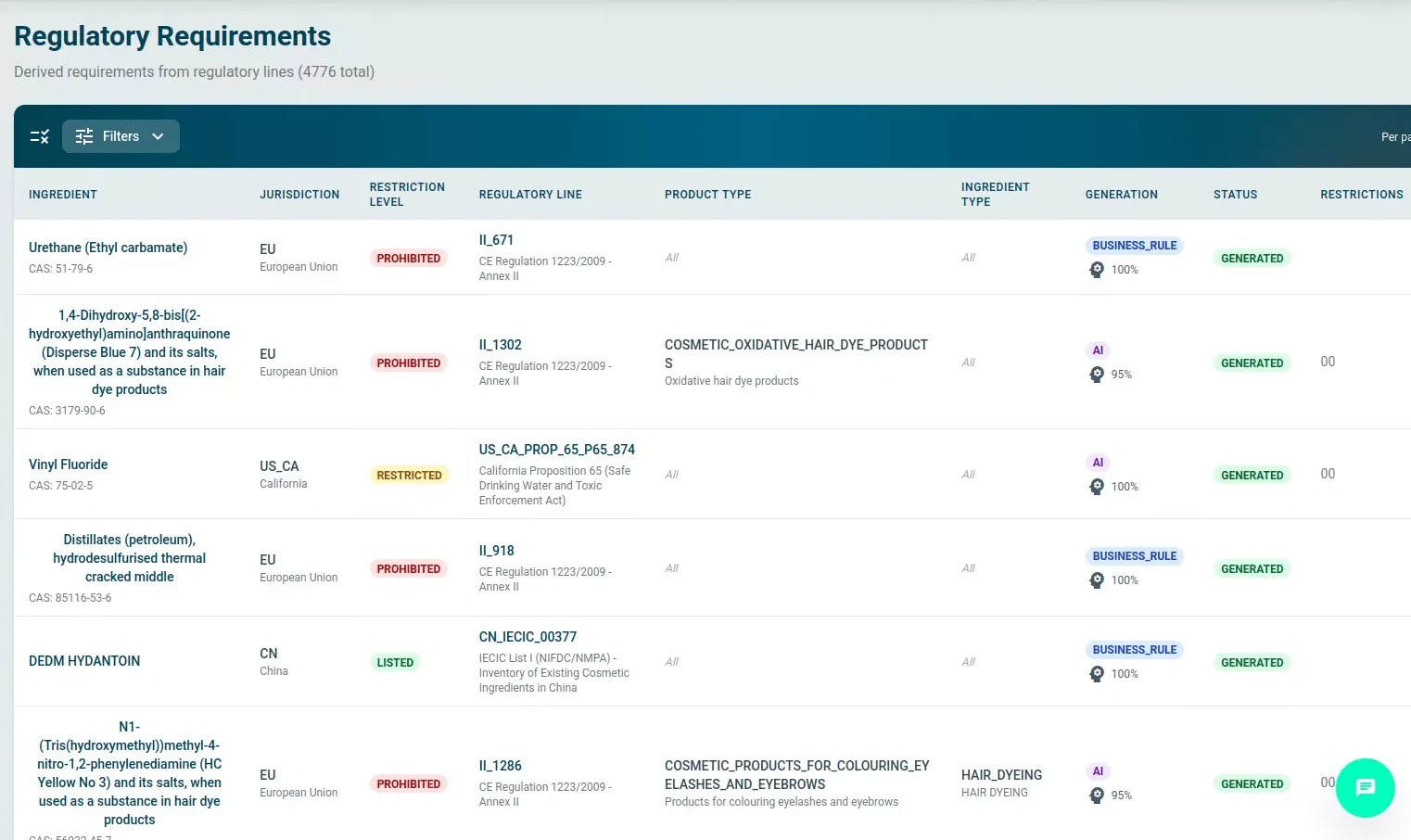
  • Nothing is a black box: every requirement states whether it comes from a business rule or from AI, with a confidence level, and you can review it.
  • Calculated by the engine: compliance is computed by the beCPG engine from validated data, not improvised by a generic AI. Chef AI answers your regulatory questions in natural language and checks the compliance of a product.
  • Your formulas stay yours: beCPG does not use them to train AI models.
beCPG Regulatory requirements, each one marked as generated by a business rule or by AI, with a confidence level

Your own rules, on top of the law

Specifications add your own constraints to the regulations of your markets: internal blacklists, retailer requirements, vegan or eco-design charters, GMO-free or ionization-free, required origins. Each ingredient is permitted, tolerated or prohibited, with maximum values.

Raw materials and formulas are checked from the first laboratory trial. Non-compliant products stay listed against the specification, with the requirement that rules them out.

It also watches what you might miss

  • Toxicity scanner, with a white-list mode and alerts on values that do not apply.
  • SVHC detection on the product specification.
  • CLP calculation with per-substance thresholds, a single accumulation of hazard statements and acute toxicity estimate (ATE) bounds.
  • Portfolio recalculation: when a raw material or a regulatory text changes, the formulas concerned are recalculated, and change orders show the new, resolved or less severe alerts before you apply them.

And if the regulatory service cannot be reached, beCPG raises an alert saying so. Silence is never treated as compliance.

Frequently asked questions

Which regulations does beCPG cover?

For food, labeling data (nutrition facts, ingredient list, allergens, claims) is calculated for more than 75 countries, and food additives are checked against EU Regulation 1333/2008. For cosmetics, the beCPG Regulatory Database covers 13 zones and more than 40 countries, nearly 94% of the global market: the European Union, the United Kingdom, North America, East Asia, Latin America, Oceania, the Eurasian Economic Union, the Gulf states and ASEAN, plus the IFRA Standards. Further regulations are added on request or as regulations evolve.

How is the regulatory base kept up to date?

Official sources are monitored every month. Each change is extracted, structured and checked by the beCPG regulatory experts before it is used, and the formulas concerned are recalculated.

Does beCPG replace our regulatory affairs team?

No. beCPG does the systematic checking, so that your experts spend their time on decisions. Every result comes with the citation it relies on, and the validation status is kept per market.

Can we add our own restrictions?

Yes. Specifications add your internal blacklists, retailer requirements and charters to the regulations of your target markets, with permitted, tolerated and prohibited ingredients and maximum values.

Can other systems use the regulatory data?

Yes. The regulatory data is available through secure APIs, for example to feed your ERP or to publish INCI lists on an e-commerce website.

Another question about your products, your markets or your systems? A PLM expert answers you, with a demo on your own products.

Bring us a formula and a target market

We will show you the answer, and where it comes from.

beCPG
Privacy Overview

This website uses cookies so that we can provide you with the best user experience possible. Cookie information is stored in your browser and performs functions such as recognising you when you return to our website and helping our team to understand which sections of the website you find most interesting and useful.