Cosmetics & HPCFormulationProject managementQualityTechnical data sheets
How to choose a PLM software for cosmetics: 10 criteria
Updated October 2026.
To choose a cosmetic PLM software, check ten points: the INCI list, fragrance allergens, regulatory checks per market, toxicology, the PIF, claims, supplier data, packaging, projects and deployment. Ask to see each of them on your own formulas during the demo. If you also make dietary supplements or personal care products, check that a single repository covers them.
A cosmetic brand or manufacturer usually starts with spreadsheets: formulas, INCI lists, supplier data and regulatory checks in separate files. The day a raw material changes or a new market opens, nobody knows which products are affected. A PLM (product lifecycle management) software puts these data in one place. This guide lists ten criteria to compare PLM software for cosmetics, with the question to ask during a demo.
The regulatory context in brief
- European Union: Regulation (EC) No 1223/2009 requires a responsible person, a product information file kept for ten years after the last batch, a CPNP notification before placing on the market, and an ingredient list in INCI names (text).
- Fragrance allergens: Regulation (EU) 2023/1545 brings the allergens to label individually to more than 80, above 0.001% in leave-on and 0.01% in rinse-off products. Products that do not comply could be placed on the market until July 31, 2026, and made available until July 31, 2028 (text).
- China and the United Kingdom: in China, special cosmetics are registered and general ones filed, with a full safety assessment report since May 2025; in Great Britain, a UK responsible person and an SCPN notification are required.
Selling in the United States: MoCRA
In the United States, the Modernization of Cosmetics Regulation Act (MoCRA) provides in particular for the registration of manufacturing facilities and the listing of cosmetic products with the FDA, subject to the applicable exemptions. The responsible person must also keep records that substantiate the safety of each product. Since December 29, 2024, the label must show a US address, US phone number or electronic contact for adverse event reports. The rules on fragrance allergen labeling and good manufacturing practices have not been proposed yet. Read the details in our MoCRA compliance guide.
Ten criteria to compare
For each criterion, the question to ask during the demo is in the summary table.
1. Formula and INCI list
Quali-quanti formula, raw materials made of several INCI ingredients, INCI list in decreasing order generated from the formula, impurities and carriers handled.
2. Fragrance allergens
Content of each allergen calculated from the composition of the raw materials, declaration thresholds for leave-on and rinse-off products.
3. Regulatory checks per market
Annexes of Regulation (EC) No 1223/2009, IFRA standards, the markets you sell in; a citation for every verdict.
4. Toxicology and hazardous substances
Toxicological data per ingredient, a toxicology calculation that takes the margin of safety into account, CLP, SVHC and CMR from ingredients and packaging.
5. Product information file
The data of the PIF gathered from the PLM: formula, specifications, documents, supplier data, and stability tests managed in the quality module.
6. Claims
Claims rolled up from raw materials (organic, natural origin, certifications), with evidence.
7. Supplier data
A portal where suppliers enter their data and documents, with validity dates.
8. Packaging and environment
Packaging bill of materials, materials and weights, recyclability, environmental scores.
9. Projects, changes and artwork
Development projects, change requests, versions and artwork proof approval.
10. Deployment and openness
SaaS or on your servers, API, data export, implementation by lots.
Summary table
| Criterion | Question to ask during the demo |
|---|---|
| Formula and INCI list | Generate the INCI list of one of our formulas live, and change one raw material. |
| Fragrance allergens | Which allergens of Regulation (EU) 2023/1545 are calculated, and where does the data come from? |
| Regulatory checks per market | Show the citation behind a restricted ingredient, and the markets actually covered today. |
| Toxicology and hazardous substances | Who maintains the toxicological data, and how is it used in the formula? |
| Product information file | Which parts of the PIF come from the PLM, and which are written by the safety assessor? |
| Claims | How is an organic percentage calculated, and where is the certificate kept? |
| Supplier data | What happens when a supplier certificate expires? |
| Packaging and environment | Can we get the PPWR recyclability grade and the Citeo export? |
| Projects, changes and artwork | Show the history of a formula change and its impact on labels. |
| Deployment and openness | Can we export all our data, and in which formats? |
One repository for cosmetics, personal care and supplements
Many groups sell more than cosmetics. The same brand may also launch personal care products, dietary supplements or biocides, each under different rules. With one tool per category, raw materials, suppliers and their documents are entered several times.
A single repository shares this data across categories, while each category keeps its own data model, rules and documents. Question to ask: Show a raw material used in both a cosmetic and a dietary supplement, with the rules specific to each product.
How beCPG answers these criteria
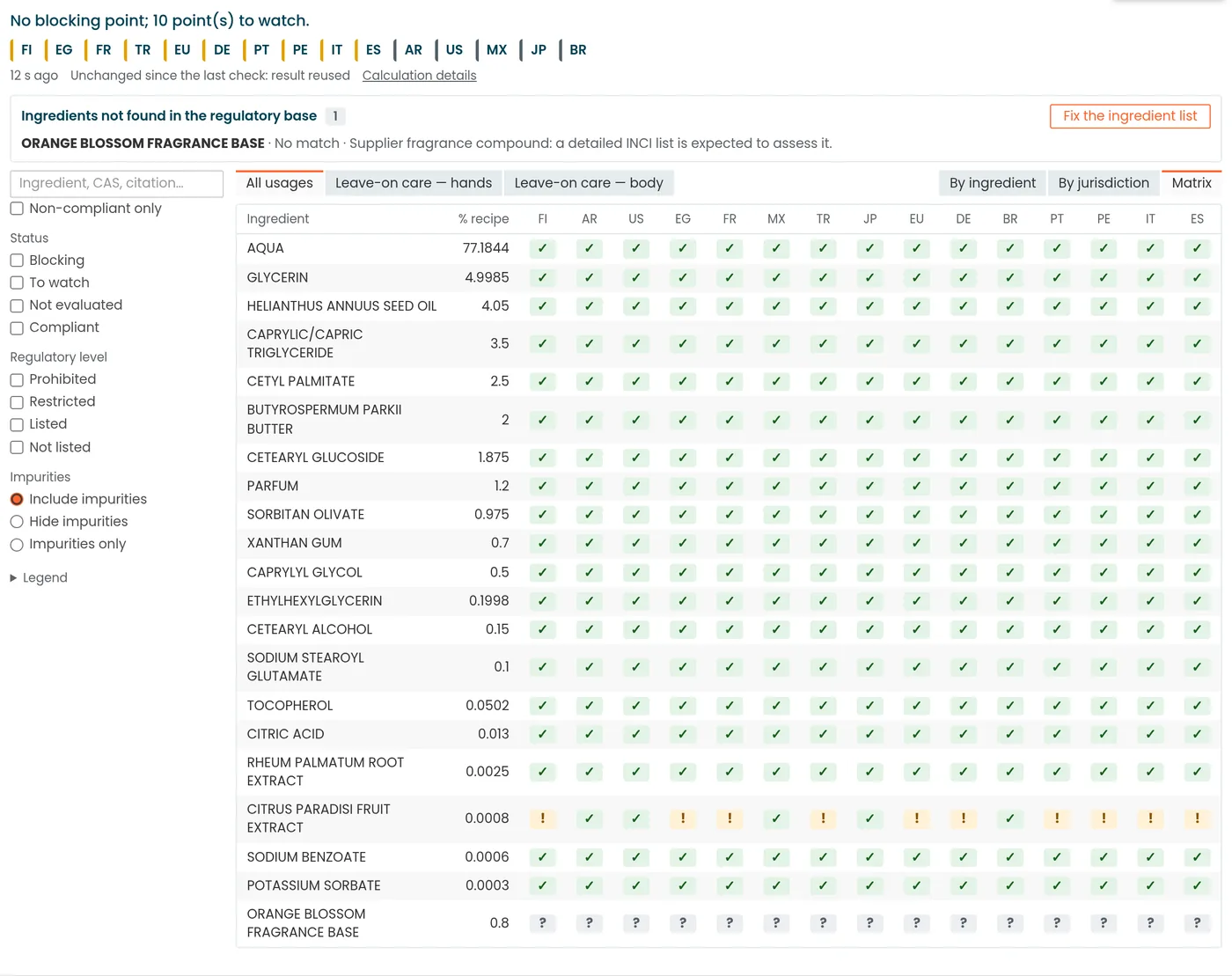
beCPG is an open source PLM for food and cosmetics. The INCI list is generated from the formula in decreasing order, impurities and carriers excluded, per market and language. Fragrance allergens are linked to the ingredients of each raw material, and they are declared above the thresholds of the regulation: 0.001% for leave-on and 0.01% for rinse-off products. The regulatory view checks each ingredient against regulatory lists, with the citation, and specifications hold your own rules. Toxicological data is stored per ingredient, the toxicology calculation takes the margin of safety into account, and CLP, SVHC and CMR come from the ingredients and the packaging. Stability tests are managed in the quality module. The beCPG regulatory database covers the United States: FDA lists, MoCRA and State laws such as California, Washington or Vermont.
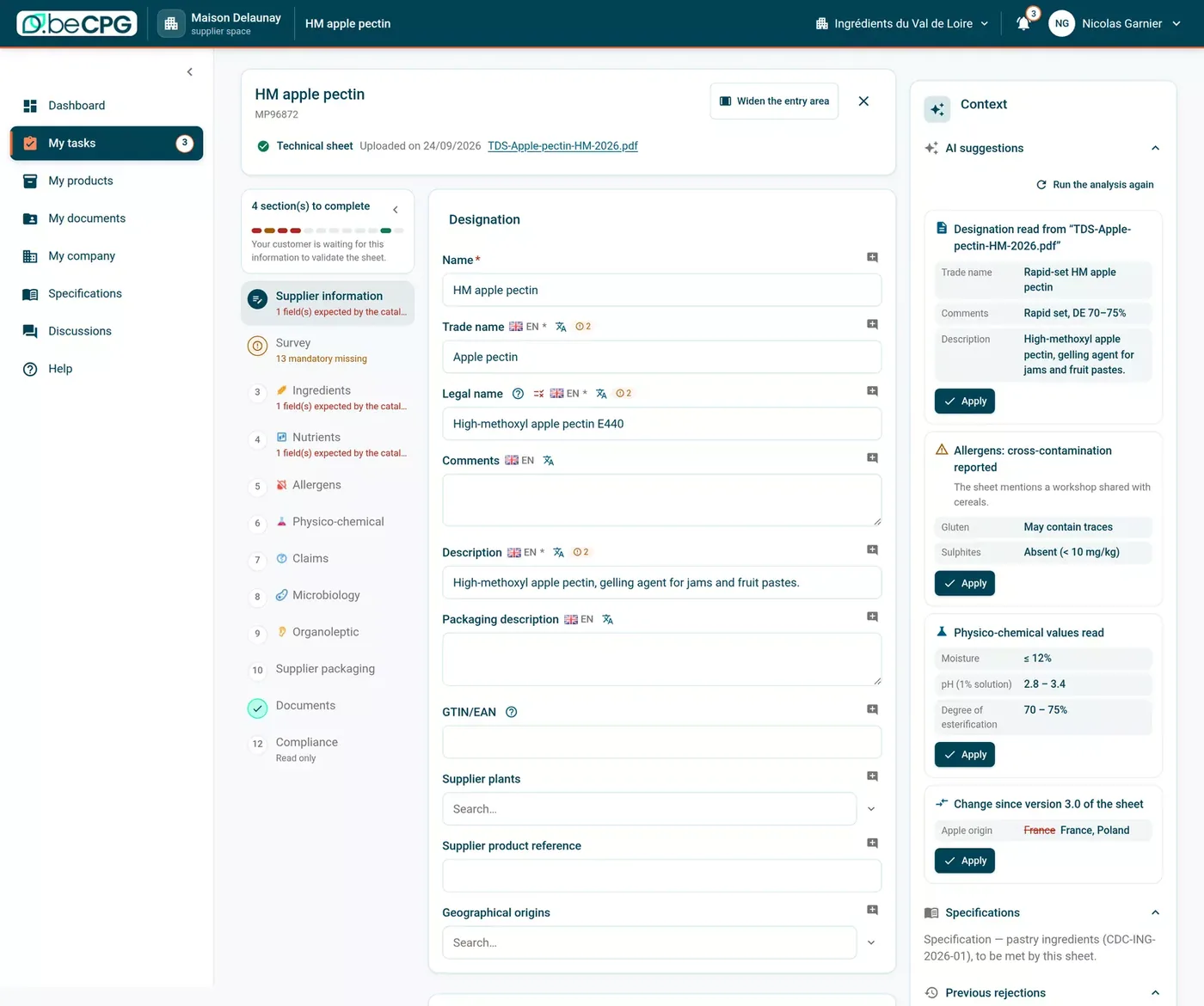
Since version 26.1, a PIF report gathers the data of the product information file, including the quali-quanti formula; the safety report itself remains the work of the safety assessor. The new supplier portal lets suppliers enter their data and documents, with an AI that reads their data sheets and proposes values for them to validate. Packaging, PPWR recyclability grade, projects, workflows and artwork approval are in the same PLM. beCPG also manages hygiene products, food supplements, biocides and food products on the same platform. It is available as SaaS, hosted on Google Cloud in Europe or the United States, or on your own servers.
Go further: discover our page on PLM software for the cosmetic industry, and our guides to the product information file and to the regulatory compliance of a formula. Download the beCPG brochure.
Sources
- Regulation (EC) No 1223/2009 on cosmetic products
- Regulation (EU) 2023/1545 on the labeling of fragrance allergens in cosmetic products
- FDA: Modernization of Cosmetics Regulation Act of 2022 (MoCRA)
Frequently asked questions
Can a PLM write the cosmetic safety report?
No. The safety report is the responsibility of a qualified safety assessor. A PLM gathers and keeps the data the assessor needs: formula, raw material data, toxicology, specifications and documents.
Does a small brand need a PLM?
From a few dozen formulas, or as soon as you sell in several markets, spreadsheets no longer show which products a change affects. That is the moment to compare PLM software.
Does a PLM replace the CPNP notification?
No. The responsible person notifies each product on the CPNP portal; the PLM provides the data to do it, such as the formula and the label.
Can cosmetics and dietary supplements be managed in the same PLM?
Yes, if the PLM keeps separate data models and rules for each category. Check that shared raw materials and suppliers are entered only once, and that each product keeps its own compliance.