How to check the regulatory compliance of a formula in several markets

Updated October 2026.
Before a food or cosmetic product reaches a new market, someone has to answer three questions: is every ingredient allowed there, at what dose, and for which use? Answered by hand, it takes days of reading, and the answer can be out of date the following quarter. This guide gives a method in seven steps, valid whatever the tool you use.
1. Define the market and the intended use
A regulation does not apply to an ingredient, it applies to an ingredient in a given use. The same recipe can pass as a savory tart and fail as a chilled ready meal; the same preservative can be allowed in a rinse-off shampoo and restricted in a leave-on cream.
- Food: the food category of the product, as used by the additive lists (for the European Union, the categories of Annex II of Regulation (EC) No 1333/2008).
- Cosmetics: the product type (rinse-off or leave-on), the application area (eyes, lips, mucous membranes) and the target population (babies and children).
- Markets: list every country of sale, not only the main one. A product sold in the European Union and in the Gulf states must meet both.
2. Know exactly what is in the formula
Compliance is checked at the level of substances, not of raw materials. The composition must therefore go down to the last level:
- every ingredient of every compound raw material (a flavor preparation, a seasoning, a premix);
- the identifier of each substance: CAS number, INCI name for cosmetics, E number for additives;
- processing aids and substances carried over from raw materials;
- impurities and traces declared by the supplier.
A raw material whose composition is unknown cannot be evaluated: it is the first point to resolve with the supplier, before any regulatory check.
3. Check each substance against the lists of each market
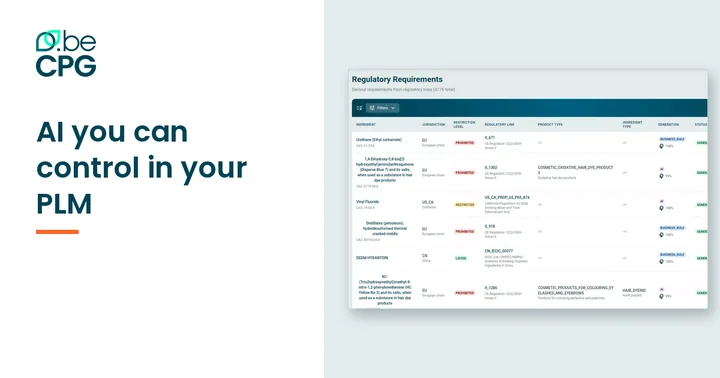
For each market, each substance has a status: prohibited, restricted (allowed under conditions: maximum concentration, product types, warnings), listed (allowed) or not listed (to be investigated). Examples of lists: the annexes of the European cosmetics regulation (EC) No 1223/2009, available in the CosIng database; the IFRA Standards for fragrances; the Union list of food additives.
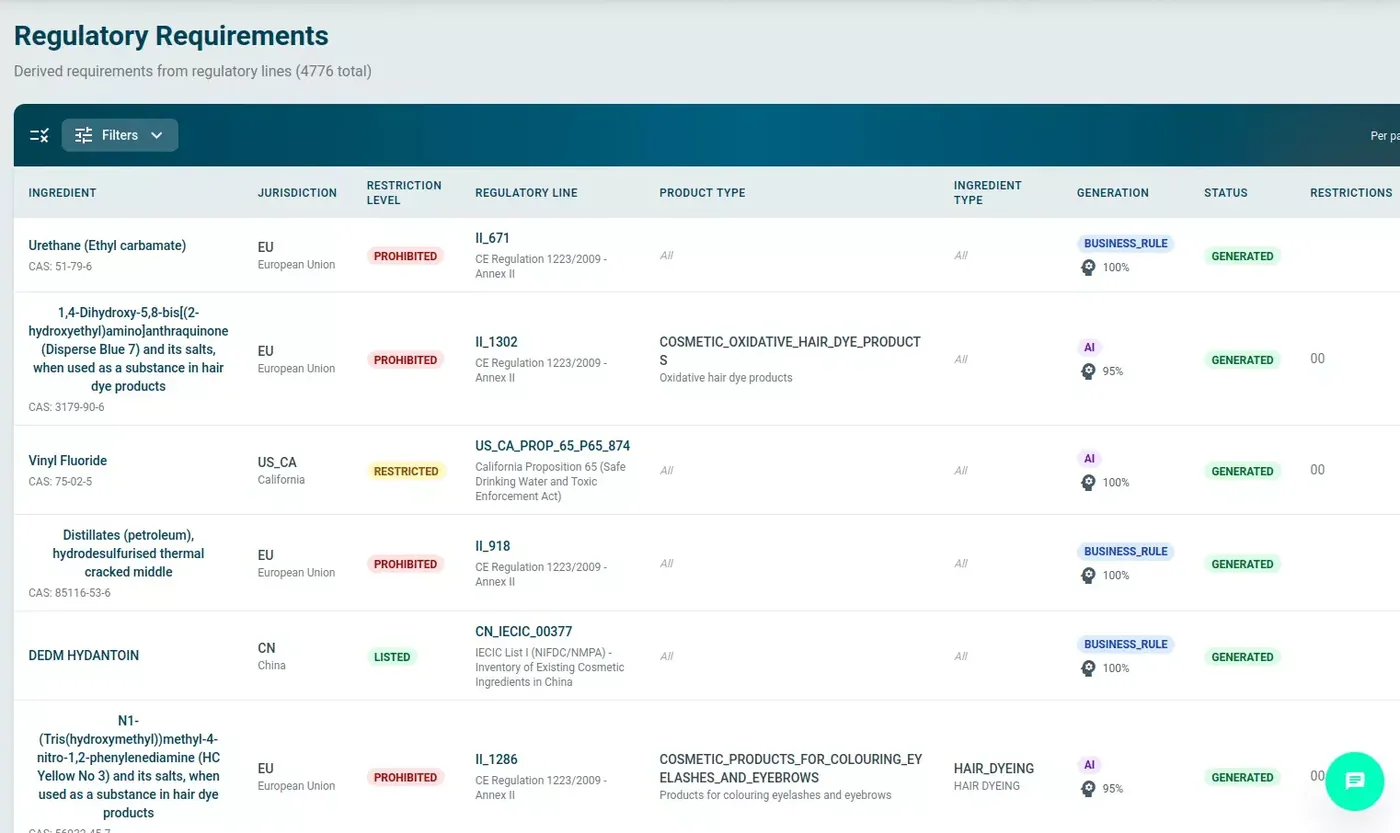
Lists change: in 2024, Implementing Regulation (EU) 2024/2067 did not renew the authorization of several smoke flavoring primary products, with transitional periods. A formula compliant last year may no longer be.
4. Compare the dose with the limit, and calculate the maximum dosage
When a substance is restricted, the question becomes: how much of the raw material can I use? If the limit in the finished product is L % and the raw material contains c % of the substance, the raw material can be used up to L / c × 100 % of the formula.
Example: a preservative limited to 0.5 % in the finished product, supplied in a raw material that contains 10 % of it: the raw material can be used up to 5 % of the formula. Above that, you reformulate; below, you ship. For substances present in several raw materials, add up the contributions before comparing with the limit.
5. Add your own rules
The law is the minimum. Customers and brands add their own requirements: retailer specifications, internal blacklists, vegan or GMO-free charters, required origins, eco-design rules. Record them in the same way as the regulations (permitted, tolerated, prohibited, with maximum values), so that a single check covers both.
6. Keep the evidence
A compliance decision must be defensible in front of a customer or an auditor, months later. For each market, keep:
- the result (compliant, to watch, blocking) and the ingredients concerned;
- the exact citation of the regulation the decision is based on, and its version;
- the date of the check and the person who validated it.
7. Monitor the changes
Regulations, raw materials and formulas all change. Re-run the check whenever one of them changes, and list the formulas affected by a new text before it applies, not after. On a portfolio of hundreds of formulas, this step is the one spreadsheets cannot keep up with.
Labeling is part of compliance
Compliance does not stop at ingredients: the ingredient list, allergens, nutrition declaration and claims must follow the rules of each market too. See our guides to Regulation (EU) No 1169/2011 and to US Nutrition Facts.
How beCPG does it
In beCPG, the composition goes down to substances, specifications hold your own rules, and the regulatory view of the product sheet gives the verdict per market and per use, with the citation behind each result and the maximum usable dosage. When a raw material or a text changes, the formulas concerned are recalculated. Calculations stay with the beCPG engine; AI only helps prepare the regulatory data, which is reviewed before use.
Discover regulatory compliance in beCPG PLM.
Frequently asked questions
Can a formula be compliant in one country and not in another?
Yes, and it is common. Lists, limits and product categories differ between markets. A check must always be made per market and per intended use.
What should I do with an ingredient that is not listed?
“Not listed” does not mean “allowed”. Check its identity (CAS number, INCI name), ask the supplier for the full composition, and look for the status of each substance.
How often should compliance be checked again?
At every change of formula or raw material, and every time a regulation that concerns your markets changes. Monitoring the official sources monthly is a reasonable minimum.