The beCPG product repository manages finished products, semi-finished products, raw materials, packaging and their documents in one place. It combines the technical data used for specifications and regulatory affairs with the product information published to customers, websites and data pools.

beCPG is ready to use for food and beverage and cosmetics, and adapts to your data without development.

1

Fill

products, raw materials and packaging in forms designed for each team
2

Share

one up-to-date source of product data
3

Find

products and documents in seconds with full-text search
4

Track

product changes, versions and their impacts
Versions graph
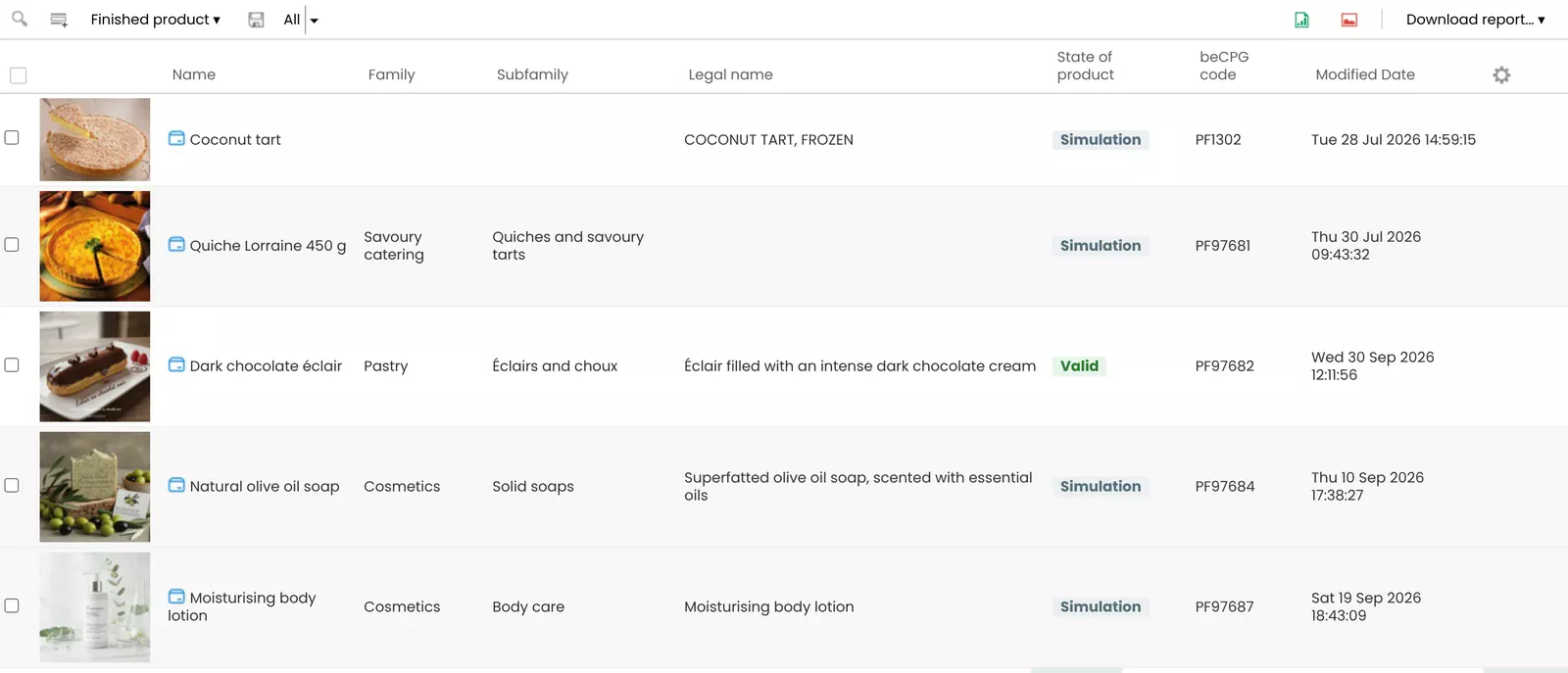
beCPG product repository: finished products with their state (simulation, valid), family and beCPG code

Product data management

The product repository captures and maintains product information throughout development and the whole life of the product.

  • Share one database between Marketing, R&D, Quality, Production, Sales and Supply Chain
  • Manage composition, packaging, process, ingredients and origins, nutrition, allergens, costs, microbiology, physico-chemical and organoleptic data, labeling and claims
  • Follow data completeness with a score and the list of missing properties for each use (customer, GDSN, website, ERP)
  • Automatic numbering and business rules to codify products
  • Manage the bill of materials with effective dates, variants and alternatives
  • Keep costs and regulatory data up to date with formulation
  • States, approval workflow and version control, with comparison of versions and products
  • Where-used analysis and change orders to measure and apply a change
  • Bulk editing, saved searches and export to Excel
  • Publish product data to GS1 GDSN data pools, websites and your ERP

Document management

Receive, track, manage and store every type of document, attached to products and projects or classified in folders.

  • Specifications, certificates, supplier documents, analysis results, contracts
  • Images and videos (digital asset management), resized automatically
  • Artwork management: annotations, comparison of versions, review workflow with checklists and approval
  • Version control with the history of who changed what and why
  • Full-text search in the content of documents
  • Online preview and sharing with external partners such as customers and printers
  • Editing in Microsoft Office and Google Docs
  • Digital signature, internally or with suppliers
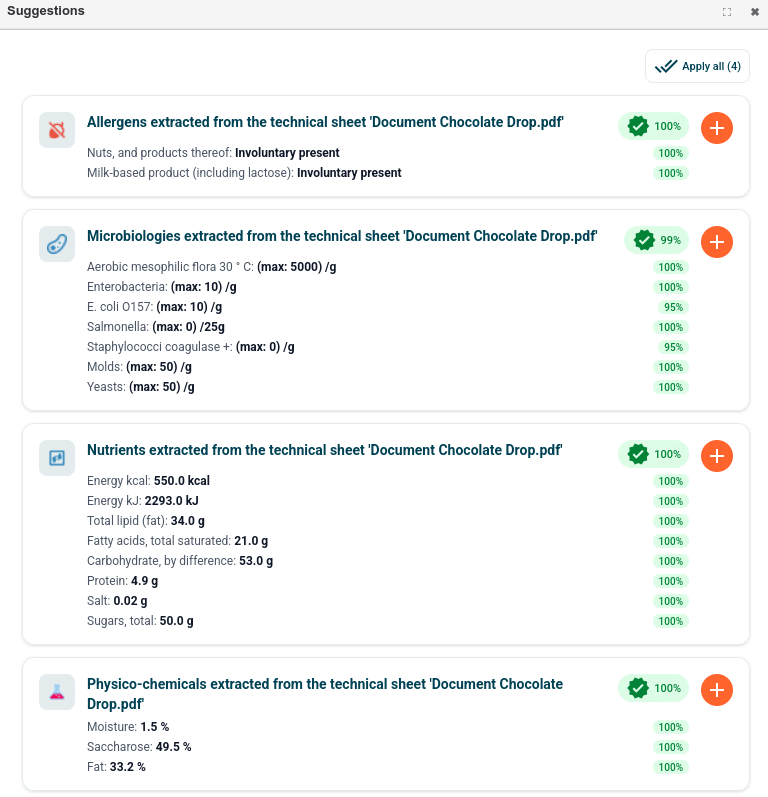
Chef AI suggestions: allergens, microbiological criteria, nutrients and physico-chemical values extracted from a technical sheet, with a confidence level and a button to apply them

Artificial intelligence that proposes, your teams validate

The beCPG AI module improves the productivity of your teams and the quality of your data. Nothing is saved without your validation.

  • Chef AI, a conversational assistant that finds, compares and creates products in natural language
  • Data suggestions: names, descriptions, families, marketing and organoleptic data
  • Extraction of data from supplier technical data sheets in PDF format
  • Artwork compliance: check that the artwork proof matches the product data
  • Translations, spell check and product image suggestions

Product repository: frequently asked questions

What is a product repository?

It is the single source of product data: finished and semi-finished products, raw materials, packaging, suppliers, customers and their documents. Every team works on the same validated data, with versions, states and the history of changes.

What is the difference between PDM, PIM and PLM?

Product Data Management (PDM) captures the technical definition of a product; Product Information Management (PIM) prepares the information published to customers, websites and data pools. beCPG PLM covers both on the same data, together with formulation, specifications and development projects.

Can beCPG publish product data to GS1 data pools and websites?

Yes. beCPG manages the GS1 GDSN product data and can feed data pools such as Equadis, Atrify, Validoo or Synkka, as well as e-commerce websites and ERP systems through the REST API and connectors.

How are product changes controlled?

Each product has a state (simulation, to validate, valid, stopped, archived) and a version history you can compare. Where-used analysis shows every product that uses a component, and change orders simulate and apply a change with an approval step.

Can we adapt the forms and fields?

Yes. New fields and data lists are added without development, forms are designed in a form designer, and permissions can be set on sites, content, actions and fields.

Another question about your products, your markets or your systems? A PLM expert answers you, with a demo on your own products.

See beCPG in action

Book a demo with a PLM expert, or start your free trial today.

beCPG

Privacy Overview

This website uses cookies so that we can provide you with the best user experience possible. Cookie information is stored in your browser and performs functions such as recognising you when you return to our website and helping our team to understand which sections of the website you find most interesting and useful.