Food & Agro-industriesFormulation
Nutri-Score: how it is calculated and how to improve it

Updated October 2026.
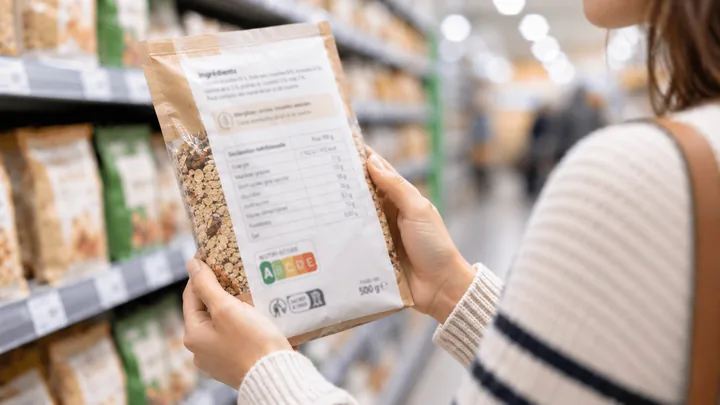
The Nutri-Score grades the nutritional quality of a food from A (dark green) to E (dark orange). It is voluntary, but widely used by brands and retailers in seven European countries. Its algorithm was updated in 2022 and 2023, and the new version now applies in all of them, with a transition period in France until 2027. This guide explains how the score is calculated, what changed, and how to improve a score without guessing.
Status and timeline
- Voluntary label, recommended by the public authorities in France, Belgium, Germany, Spain, the Netherlands, Luxembourg and Switzerland, which share its governance since 2021.
- Updated algorithm: approved in July 2022 for foods and in March 2023 for beverages.
- Entry into force: 1 January 2024 in Germany, Belgium, Switzerland and the Netherlands, 5 March 2024 in Luxembourg, and 16 March 2025 in France (order of 14 March 2025), with two years for companies to update their packs.
- No EU-wide label yet: the harmonised front-of-pack label announced in 2020 has not been proposed; the Commission is still assessing the options.
How the score is calculated
The score is calculated per 100 g or 100 ml of product as sold, or as prepared for products that are reconstituted before eating. It balances two sets of points:
- negative points for energy, saturated fat, sugars and salt, plus non-nutritive sweeteners for beverages;
- positive points for protein, fibre and the content of fruits, vegetables and legumes.
The difference gives a score, converted into a letter with thresholds that depend on the category: general foods (with specific rules for cheeses and red meat), fats, oils, nuts and seeds, and beverages. Two products with the same nutrients can therefore get different letters if they do not belong to the same category.
What the updated algorithm changes
- sugar and salt are penalised more strictly;
- red meat scores lower than poultry, and whole-grain products are better distinguished;
- oily fish and oils low in saturated fat score better (olive, rapeseed and walnut oils move from C to B);
- milk, drinking yogurts and dairy or plant-based drinks are now scored as beverages;
- sweeteners count in beverages, so most light drinks lose their B; water is the only beverage rated A.
Many products change letter. Before printing new packs, recalculate the whole range with the new algorithm and list the products whose letter moves.
How to improve a score
| Lever | Effect | Watch out for |
|---|---|---|
| Reduce sugars or salt | Fewer negative points | Taste, shelf life, texture; work in small steps |
| Increase fibre (whole grains, legumes) | More positive points | Fibre method (NSP or AOAC) of the raw material data |
| Increase fruits, vegetables and legumes | More positive points | Only the content in the finished product counts |
| Change the fat profile | Fewer saturated fat points | Cost and process of the new fat |
| Check the category | Different thresholds | The category follows the product, not the marketing claim |
A reformulation is a trade-off between nutrition, taste and cost. The useful question is not “how do we get an A?” but “which change moves the letter, for what cost?”. Calculate it on the recipe before any trial.
Calculating the Nutri-Score in beCPG
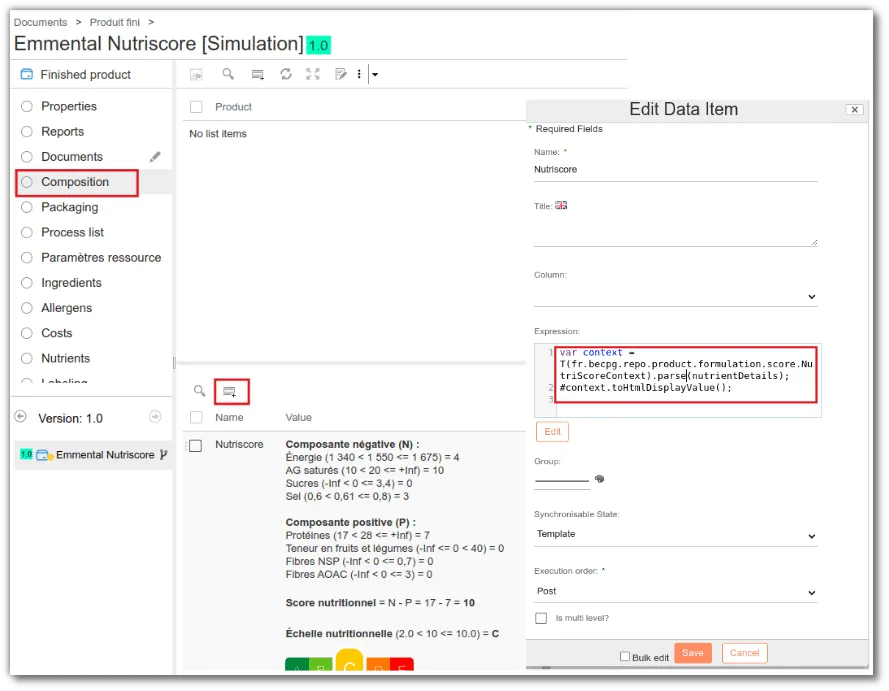
In beCPG, the Nutri-Score is calculated at formulation, from the nutrients and quantities of the raw materials, with the detail of the negative and positive points on hover. The fruit, vegetable and legume content, the fibre method and the category are product data, so the score is recalculated as soon as the recipe changes. For products to reconstitute, the values per serving and the score are recalculated for the prepared product. The algorithm, 2023 or 2017, is chosen product by product: the 2017 version remains available during the transition.
Since version 26.1, the scores of a product (Nutri-Score, traffic lights, front-of-pack warnings and others) are gathered in a Scores list, with a dashboard and a search by class to find, for example, every product that moves from B to C. Chef AI can compare the Nutri-Score of several recipes; the calculation itself stays with the formulation engine. Using the logo on packs remains subject to registration with Santé publique France.
Frequently asked questions
Is the Nutri-Score mandatory?
No. It is voluntary in the seven countries that recommend it. No EU-wide front-of-pack label has been proposed so far.
When must packs show the updated score in France?
The updated algorithm applies in France since 16 March 2025, with a two-year transition for companies to update their packs.
Is the score calculated on the product as sold or as prepared?
As sold, except for products that must be reconstituted, such as powders to mix with water or milk: the calculation is then made on the prepared product.
Why does my product change letter with the new algorithm?
Mostly because of sugars, salt or sweeteners, which are counted more strictly, or because the product now belongs to another category, as dairy drinks do.
Official information: Santé publique France and Manger Bouger (in French).
Go further: discover formulation in beCPG PLM, our page for bakery and pastry, and our guides to EU food labelling and US Nutrition Facts. Download the beCPG brochure.