PLM supports product design and development, while ERP handles day-to-day operations such as purchasing, production and inventory. The two systems need to exchange data to avoid retyping and inconsistencies.
Choosing food PLM software takes more than comparing feature lists. Several criteria matter, depending on your business: formulation, nutrition calculation, allergen management, regulatory compliance, supplier collaboration and more. How do you compare vendors and find the one that fits your organization? Here are ten criteria to review.
Since the Modernization of Cosmetics Regulation Act of 2022 (MoCRA) was enacted, cosmetic companies that sell in the United States face stronger obligations. Most of its obligations already apply: facility registration, product listing, serious adverse event reports, safety records and a contact on the label. Here is where things stand in October 2026, and which product data you need to keep structured to stay compliant.
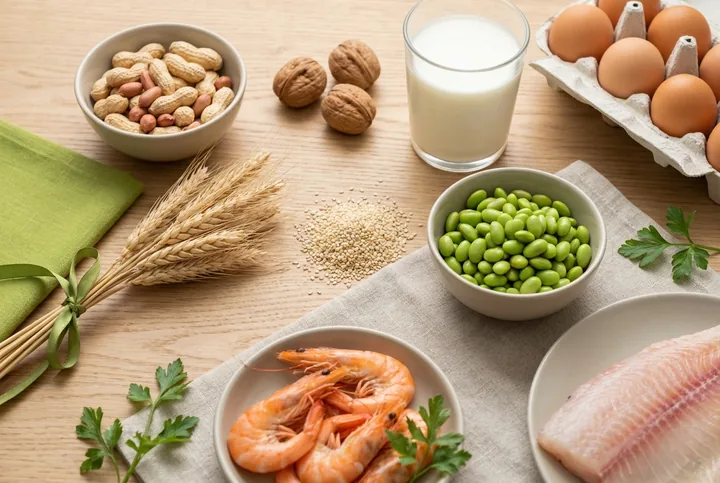
In the United States, nine major food allergens must be declared on the label: milk, eggs, fish, crustacean shellfish, tree nuts, peanuts, wheat, soybeans and sesame. The law sets how to declare them, in the ingredient list or in a “Contains” statement. Unlike the declaration of allergens present as ingredients, precautionary statements such as “may contain” are not subject to specific presentation rules. The FDA still reminds manufacturers that they must not be misleading. And the FDA guidance of January 2025 changed the scope of milk, eggs and tree nuts.
“Can we sell this in Brazil?” The question comes from sales, lands on the regulatory desk, and the honest answer is often “give me a week”. A good part of that week goes into one precise question: how many warning symbols will the product have to carry on the front of pack, and in which countries.
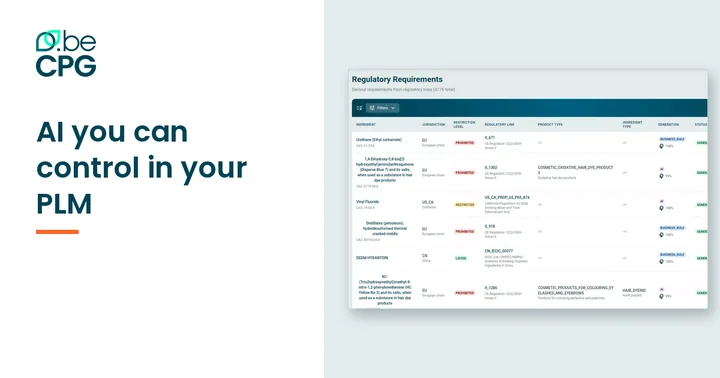
Your teams already use an AI assistant. It writes their emails, summarizes their documents, and knows nothing about your products. With beCPG 26.1, it can.
AI assistants are arriving in PLM software. On a demo, they look alike: you ask a question, a confident answer appears. The difference shows up later, when an auditor asks how a value was produced. Here are the three questions that surface it before you sign.
A pallet, a grouping carton, a roll of stretch film: your supplier ships in something, and that something rarely lands in the right place in your data. Filed alongside the product’s own packaging, it inflates the tare weight, the material breakdown and, further down the line, your packaging declaration. Filed nowhere, it is missing the day a customer asks for case dimensions. The answer is not to choose between the two — it is to keep them apart.
On many packs, “may contain traces of…” has become a reflex: you write it because you cannot quantify the risk. Allergic consumers end up ignoring it, or giving up products they could safely eat. Regulators and international standards are now pushing the other way: a precautionary statement that rests on a calculation, product by product. The question is where the numbers come from.
In Australia and New Zealand, the front of pack carries stars: from half a star to five, in half-star steps. The system is voluntary, which does not make it optional: shoppers compare stars on shelf, and a range that displays nothing reads as a range with something to hide. The question is how many stars your product earns, and what it would take to gain one.