Food & Agro-industriesFormulation
Calculate your nutrition claims with beCPG
Nutrition claims are a great way to highlight its products. However, these claims are governed by strict regulations.
For example:
- LOW ENERGY : the product does not contain more than 40 kcal (170 kJ)/100 g for solids or more than 20 kcal (80 kJ)/100 ml for liquids
- ENERGY-FREE : the product does not contain more than 4 kcal (17 kJ)/100 ml
- SUGARS-FREE : the product contains no more than 0,5 g of sugars per 100 g or 100 ml
- SODIUM-FREE or SALT-FREE : the product contains no more than 0,005 g of sodium, or the equivalent value for salt, per 100 g
There are many claims and their verification is tedious so it is interesting to check automatically them, especially when recipes are changing!
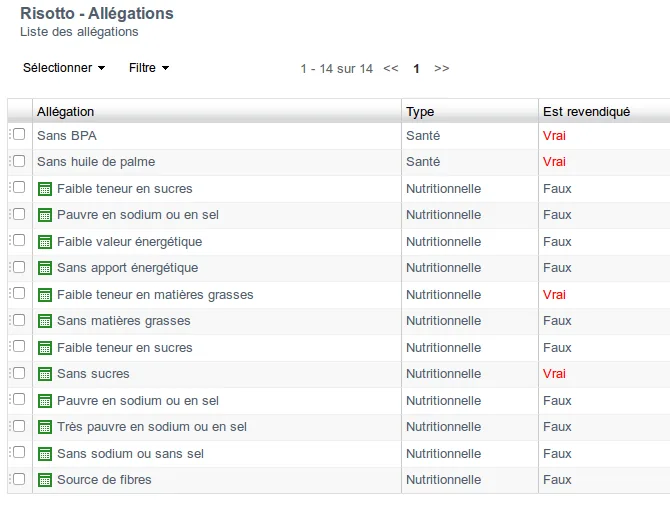
Therefore beCPG software manages claims of products and automatically calculates them. Depending on the recipe of the product and its characteristics, beCPG displays authorized claims.
In beCPG, you can:
- choose claims that are relevant to your products,
- set up your own claims,
- write your rules and criteria (eg I want to create two claims full fruit sorbet, ice cream).
Here are some sites about the regulation of claims:
- Nutrition Claims [Europan Union Register]
- Guidance for Industry: A Food Labeling Guide [FDA]
- Nutrition Labelling, Nutrient Content Claims and Health Claims [Canadian Food Inspection Agency]
Go further: discover formulation and R&D in beCPG PLM.