Food & Agro-industriesFormulationQuality

Ingredient labeling for food products
Ingredient labeling for food products

This September 2013, beCPG improved its labeling module making it more configurable.

If you encounterthese issues when calculatingthe list of ingredients:

  • Your clients have specific labeling rules
  • You want to highlight some ingredients and mask other ones
  • You want to anticipate the INCO regulation

beCPG software can help you by automatically calculating the list of ingredients for your products.

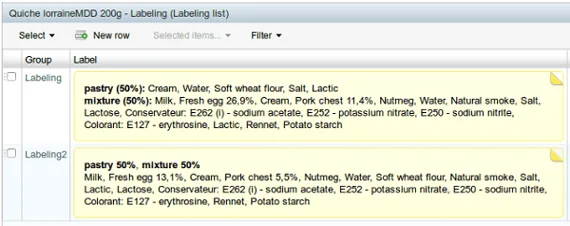
beCPGallows multiplelabelingformatsset:

Ingredient labeling for food products

The module allows the addition of labeling rules to automatically rework the labeling of products, for example :

  • Formatting rules to display the percentages, to underline or highlight one or several ingredients
  • Aggregation of ingredients (I declare “cooking salt” and “table salt” as “salt”)
  • Combining some ingredients (I combine the ingredients “water” and “milk powder” in some proportions and I declare them as “milk reconstituted”)
  • I rename the ingredient “wheat flour” to “flour”
  • I declare the ingredient “pectin” as “gelling agent” or “thickening agent”
  • Combining products to declare them as a layer (I combine a “sauce” and “pistachio” and I declare them as a layer)
  • The ability to omit some ingredients according to their quantity (eg: water) and their properties (eg: processing aids)
  • Detail or Not detail some composite raw materials
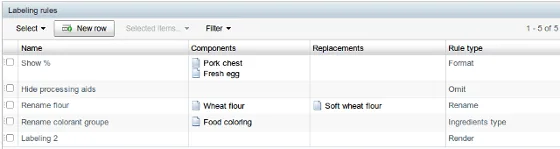
Ingredient labeling for food products

In addition, manual rewrite of label is possible (partially or totally)
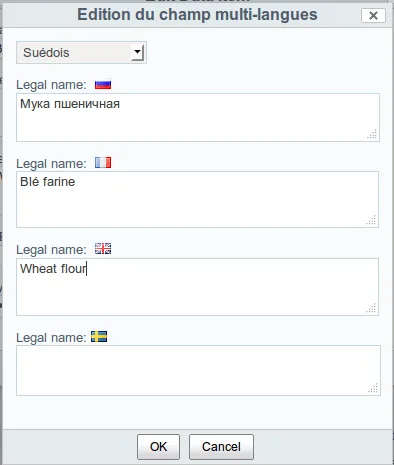
Finally, beCPG manages natively the creation of labels in multiple languages​​.

Ingredient labeling for food products

Below, you will find some links that explain food labeling:
Read also

IT & computing

PLM vs ERP: who owns which product data?

PLM supports product design and development, while ERP handles day-to-day operations such as purchasing, production and inventory. The two systems need to exchange data to avoid retyping and inconsistencies.

Philippe Quéré4 min

Food & Agro-industries

How to choose food PLM software: 10 criteria

Choosing food PLM software takes more than comparing feature lists. Several criteria matter, depending on your business: formulation, nutrition calculation, allergen management, regulatory compliance, supplier collaboration and more. How do you compare vendors and find the one that fits your organization? Here are ten criteria to review.

Philippe Quéré5 min

Food & Agro-industries

US food allergen labeling: the 9 major allergens and FDA rules

In the United States, nine major food allergens must be declared on the label: milk, eggs, fish, crustacean shellfish, tree nuts, peanuts, wheat, soybeans and sesame. The law sets how to declare them, in the ingredient list or in a “Contains” statement. Unlike the declaration of allergens present as ingredients, precautionary statements such as “may contain” are not subject to specific presentation rules. The FDA still reminds manufacturers that they must not be misleading. And the FDA guidance of January 2025 changed the scope of milk, eggs and tree nuts.

Philippe Quéré5 min

See beCPG in action

Request a demo or start your free trial.