How many score labels does your product have to carry?

A drink sold in six countries now carries six different marks: a letter here, stars there, traffic lights elsewhere, black octagons further on. None is calculated the same way, and none can be derived from another. The question is no longer which one is right, but how to keep them all current on the same product record.
One product, five ratings — and counting
Here is a single recipe — a chocolate éclair — seen through several schemes. The Nutri-Score rates it D in both versions, the UK traffic lights flag saturated fat in red and Italy offers its reference intake batteries. On the same record, Australia gives it two stars out of five and the PPWR recyclability of its packaging is rated B.
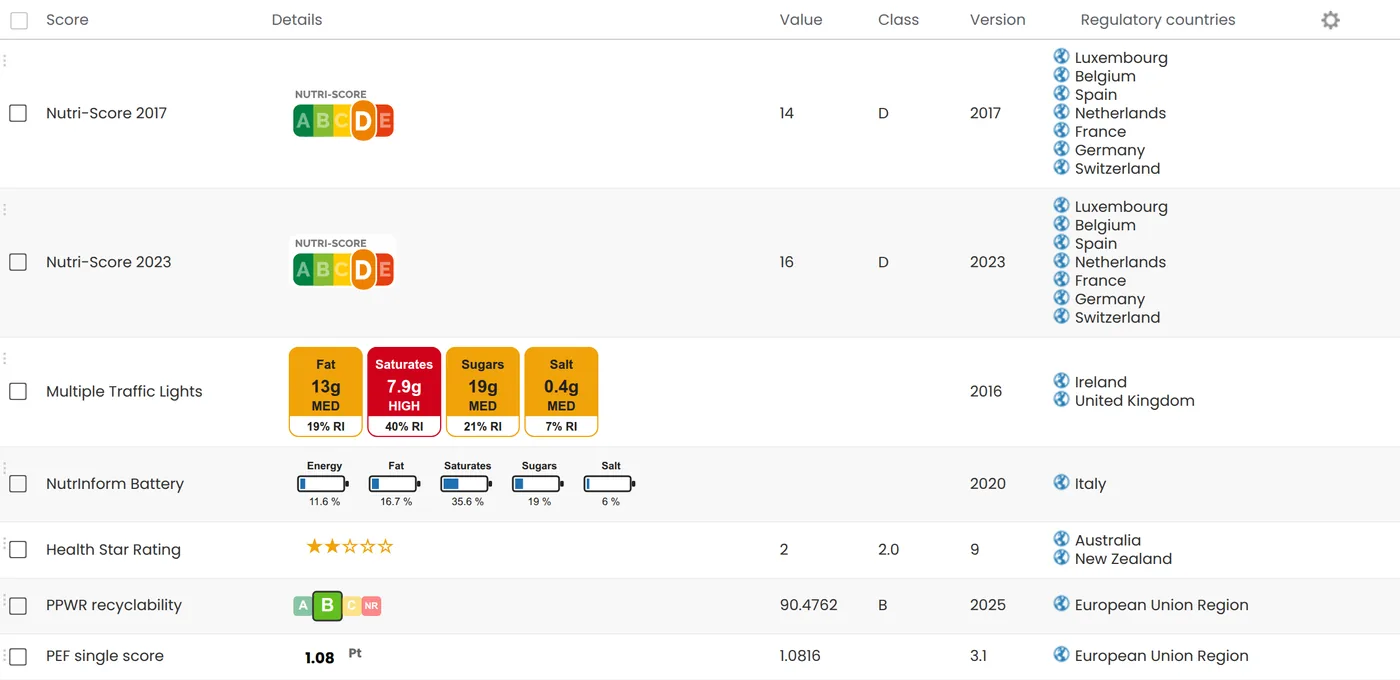
This is not an inconsistency. These scores do not measure the same thing: one speaks about environmental impact, the others about nutritional profile — and among those, some condense the product into one symbol while others break it down nutrient by nutrient.
Why they look nothing alike
Front-of-pack schemes fall into three families, and the family decides what a shopper does with them:
- summary ratings — a letter, a number, stars — which compress the whole product into one symbol and make products comparable;
- detailed displays — traffic lights, reference intake batteries — which pass no judgment and leave the reader to weigh each nutrient;
- warnings — octagons, magnifying glasses — which only appear above a threshold and say nothing when the product sits below it.
On top of that sits a less visible but more structural split: some scores are official, backed by legislation or a public program; others are private — a mobile app rating, an industry framework, a brand’s own internal score.
What actually separates one score from another
Behind every mark, four parameters are enough to describe it: the version of the scale, the engine that computes it, the output it produces, and whether it is official.
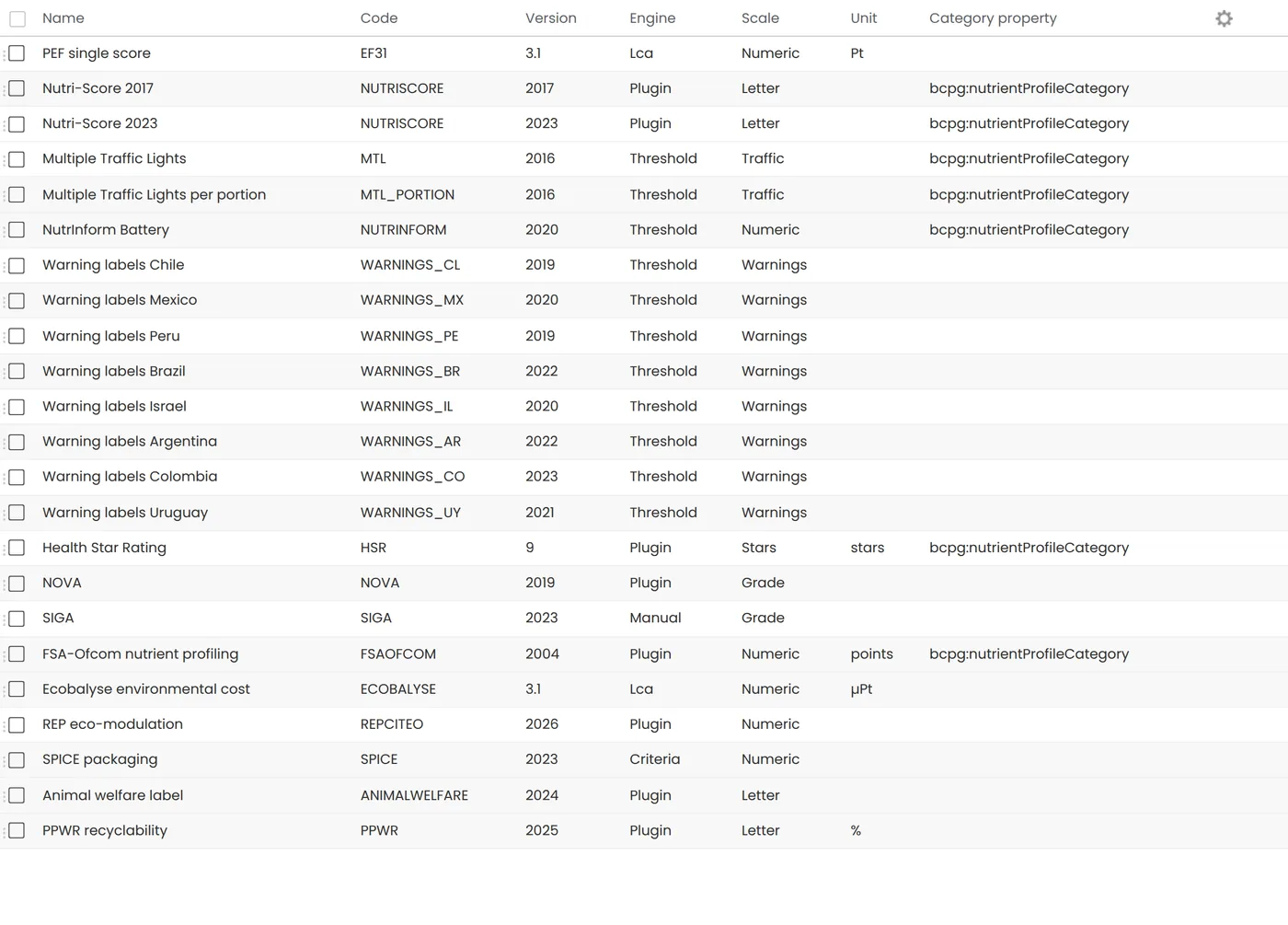
That table is what makes the whole set manageable. A score built on a complex regulatory algorithm needs a dedicated engine; a score based on per-nutrient thresholds is fully described by its thresholds; a score made of weighted criteria is written as formulas; an indicator entered by hand stays entered by hand. For a threshold- or criteria-based score, adding a mark usually means configuring rows in that reference data, without writing code.
One score can hide several
Some schemes do not stop at an overall grade: they expose the axes behind it, such as pesticides, biodiversity and climate for an environmental score. The axis often matters more to R&D than the grade itself.
When the headline rating slips, knowing which axis moved is what points reformulation in the right direction. A falling average does not tell you what to change; a sub-indicator does.
The real issue is the version
Scales change. The Nutri-Score algorithm has been revised, environmental frameworks ship successive versions, and warning thresholds tighten from one country to the next as they are reviewed. A score with no version number is a figure nobody can date or justify.
That is why every line carries its version and its year: when an auditor or a customer asks what a rating was based on, the answer is on the record. It is the same reflex described when the Nutri-Score algorithm changed — what matters is not recalculating, it is knowing what you displayed, and when.
Your products will carry more scores tomorrow than they do today. Better to decide now where they live. If you want to see what your own recipes return, let’s talk.