
The recipe changes in R&D, the label is updated, and Quality gives its approval. Three weeks later, the same product page on the retailer’s website is still displaying the old allergen list. And that is the information the consumer sees. The discrepancy does not appear on any of your screens. It only appears on theirs.
How can you avoid this gap between data validated internally and the information actually published? From the product repository to artwork approval, including Nutri-Score, we will explore how beCPG helps ensure reliable data at every stage and makes discrepancies easier to detect.
Discrepancies are not always visible from the inside
Once a product data sheet has been validated, it is distributed across many channels: retailer websites, marketplaces, scanning apps, or the file sent to the printer for final artwork approval. Each of these channels receives a copy at a given point in time.
These copies do not update themselves automatically. A discrepancy may only be discovered following a customer complaint, a report from a consumer association, or feedback from a retailer. In the worst case, it may lead to a recall.
Verification means comparing against a reference: but you need one first
Checking published information means being able to answer three questions for each value:
- what is the correct value today?
- when was it validated?
- which version of the rule was used to calculate it?
When data is spread across multiple files, ensuring that it matches the latest validated version becomes complex.
This is precisely the role of the product repository in beCPG: centralizing validated data and providing a common reference against which information published across different channels can be compared.
The calculated value is not the labeled value
Comparing published data with the product repository requires an important distinction: the value calculated in the PLM is not always the value displayed on the label.
In beCPG, both values are stored side by side. The calculated value is derived from the formulation, while the labeled value takes into account the rounding rules applied to nutritional information. Indeed, the values displayed on packaging are rounded according to the rules of Regulation (EU) No 1169/2011.
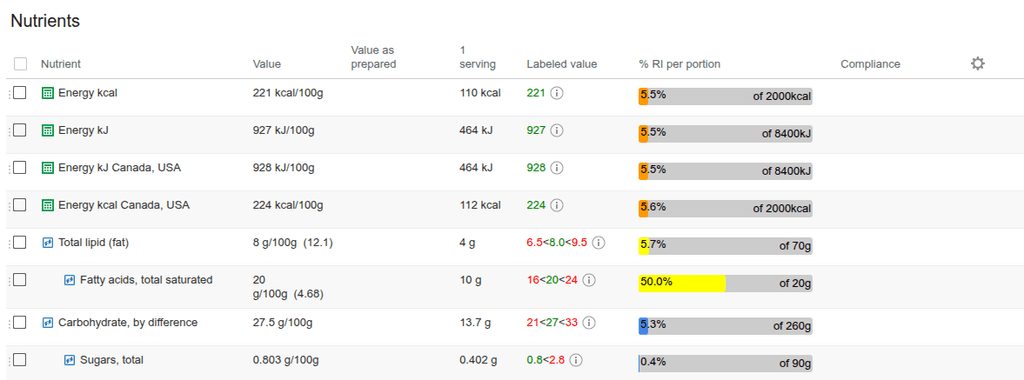
The same principle applies to the ingredient list. Information intended for labeling may include ingredient groupings, regulatory statements, or the highlighting of allergens
Nutri-Score: data that also depends on its version
The Nutri-Score calculation method has changed, and we previously explained what the new algorithm changes. As a direct consequence, a D calculated using the previous scoring system and a D calculated using the new one are not based on the same rules. A published score without any indication of the version used therefore becomes difficult to interpret and verify.
In beCPG, the score is associated with the information needed to understand how it was calculated: the profile used, the profile version and the nutritional score.
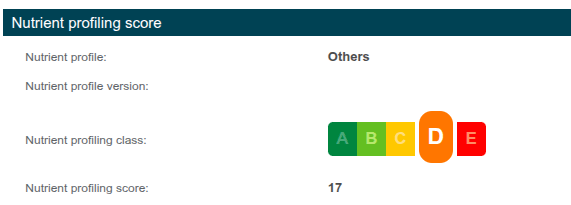
This approach also makes it possible to assess how a formulation change could affect the nutritional score. R&D teams can compare different scenarios and evaluate their impact on the Nutri-Score before validating a new formula.
Artwork approval: checking the label before printing
Before packaging is printed, final artwork approval is an essential step in ensuring that the information shown on the label matches the product’s validated data.
In beCPG, artwork approval is directly integrated into the product development process. Marketing, Quality, Regulatory and Packaging teams can work within the same workflow to review, comment on and approve the artwork. Different versions of the document are retained, making it possible to track changes throughout the approval process.
Teams can therefore rely on the data centralized in the product repository: ingredient lists, allergens, nutritional values and other labeling information. beCPG can also compare different versions of a document to make changes easier to identify.
The aim is not to replace human validation, but to detect discrepancies more quickly before printing. This is precisely the purpose of the graphic chain.
Compliance built on reliable data
From recipe development through to labeling, compliance depends first and foremost on reliable data.
By centralizing product information in beCPG, teams have a common reference for checking labeling, tracking changes to Nutri-Score and securing artwork approval.
AI and connected tools complement this approach by making it easier to detect discrepancies and perform certain checks. They do not replace the expertise of your teams. Instead, they allow them to focus on the situations that genuinely require their attention.
To explore what this could mean for your organization, contact us!
