Food & Agro-industriesCosmetics & HPCFormulationQualityProduct portfolio
How do you meet regulatory constraints while you formulate?
A banned additive, a preservative with a maximum level, a customer who only accepts EU-grown apples: a formula has to meet constraints from several sources. Checked once the recipe is frozen, they cost a trial, sometimes a batch. Checked with every change to the formula, they stop the error before it reaches production.
Three sources of constraints on one formula
A formulator works with three sets of rules that rarely sit in the same document:
- regulations in each market you sell to: permitted food additives and their levels, allergens to declare, restricted substances and preservatives in cosmetics;
- customer specifications: maximum salt content, required origin, refused additives;
- your own rules: ingredients to avoid, claims targeted for the range.
These rules change. In the European Union, for example, titanium dioxide (E 171) was removed from the list of authorized food additives by Regulation (EU) 2022/63, applicable since 7 August 2022 after a six-month transition. A one-off check is therefore not enough: a recipe that complied when it was approved may not comply today.
Turn each constraint into a requirement
A constraint can be checked once it applies to data in the formula: an ingredient, an allergen, a nutrient, a physico-chemical property. You also need to state what it triggers. beCPG uses four requirement levels:
| Level | Effect on the formula | Example |
|---|---|---|
| Forbidden | Alert as soon as the item is present, or above a maximum level | Additives E250 and E262(i) forbidden; an ingredient forbidden above 0.2 % |
| Tolerated | Alert without a ban, on presence or above a threshold | Preservative E252 accepted for cured meats only |
| Authorized | Positive list: anything not on the list is treated as forbidden | Only certain ingredient categories accepted in a market |
| Information | Informative message, no effect on compliance | Avoid pepper from a given origin |
In beCPG: specifications checked at every formulation
In beCPG, these rules are grouped in product specifications, the equivalent of customer requirement documents. A specification holds lists of requirements: forbidden allergens, nutrients and physico-chemical properties with a minimum or a maximum, claims, forbidden ingredients, and CLP hazard statements. For ingredients, you can also forbid GMOs, irradiation or certain geographical origins, and require an origin.
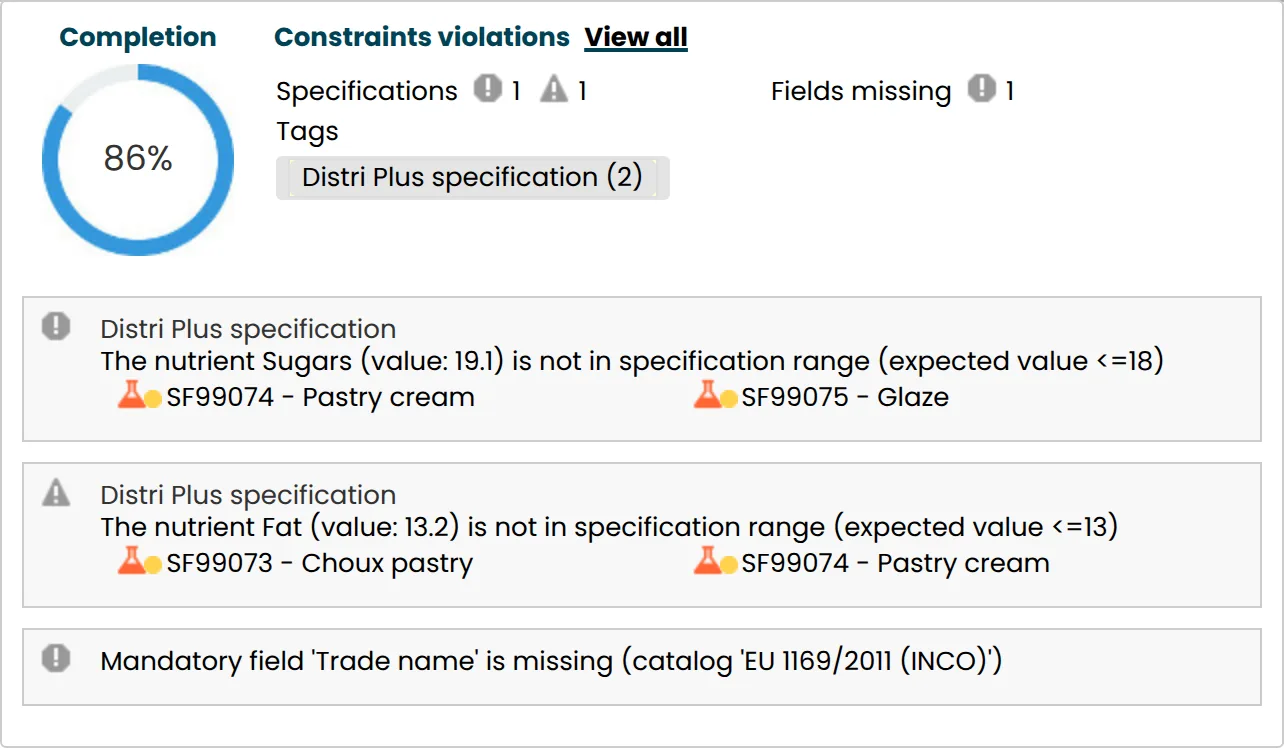
You link one or more specifications to the product in the "Specifications" field of its properties. At every formulation, beCPG compares the recipe with the requirements. An unmet requirement is shown on the line concerned, with the message you wrote, and in the product's completion wheel.
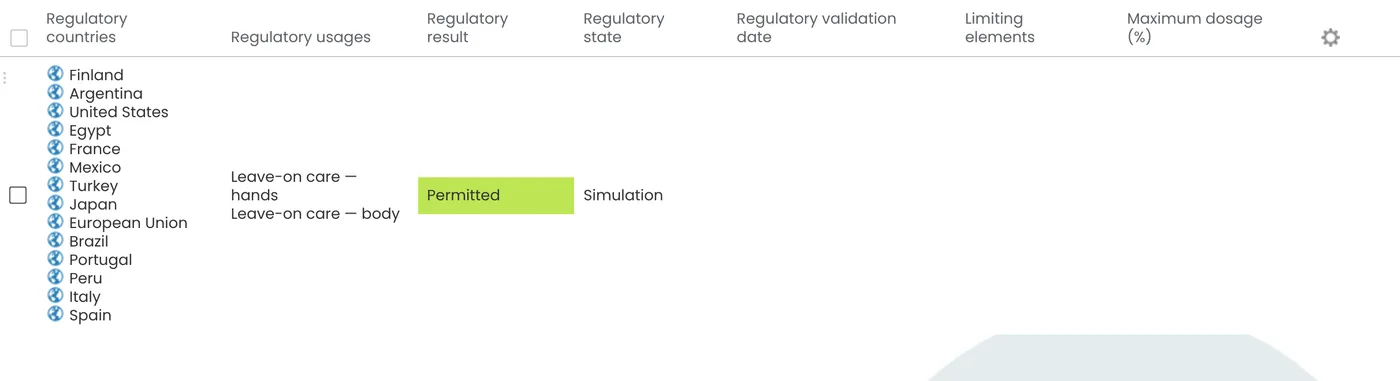
To check a formula against several markets, the "Compliance" list shows the result by country and regulatory usage. It relies on your specifications, on the beCPG regulatory module (optional) or on a connector to an external regulatory database. Our guide to checking a formula's regulatory compliance describes this approach.
When a raw material changes
The risk does not only come with new products. A supplier changes a raw material, a customer tightens its specification, and approved recipes stop complying. In beCPG, specifications are reformulated automatically every evening, and you can formulate a product again at any time.
Before replacing a raw material across several recipes, a change order simulates the change. The simulation lists the products whose requirements would no longer be met, for example a salt content that is too high, before you apply the replacement.

A constraint written once and checked at every change is worth more than a final review. Book a demo with one of your customer specifications.
Sources
- Regulation (EC) No 1333/2008 on food additives and Regulation (EU) 2022/63 on titanium dioxide (E 171)
- Regulation (EU) No 1169/2011 on the provision of food information to consumers
- Regulation (EC) No 1223/2009 on cosmetic products
Read more: discover regulatory compliance in beCPG PLM and our post on product specification management for food and beverages.
Frequently asked questions
What is the difference between a specification and a customer requirement document?
In beCPG, they are the same object. A product specification formalizes the requirements of a customer, a market or your company, and applies to every product linked to it.
Do you have to enter all regulations by hand?
No. You can enter your own requirements in specifications, use the optional beCPG regulatory module, or a connector to an external regulatory database. The three sources can be combined.
Where do unmet requirements appear?
On the line of the list concerned, with the message from the specification, and in the product's completion wheel. The component that caused the alert is shown, so you do not have to go through the whole bill of materials.
Do these checks work for cosmetics?
Yes. Specifications also cover ingredients with a maximum level, CLP hazard statements and allergen labeling thresholds, which differ for rinse-off and leave-on products.