Citeo packaging declaration in France: data, calendar and method
Updated October 2026.
In France, companies that place packaged products on the market finance the collection and recycling of household packaging, under extended producer responsibility (EPR). They join an approved producer responsibility organization, most often Citeo, and declare every year the packaging they placed on the market. This guide explains who declares, when, which data to collect and how to make it reliable. It applies to products sold in France.
Who declares, and when
- The producer is the company that places the packaged product on the French market. Since 2026, Citeo states that the companies that order the products, including for private labels, are always considered as the producers.
- The declaration covers the packaging of year N and is made between 1 January and 28 February of year N+1.
- Invoicing is quarterly, with an adjustment, above €5,000 of contribution, and once a year in December below.
What is declared
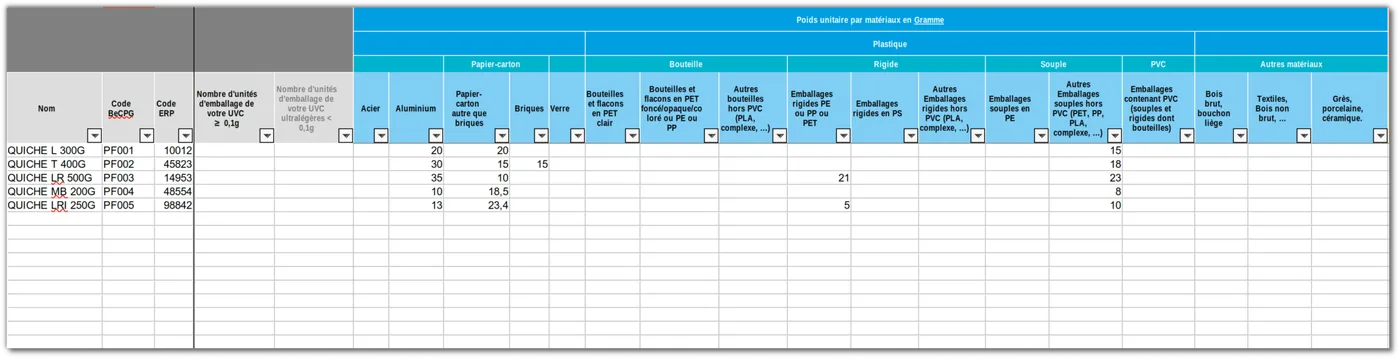
The contribution is based on the consumer sales units placed on the French market. For each unit, you need the weight of each packaging material, in the categories of the Citeo grid (steel, aluminum, paper and board, cartons, glass, plastics by resin and shape, other materials). The fee combines a rate per material weight and eco-modulation bonuses and maluses, which reward or penalize some packaging choices. Amounts change every year: refer to the rates published by Citeo.
Professional and food service packaging
- Food service packaging (cafés, hotels, restaurants): a dedicated scheme, operational since March 2024.
- Professional packaging (industrial and commercial): three organizations were approved in June 2026, and the scheme becomes operational on 1 January 2027. Transport and grouping packaging that does not reach consumers is concerned.
The European PPWR adds its own recyclability and recycled content requirements from 2030: see our article on the PPWR. The same packaging data serves both.
A method for a reliable declaration
| Step | What to do | Common error |
|---|---|---|
| 1. Describe each packaging | Components, materials and weights, per level (primary, secondary, tertiary) | Theoretical weight never checked |
| 2. Classify the materials | One Citeo category per material | Multilayer material in the wrong category |
| 3. Consolidate per sales unit | Weight per material for one unit sold | Multipacks and kits counted twice |
| 4. Reconcile with sales | Volumes of the year per unit (ERP) | Products discontinued during the year |
| 5. Keep the evidence | Dated specifications and supplier sheets | Packaging change not recorded |
Preparing the declaration with beCPG
In beCPG, the packaging of each product is described per level, with its components, materials and weights; the material list uses the Citeo categories. An Excel export gives, for each finished product, the unit weight of each material per sales unit, ready to combine with the sales volumes of your ERP. Since version 26.1, packaging is described as a multi-level bill of materials, the origin of materials rolls up to the finished product, and beCPG calculates the PPWR recyclability grade of each product.
Frequently asked questions
Does a private label declare its own packaging?
Yes: since 2026, Citeo states that the companies that order the products, including for private labels, are always considered as the producers.
Must transport packaging be declared?
Not in the household packaging declaration. It falls under the professional packaging scheme, operational on 1 January 2027.
Can theoretical weights be declared?
They must reflect the packaging actually placed on the market: check them by weighing or against supplier specifications, and update them at every change.
Go further: discover packaging and eco-design in beCPG PLM, and our life cycle assessment guide. Download the beCPG brochure.