Selling in Latin America: how many octagons on your label?
“Can we sell this in Brazil?” The question comes from sales, lands on the regulatory desk, and the honest answer is often “give me a week”. A good part of that week goes into one precise question: how many warning symbols will the product have to carry on the front of pack, and in which countries.
One device, eight variations
Chile led the way with its black octagons. The principle spread across the region and beyond: each country took the idea, then adapted it — the shape, the wording, the nutrients targeted and, above all, the thresholds.
The same product can carry three symbols in one country, two in the next and none in a third. Israel applies the same mechanism outside the region, with red symbols. This is not a matter of overall strictness: the thresholds and the nutrients in scope simply differ from one text to the next.
What triggers a symbol
These marks do not rate the product, they warn about it. A symbol appears when a level crosses a threshold on a short list of nutrients: sugars, saturated fat and sodium and, depending on the country, energy, total fat or trans fat.
The threshold is not expressed the same way everywhere. Chile, Peru, Brazil and Uruguay compare the content per 100 g or 100 ml with a fixed value. Mexico, Colombia and Argentina reason in share of energy: sugars and fats as a percentage of calories, sodium in milligrams per kilocalorie.
The consequence is blunt and useful at once: it is all or nothing. A product a hair below the threshold shows nothing; the same product a hair above shows the full octagon. There is no half measure and no offsetting by a favorable ingredient — unlike a summary rating where fiber buys back sugar.
Sodium, country by country
Sodium shows how far apart the countries are. With 437 mg of sodium per 100 g, our quiche exceeds the 400 mg of Chile and Peru, and the 300 mg of Mexico, Colombia and Argentina. It stays under Uruguay’s 500 mg and Brazil’s 600 mg: five countries out of seven require the sodium octagon.
| Country | Wording | Sodium threshold | Regulation |
|---|---|---|---|
| Chile | ALTO EN SODIO | more than 400 mg/100 g; more than 100 mg/100 ml | Supreme Decree 13/2015 |
| Peru | ALTO EN SODIO | 400 mg/100 g or more; 100 mg/100 ml or more (second phase) | Supreme Decree 017-2017-SA (phase dates to be confirmed) |
| Brazil | ALTO EM SÓDIO (magnifying glass) | 600 mg/100 g or more; 300 mg/100 ml or more | ANVISA IN 75/2020 |
| Uruguay | EXCESO SODIO | more than 500 mg/100 g; more than 200 mg/100 ml | Decree 34/021 |
| Mexico | EXCESO SODIO | 1 mg/kcal or more, or 300 mg/100 g or more; no-calorie beverages: 45 mg/100 ml or more | NOM-051-SCFI/SSA1-2010 as amended in 2020 |
| Colombia | EXCESO EN SODIO | 1 mg/kcal or more, or 300 mg/100 g or more; no-energy beverages: 40 mg/100 ml or more | Resolution 810 of 2021, amended by Resolution 2492 of 2022 |
| Argentina | EXCESO EN SODIO | 1 mg/kcal or more, or 300 mg/100 g or more; no-calorie beverages: 40 mg/100 ml or more (rule taken from the ANMAT manual, to be confirmed against the decree) | Law 27.642 and Decree 151/2022 |
Several regulations also only cover products to which the nutrient of concern was added: salt, sugar or fat. beCPG compares the contents with the thresholds; the regulatory team still has to check that added-ingredient condition.
Brazil chose the magnifying glass
Brazil applies the same threshold logic with a different symbol: a magnifying glass carrying the words “ALTO EM”, placed on the front of pack according to the positioning rules set by ANVISA. An exporter who has prepared a Chilean file cannot simply copy it across: the calculation starts again, with different thresholds and a different rendering.
Each country also has its own edition of the scale, revised on its own timetable. A warning computed two years ago may no longer match the text in force.
Remove one, or accept it
Once the number of symbols is known, the decision is as commercial as it is technical. Reformulating to drop back under a threshold has a cost — recipe, taste, cost price — and that cost is only justified if removing the symbol changes something about the listing you are after.
Making that call requires knowing by how much you are over, country by country. Being a few percent above and being double the limit do not lead to the same decision, and that information appears nowhere on the symbol itself.
The symbol is only the visible part of the file
Warning labeling is one of several questions a new market opens. Behind it come the status of each ingredient in the target country, the applicable limits, the statements to carry and the regulatory citation behind the decision.
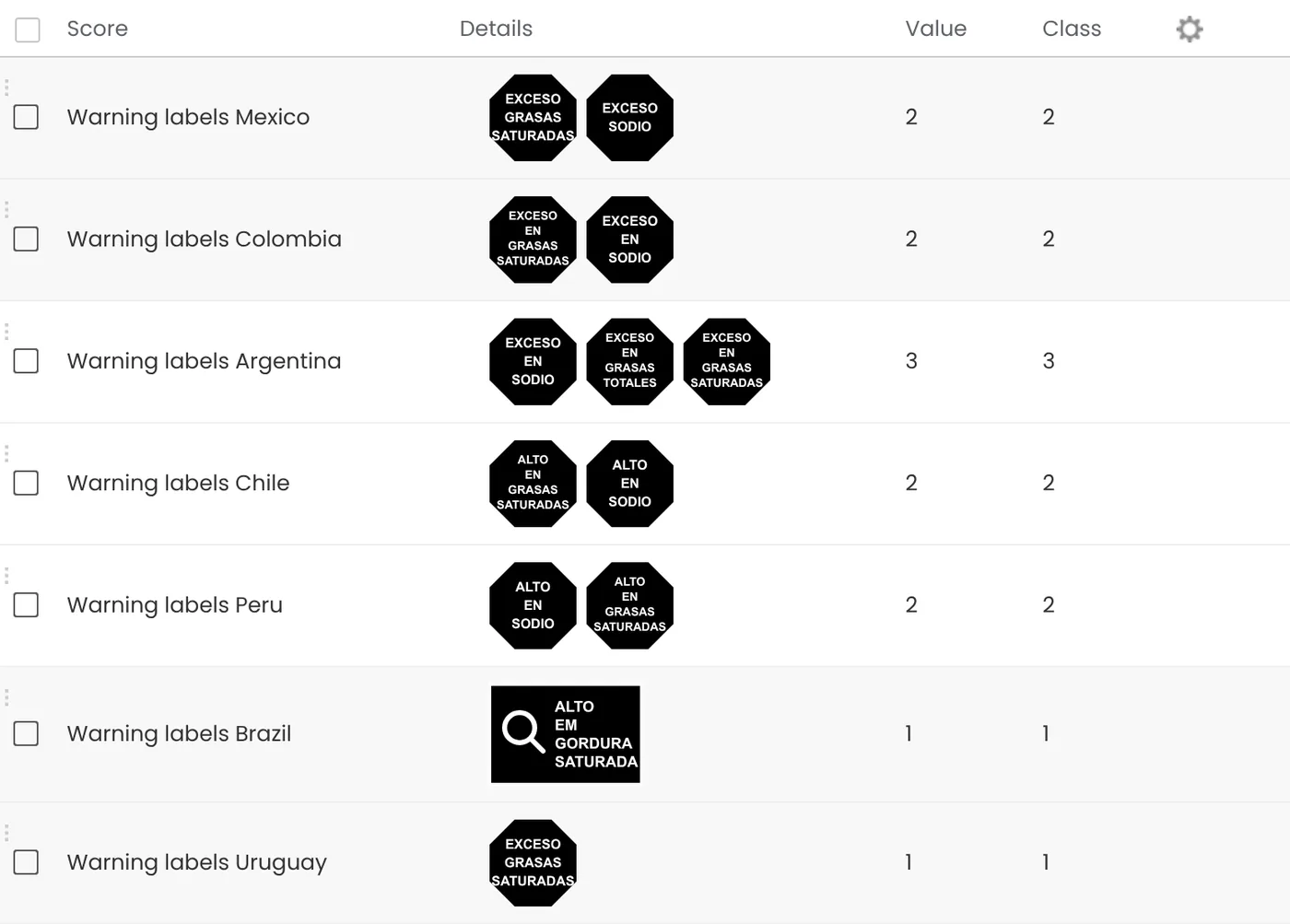
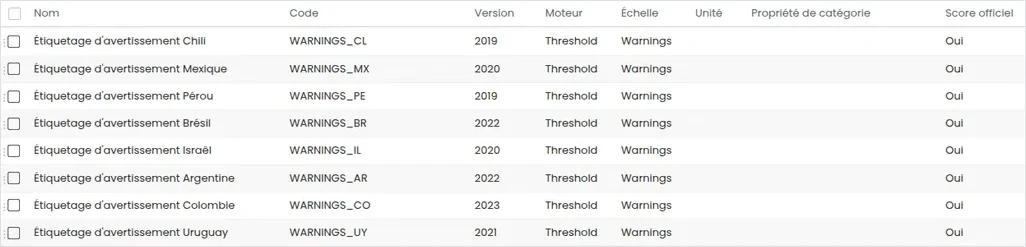
What saves the week is that thresholds and statuses are already there, attached to the market. Since version 26.1, beCPG calculates these warning labels at formulation, market by market (Chile, Mexico, Peru, Uruguay, Brazil, Argentina, Colombia, Israel), and shows them in the Scores list of the product, with the detail of the calculation. “Can we sell this in Brazil?” then becomes a formulation run rather than an investigation.
See also how beCPG calculates the Brazilian nutrition declaration and handles regulatory compliance. If you want to see how many symbols your references would carry, let’s talk or download the brochure.