Food & Agro-industriesFormulationQualityTechnical data sheets
US Nutrition Facts label: how to calculate it (FDA guide)

Updated October 2026.
The Nutrition Facts label is the US counterpart of the European nutrition declaration. It is governed by the Food and Drug Administration (FDA), in 21 CFR 101.9, and it differs from the European table on almost every point: values per serving instead of per 100 g, different mandatory nutrients, calories only, specific rounding rules and percentages of daily value. This guide explains what the label must contain, how to calculate it and what changes between 2025 and 2028.
The current label: the 2016 FDA rule
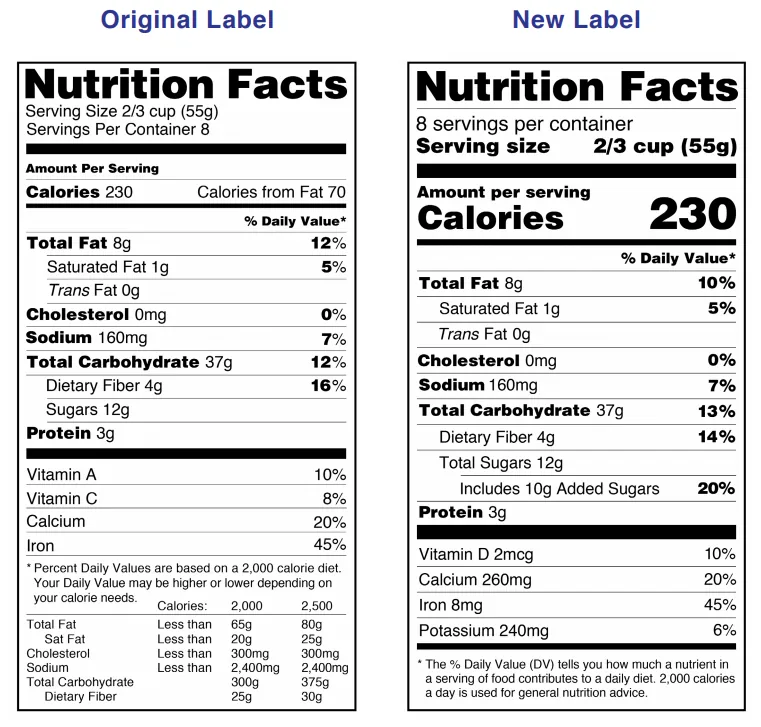
The FDA updated the label by a final rule published on 27 May 2016. After an extension decided in 2018, manufacturers with annual food sales of 10 million dollars or more had to comply by 1 January 2020, and smaller manufacturers by 1 January 2021. The main changes:
- calories and serving size in larger, bold type;
- serving sizes updated to the amounts people actually eat (for example ⅔ cup of ice cream instead of ½ cup, 12 fl oz of soda instead of 8);
- added sugars declared in grams and as a percentage of daily value;
- vitamin D and potassium now mandatory, with calcium and iron, in actual amounts and in % DV; vitamins A and C become optional;
- daily values updated, and “Calories from fat” removed;
- a new footnote that explains what the % Daily Value means.
Step 1: define the serving
Every value of the label is given per serving. The serving is set from the reference amounts customarily consumed (RACC) of 21 CFR 101.12, for each food category, and expressed in a household measure (cup, tablespoon, piece) with its metric equivalent. The number of servings per container follows from the net quantity.
- A package that contains less than 200% of the reference amount is labelled as a single serving.
- Between 200% and 300%, a dual-column label is required: per serving and per package.
- Define the serving size and the number of servings before any calculation: everything else depends on them.
Step 2: gather the nutrients
The US label asks for nutrients that the European declaration does not: trans fat, cholesterol, added sugars, vitamin D, calcium, iron and potassium. For a product sold in both markets, these values must be available for every raw material, from supplier data or from a food composition database such as the USDA one.
| Nutrient | United States (FDA) | Canada | European Union (1169/2011) |
|---|---|---|---|
| Energy | M (calories) | M (calories) | M (kJ and kcal) |
| Fat | M | M | M |
| Saturated fat | M | M (with trans) | M |
| Trans fat | M | M (with saturated) | |
| Cholesterol | M | M | |
| Sodium | M | M | salt |
| Carbohydrate | M | M | M |
| Dietary fibre | M | M | o |
| Total sugars | M | M (with % DV) | M |
| Added sugars | M | ||
| Protein | M | M | M |
| Vitamin D | M | o | o |
| Calcium | M | M | o |
| Iron | M | M | o |
| Potassium | M | M | o |
| Vitamins A and C | o | o | o |
M: mandatory; o: optional (mandatory when added or when a claim is made); empty: not declared.
Step 3: calculate, round and compare with the daily values
Values are calculated for the serving, then rounded with the FDA rules of 21 CFR 101.9(c). A few examples:
- calories: under 5 declared as 0, to the nearest 5 up to 50, to the nearest 10 above;
- total fat: under 0.5 g declared as 0, to the nearest 0.5 g below 5 g, to the nearest gram above;
- sodium: under 5 mg declared as 0, to the nearest 5 mg from 5 to 140 mg, to the nearest 10 mg above.
Each nutrient is then expressed as a percentage of its daily value, based on a 2,000-calorie diet. Finally, the declared values must hold against laboratory analysis: under 21 CFR 101.9(g), added vitamins and minerals (class I) must reach at least 100% of the declared value, naturally occurring nutrients (class II) at least 80%, and calories, fat, sugars or sodium must not exceed 120%.
Which format to print?
The layout of the panel is regulated too: type size and weight, rule thickness and the hierarchy of information are part of the requirements. Having the right values is not enough: they must be laid out in one of the formats provided by the FDA.
Several layouts, and not for aesthetic reasons
The FDA does not offer several variants to give designers a choice. Each answers a product or packaging situation:
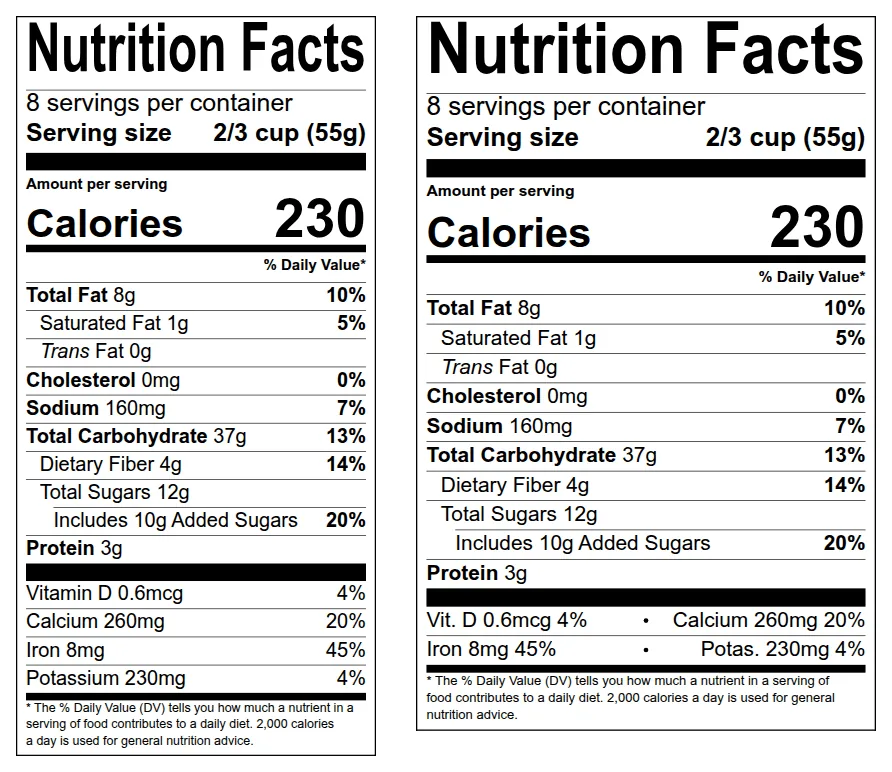
- the standard vertical panel, the default;
- the tabular and linear formats, when the label surface cannot take the vertical panel;
- the simplified format, when several nutrients are present only in insignificant amounts;
- the side-by-side micronutrients and dual column layouts, for particular presentations.
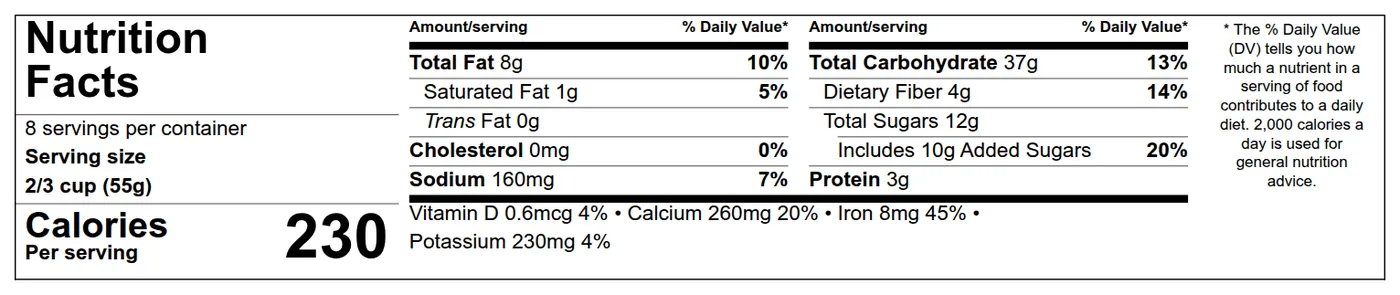
The tabular panel above carries exactly the same values as the vertical one: same product, same formulation, different layout. Available label space decides, not brand preference.
When the package requires two columns
In some situations, US rules require a dual-column panel: values are shown per serving and per container, for example for a package holding two to three reference servings.
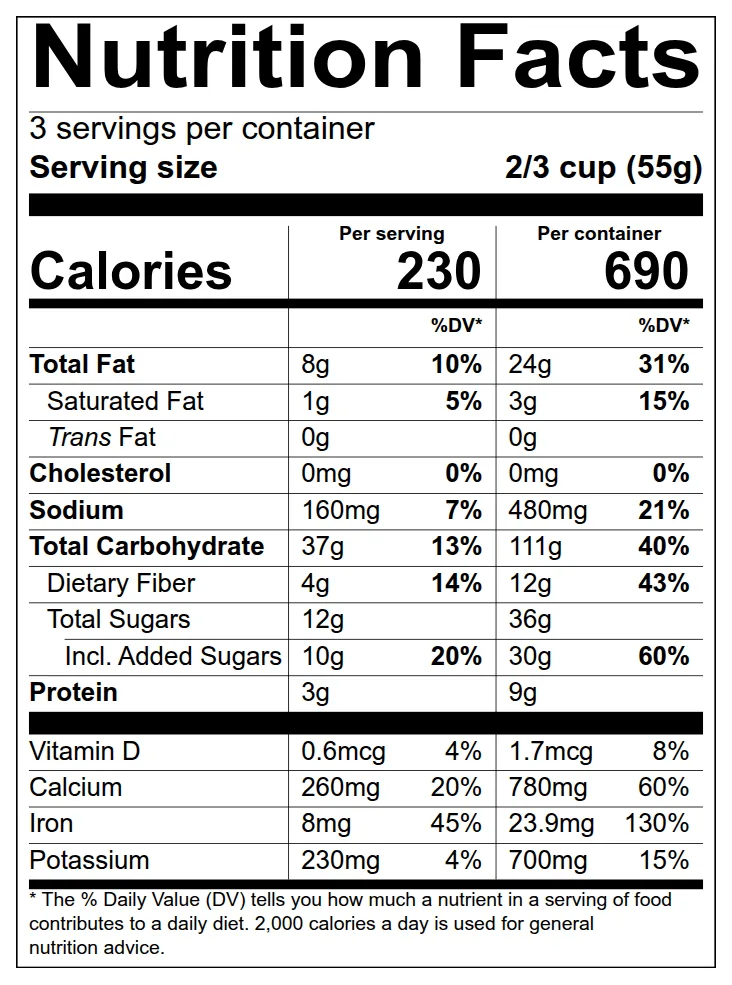
This format doubles the number of values to produce and check. Done by hand, it increases the risk of error, all the more as the daily value percentages differ from one column to the other.
What changes in 2025-2028
- “Healthy” claim: the FDA final rule of December 2024 redefines when a food can be labelled “healthy”, from food groups and limits on saturated fat, sodium and added sugars. It took effect on 28 April 2025; compliance is required by 25 February 2028. FDA announcement.
- Front-of-package “Nutrition Info box”: the FDA proposed on 16 January 2025 a box on the front of the pack giving saturated fat, sodium and added sugars per serving, each rated Low, Med or High. As of October 2026, it is still a proposed rule, without a final text or compliance date. FDA page.
How beCPG produces the Nutrition Facts label
In beCPG, the nutrients of each raw material come from your suppliers or from a composition database (USDA, CIQUAL…). Formulation calculates the values of the finished product per 100 g and per serving, taking losses and yield into account, applies the US rounding rules and the daily values, and shows the FDA tolerances next to each labelled value.
Since version 26.1, the label itself is generated in the technical sheet and in the labelling rules, as a vector image ready for print, in the FDA formats: standard vertical, tabular, linear, simplified, dual column and side-by-side micronutrients. When a raw material or a recipe changes, the label is recalculated.
To sell in Canada as well, see our guide to the Canadian Nutrition Facts table and front-of-package symbol; for Europe, the guide to Regulation (EU) No 1169/2011.
Frequently asked questions
Can I convert a European nutrition table into a US label?
Not directly. The US label is per serving, uses calories only, declares sodium instead of salt and needs nutrients the European table does not contain (trans fat, cholesterol, added sugars, vitamin D, potassium). The values must be recalculated from the recipe, then rounded with the FDA rules.
Do I have to declare added sugars?
Yes, in grams and as a percentage of the daily value of 50 g. Added sugars include sugars added during processing, syrups, honey and concentrated fruit juices beyond what the same volume of 100% juice would contain.
Is a laboratory analysis mandatory?
No, the label can be calculated from the recipe. But the declared values must pass the FDA compliance test on analysis, so a calculation from reliable raw material data, checked by analysis, is the usual practice.
Going further
Nutrition is only one part of compliance: see our guide how to check the regulatory compliance of a formula, and how beCPG handles regulatory compliance and formulation. Download the beCPG brochure.
Sources: FDA, Changes to the Nutrition Facts Label; 21 CFR 101.9.