How to score and select new product ideas
Updated October 2026.
Most new product ideas should never become projects. The difficulty is to tell which ones, early, before R&D time and trial budgets are spent. A simple, shared scorecard does most of the work.
1. Collect every idea in one place
Ideas come from everywhere: customer and retailer requests, sales, R&D, trends, complaints, cost reduction. Record each one with its origin, its type (new product, renovation, line extension, private label) and a sponsor. An idea without an owner is not reviewed.
2. Screen with a few must-have criteria
Before scoring, remove the ideas that fail a mandatory condition. Answer by yes or no:
- Does it fit the strategy and the brands?
- Is it allowed in the target markets (ingredients, claims, labeling)?
- Can the plants produce it, or with which investment?
- Is there a customer, a channel or a retailer for it?
3. Score the remaining ideas with weighted criteria
Keep five to seven criteria, scored from 1 to 5, with weights agreed once by Marketing, R&D, Quality and Finance. An example for food and cosmetics:
| Criterion | Weight | Question |
|---|---|---|
| Market attractiveness | 25 % | Size, growth and price level of the segment |
| Strategic fit | 20 % | Brand, channel, existing ranges |
| Technical feasibility | 15 % | Formulation, process, shelf life or stability |
| Margin | 15 % | Target cost against expected selling price |
| Regulatory risk | 15 % | Ingredients, claims and labeling in each market |
| Time to market | 10 % | Can it launch in the targeted window? |
The score ranks the ideas; it does not decide alone. Write down the reason for each decision, so that the team can come back to it.
4. Balance the portfolio
A list of the best scores can still be a bad portfolio: only renovations, or only risky innovations, or too many projects for the same team. Look at the selection as a whole: mix of project types, risk, workload per team and launch dates.
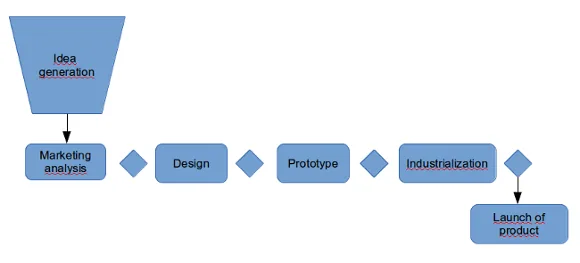
5. Decide at each gate: go, kill, hold or rework
A score is not final. Update it at each gate with what the project has learned: first trials, real cost, customer feedback. Stopping a project at the feasibility gate costs far less than after the industrial trials.
Mistakes to avoid
- Scoring without weights agreed beforehand: each meeting re-opens the debate.
- Too many criteria: the score no longer separates the ideas.
- Never killing a project: the pipeline fills up and every launch slips.
- Discovering the regulatory risk at the end: check ingredients and claims at the screening stage.
In beCPG
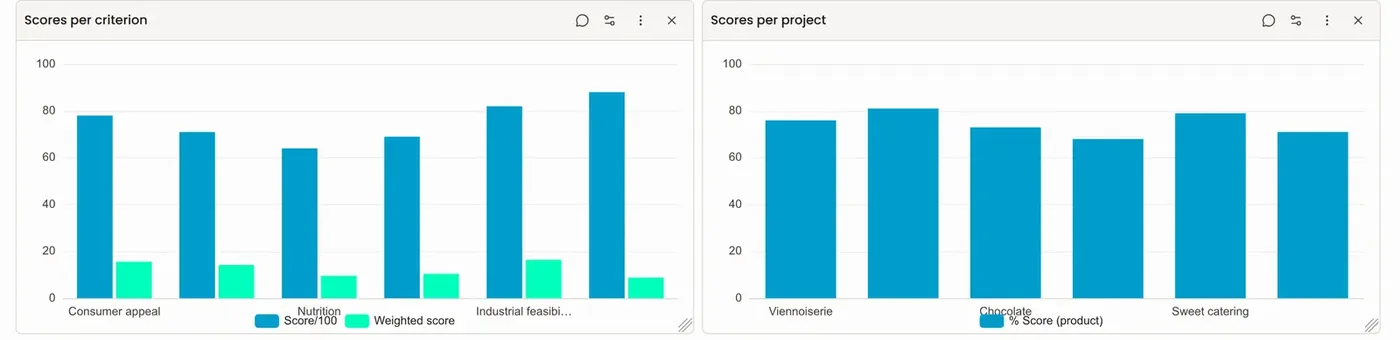
Project templates include an evaluation grid with questions, answers and scores, completed at each stage. The project overview shows the scores of every project side by side, and dashboards analyze the portfolio by family, customer or stage. Discover project management in beCPG PLM.