
One product, five markets, five nutrition labels

The same drink: rated E in France, D in Singapore, carrying black octagons in Chile, traffic lights in the United Kingdom and one and a half stars in Australia. The product did not change — only the country it is sold in did. For an R&D team the hard part is not computing a score. It is knowing which one will move when the recipe does.
The same product tells a different story per country
The market column is the most instructive part of the record. Below are the scores of a dark chocolate éclair: Nutri-Score D in Europe, octagons in Chile, two stars in Australia. The column says which mark applies where. A score is not a property of the product, it is a property of the product-market pair.
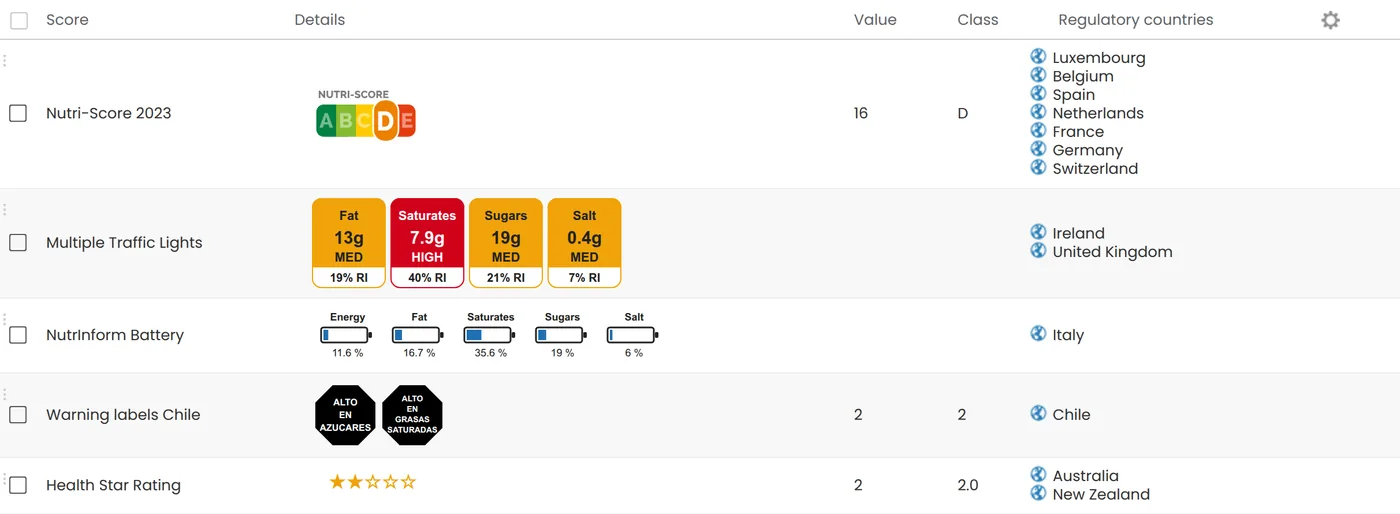
The Nutri-Score covers several European countries, traffic lights are a UK scheme, the reference intake battery is Italian, and Singapore’s Nutri-Grade currently covers drinks only (an extension to salt, sauces, seasonings, instant noodles and cooking oils is planned from mid-2027). A range exported to ten countries does not carry the same symbol ten times: it carries different symbols, over different scopes.
Three ways of saying the same thing
Nutritional schemes follow three logics, and they do not react to reformulation in the same way:
- the summary rating — letter or stars — balances nutrients to limit against favorable components; adding fiber or vegetables can offset sugar;
- the detailed display — traffic lights, batteries — offsets nothing: every nutrient is judged on its own, and cutting salt will never turn the sugar light green;
- the warning — Latin America’s octagons — works on a threshold: either you drop below it and the symbol disappears, or you stay above and it stays whole.
That is what makes multi-market reformulation awkward: the same change improves a summary rating, does nothing to a traffic light, and removes an octagon only if it crosses the threshold.
Watching every score move at once
This is the point of keeping every mark on the same record: a recipe change is formulated once, and all the scores recalculate. You see in the same pass what you gain in one market and what you lose in another, before deciding.
Without it, each score lives in its own file, computed on a different date, against a different version of the scale — and nobody can say whether the five ratings on display still match the formula in production.
All these scores start from the same nutritional values calculated from the formula, the ones that also feed regulatory panels such as the US Nutrition Facts label. That is the job of the formulation module in beCPG.
The scores nobody obliges you to carry
Alongside official schemes sit ratings nobody asked for and consumers still read: processing-level classifications, ultra-processing indices, mobile app scores. They carry no regulatory weight so far, and they move product on shelf anyway.
Tracking them is the same gesture as tracking an official score: compute them on your own data, rather than discovering the rating at the same time as the shopper.
Adding the next market
Every new market brings its own mark. The question put to the team is never “can we compute this score?” but “how long will it take?”.
When scales, thresholds and outputs are reference data, adding a country means adding rows. When they are code, it means a release.
You do not get to choose between schemes — your markets choose for you. You do get to choose to compute them all in one place. If you want to see what your own recipes return, let’s talk.