Three questions to ask any PLM vendor about their AI
AI assistants are arriving in PLM software. On a demo, they look alike: you ask a question, a confident answer appears.
The difference shows up later, when an auditor asks how a value was produced. Here are the three questions that surface it before you sign.
1. “Which of your calculations involve a language model?”
A language model does not calculate. It predicts the most plausible next words. That is ideal for a product description and unacceptable for an allergen declaration.
Ask which outputs go through the model. If nutritional values, labeling, claims or regulatory status are on that list, ask the follow-up: how do you reproduce a value from six months ago? A system that cannot answer the same question twice with the same number is a system you will have to defend by hand.
In beCPG, none of those involve a model. Nutri-Score, ingredient and allergen labeling, QUID, CLP classification and cost optimization under constraints are computed by deterministic engines. AI is used where a mistake costs a correction, not a recall: reading a supplier data sheet, searching, drafting, translating. See how beCPG governs its AI.
2. “Can I see the source behind a compliance decision?”
Not a summary. The regulation, the article, and the date of the version used.
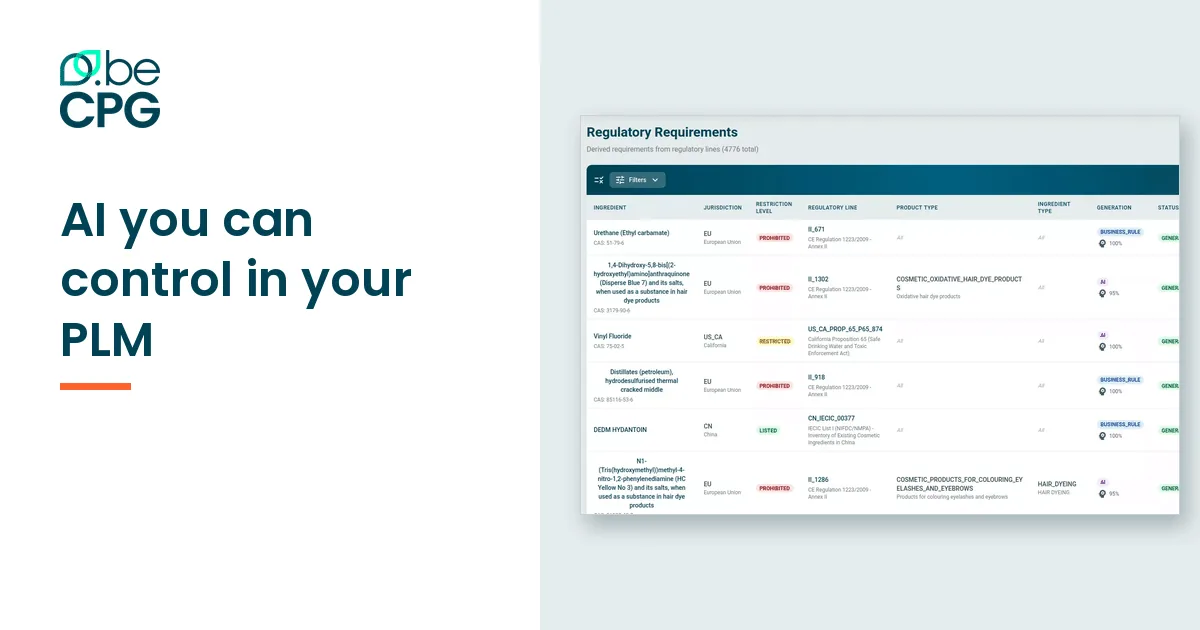
A coverage figure tells you how many countries or substances are handled. It does not tell you which text a given decision rests on, and that is what an auditor asks for.
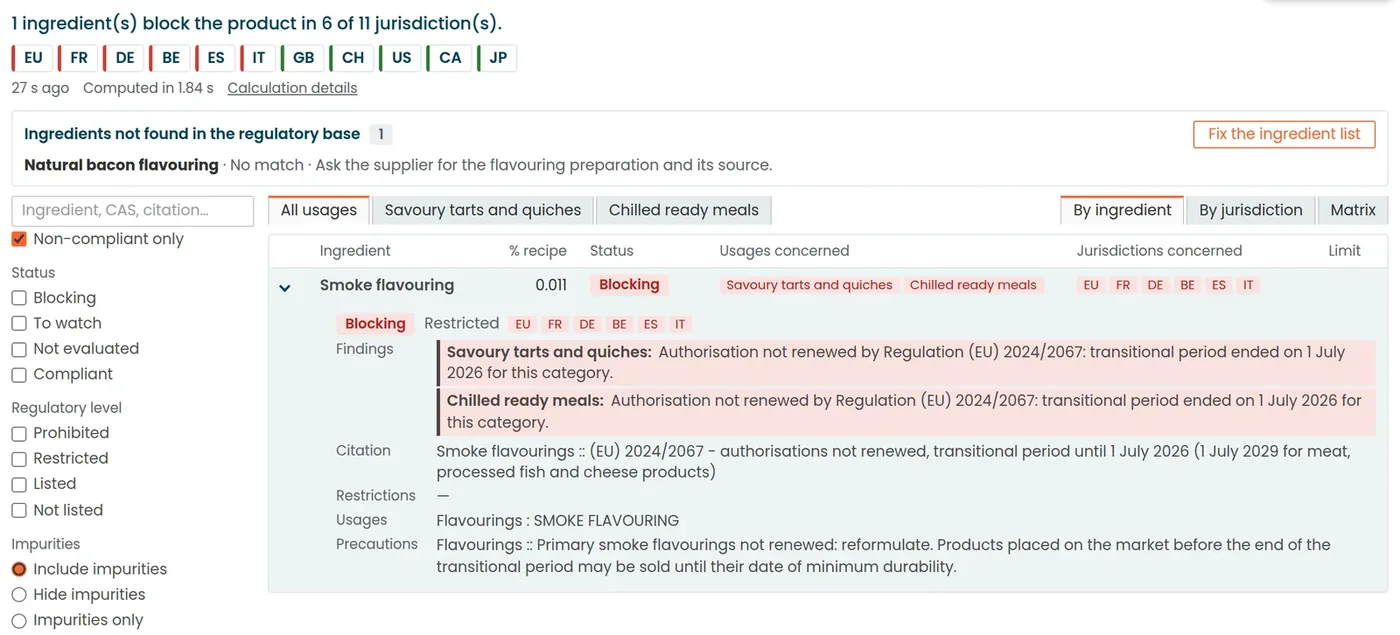
In beCPG, every ingredient decision of the regulatory view carries its regulatory citation, the limit that applies and the market concerned. When an auditor asks what a decision relied on, that is one click rather than one week.
3. “Can our own AI assistant call your system?”
Your teams already use an assistant. It knows everything except your products.
If the answer is no, your teams will copy data from one tool to the next, or work around the PLM.
beCPG can be called — Claude, Gemini or your own agent, through the MCP standard, with the permissions of the person who connected, and with changes that go through suggestions.
What this actually buys you
Faster work on everything that is tedious, and no new risk on anything that is legal. That is what it takes for AI in a PLM to survive an audit. Discover Chef AI, the beCPG AI assistant.
Bring us a formula and a target market — we will show you the answer and where it comes from.
Book a 30-minute demo · Download the brochure
beCPG is the open source PLM for food, beverage and cosmetics, used by more than 100 manufacturers. Chef AI and the regulatory module ship with version 26.1.
Frequently asked questions
Does beCPG use AI to calculate nutritional values or labeling?
No. Nutritional values, Nutri-Score, ingredient and allergen labeling, QUID, CLP classification and cost optimization are calculated by the deterministic beCPG engines: the same data always gives the same result.
What is AI used for in beCPG?
For tasks where a mistake costs a correction: reading a supplier data sheet to pre-fill a raw material, searching, drafting descriptions, translating, comparing an artwork with the product data. Every proposal is a suggestion that a user validates.
Can we connect our own AI assistant to beCPG?
Yes, through the beCPG MCP server: Claude, Gemini or your own agent work with the permissions of the connected user, and changes go through suggestions, applied according to the policy set for your instance.