Generative AI and PLM: speeding up product development

Generative AI built into PLM is gradually changing new product development. Yet a large share of the time still goes into repetitive tasks: entering supplier data, writing product sheets, translating, correcting and proofreading content.
The goal is not to replace the expertise of formulators, product managers or regulatory teams. It is to let them focus on what actually creates value.
Chef AI, the assistant built into beCPG
That is why beCPG includes Chef AI, its conversational assistant. Available as a chat and as a suggestions panel on your products and documents, it supports your teams throughout product development.
Drafting content faster
Launching a new product means producing a lot of content: marketing descriptions, sensory profiles, product names and more.
Starting from the data already in the PLM, the AI drafts a first version. It uses the product’s characteristics to suggest content that fits the context:
- in food, a marketing description, a sensory profile (color, texture, flavor, odor) or a product classification;
- in cosmetics, marketing messages that highlight the product’s benefits, or a sensory profile.
Teams get a working draft that they enrich and approve before it is published.
Illustrating a product concept
Before a prototype exists, a first visual often helps. Once the option is enabled, Chef AI can suggest an illustration for the product, which teams share with the other people on the project.
Cutting re-keying
Teams still spend a large part of their time entering and checking data. The AI takes on part of that work to reduce re-keying and improve data quality. It can, for example:
- extract data from a supplier technical data sheet to pre-fill a raw material: ingredients, allergens, nutrients, technical characteristics;
- suggest translations of product sheet fields into several languages, to prepare international launches;
- correct the spelling of entered content;
- detect allergens from the composition.
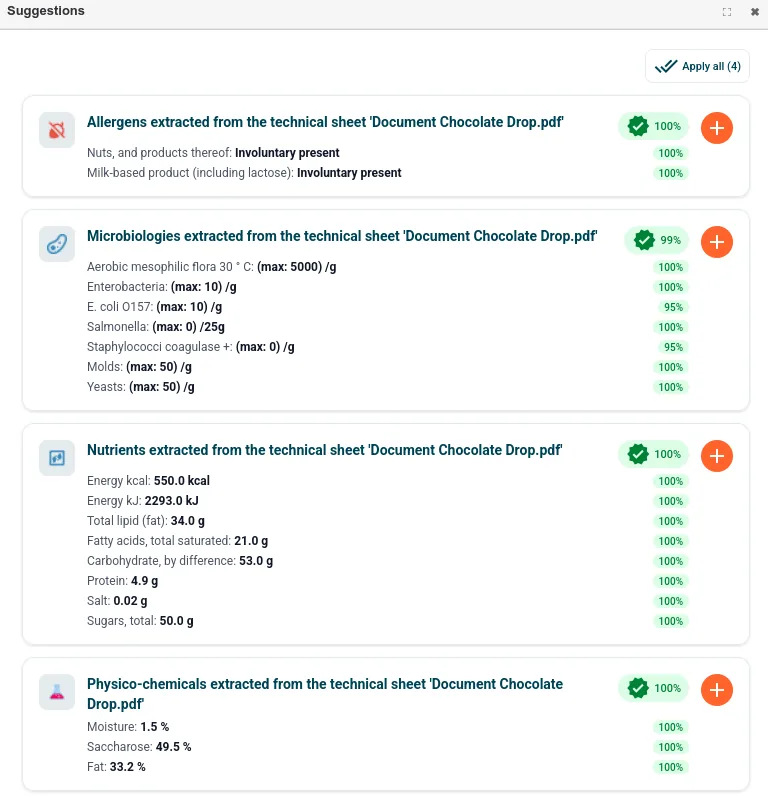
All these suggestions rely on PLM data and are approved by users before they are saved.
Supporting decisions
The AI does more than generate content. It also helps teams decide. It can, for example:
- analyze a recipe’s composition and its costs;
- optimize the cost of a recipe under constraints, using the beCPG solver;
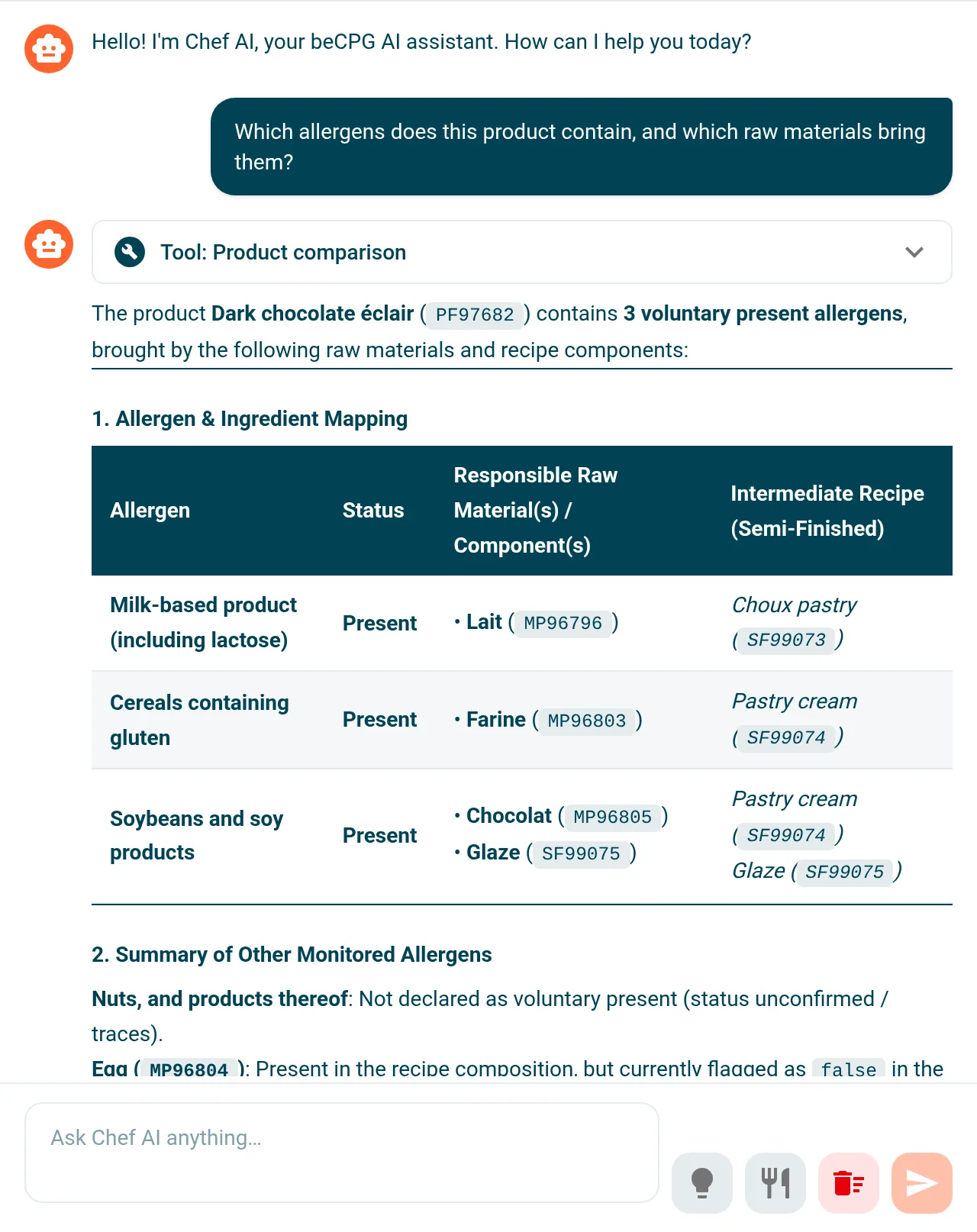
- compare several products, or create a project, a product or a packaging item from a brief.
Securing compliance and documentation
On regulatory and document work, the AI can:
- answer a regulatory question and check a product’s compliance using the regulatory module;
- compare packaging artwork with its specification to spot discrepancies;
- find a specific piece of information in a technical data sheet or a long PDF.
Calculations with regulatory weight do not go through the AI: nutritional values, labeling and CLP classification stay with the beCPG engines. See how beCPG governs its AI.
Running projects
Chef AI also supports project managers. It finds ongoing projects, shows priority tasks, displays a schedule and analyzes a team member’s workload. Project managers spend less time on administration and more on steering.
AI at the heart of the PLM
The strength of AI in beCPG lies in its integration with the PLM. It draws on the product data, formulations, suppliers, projects, technical documents and regulatory reference data already in the application.
Users stay in control of the information: every proposed creation or change is a suggestion, saved only once approved, then tracked like any other change.
For technical teams, beCPG also exposes its tools through its MCP server (Model Context Protocol). Your work assistants, such as Claude or Cursor, connect to the PLM with each user’s permissions.
This approach cuts repetitive tasks and improves data quality, while keeping a single source of truth in the PLM. For a personalized demo, contact us.