Food & Agro-industriesFormulation
From a 5-color nutrition scale to the Nutri-Score: what changed
In 2014, a report to the French Minister of Health proposed a five-color nutritional quality scale on the front of food packs. Three years later, it became the Nutri-Score, now recommended in seven European countries. Here is how the label came about, what has changed since, and what it means for your recipes today.
2014: a five-color scale for French nutrition policy
France has run a National Nutrition and Health Program (PNNS) for public health nutrition policy. In January 2014, its chair, Professor Serge Hercberg, submitted a report with proposals to relaunch that policy. One of them was a single, simple nutrition label on the front of food packaging.
The proposal worked in two steps, which the Nutri-Score still follows:
- a nutritional score common to all foods, derived from the nutrient profiling model of the UK Food Standards Agency;
- a five-class scale, each class with its own color, that translates the score for shoppers.
As early as 2014, manufacturers could assess their ranges against this model and prepare for the health law then being drafted in France.
From proposal to official label
| Date | Milestone |
|---|---|
| January 2014 | Hercberg report proposes a five-color nutrition scale |
| 2015 | The French High Council for Public Health adjusts the score for cheeses, added fats and beverages, and sets the thresholds of the five classes |
| 26 January 2016 | French health law allows the mandatory nutrition declaration to be complemented by graphics or symbols, as Article 35 of Regulation (EU) No 1169/2011 permits |
| Late 2016 | The label is tested against three other systems in real shopping conditions |
| 31 October 2017 | A French order adopts the Nutri-Score as the state-recommended label; Santé publique France, the French public health agency, owns the trademark |
| 2021 | Joint governance by seven countries: France, Belgium, Switzerland, Germany, Spain, the Netherlands and Luxembourg |
| 2022 and 2023 | Algorithm updated for foods, then for beverages |
| 2024 and 2025 | Updated algorithm in force: 1 January 2024 in Germany, Belgium, Switzerland and the Netherlands, 16 March 2025 in France, with two years to update packs |
Between the 2014 proposal and the 2017 label, the principle stayed the same: a score, then a class from A to E. What changed were the calculation rules, the thresholds and the food categories.
What the Nutri-Score means for brands today
The Nutri-Score is voluntary. To use the logo, a company registers with Santé publique France and commits to applying it to all products of the registered brands. There is no harmonized EU front-of-pack label to date, so brands selling across Europe still deal with different national schemes.
The updated algorithm penalizes sugars and salt more strictly and scores milk drinks as beverages. A product graded before 2024 can therefore change letter. Recalculate the whole range before reprinting packaging. Our Nutri-Score guide explains the calculation and the reformulation levers in detail.
The calculation in beCPG, from 2014 to today
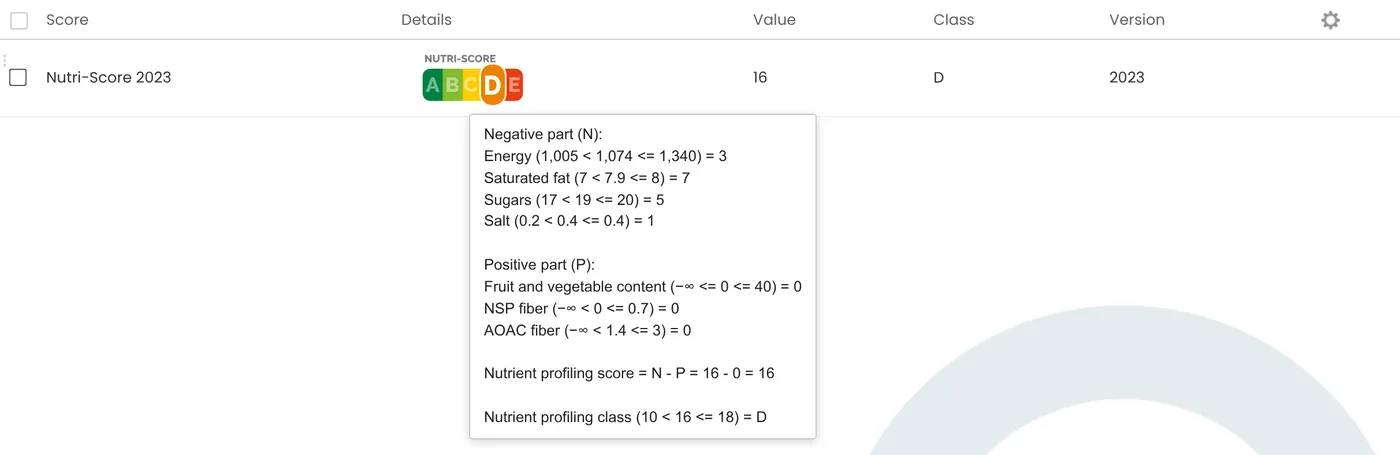
In 2014, beCPG calculated the nutritional score and the five-class scale from the recipe. Today, the Nutri-Score is calculated during formulation, from the nutrients of the raw materials, the fruit, vegetable and legume content and the product category. You choose the algorithm, 2023 or 2017, product by product. Hovering over the logo shows the detail of the points, and the score can be displayed among the dynamic characteristics of the composition.
A label born from a public health proposal has become a formulation criterion. Book a demo to recalculate one of your ranges.
Sources
- Hercberg report on French public health nutrition policy (2014, in French)
- French Law No 2016-41 of 26 January 2016, Article 14 (in French)
- French order of 31 October 2017 adopting the Nutri-Score (in French)
- Regulation (EU) No 1169/2011 on the provision of food information to consumers, Article 35
- Santé publique France: Nutri-Score
Read more: discover formulation in beCPG PLM and our posts on nutrition claims and HFSS profiling in the UK.
Frequently asked questions
Are the five-color scale and the Nutri-Score the same system?
In principle, yes: a nutritional score converted into five color classes. The Nutri-Score has been its official version since 2017, with letters from A to E and calculation rules that have been updated since.
Is the Nutri-Score mandatory?
No. It is voluntary in the seven countries that recommend it. A company that uses it commits to displaying it on all products of its registered brands.
Is there an EU-wide front-of-pack nutrition label?
Not yet. A harmonized label was announced in 2020 but has not been proposed. Brands follow the national schemes of each market, such as the Nutri-Score or the UK traffic lights.
Should products graded before 2024 be recalculated?
Yes. The updated algorithm changes the letter of many products, especially sweet or salty products and beverages. Recalculate the range before any new packaging run.