Nutri-Score
This section explains the Nutri-Score principle and how it is calculated in beCPG.
The Nutri-Score is a graphic scale that divides the nutritional score into 5 classes (expressed by a colour and a letter), to help consumers see, interpret and understand the nutritional value.
The Nutri-Score has been adopted by different European countries (France, Belgium, Spain, Germany, the Netherlands, Luxembourg and Switzerland). The objective is not to separate "good" foods from "bad" foods, but rather to use the 5 classes to distinguish foods that are healthier from those that are less healthy from a nutritional point of view. This also helps food producers to decide how to reformulate their products so they can move to a higher score.

The objectives and outcomes of the latest modifications of the algorithm are as follows:
- Improve the classification of fatty fish
- Improve the discrimination between whole grain products rich in fiber and refined products in alignment with food-based dietary guidelines
- Improve the discrimination between vegetable oils
- Improve the discrimination of products according to their sugar content, especially for products very rich in sugar, sweetened dairy products and sweetened breakfast cereals
- Improve the discrimination of products according to salt content
- Improve the discrimination between red meat – to be limited in food-based dietary guidelines – compared to poultry
- Improve the discrimination of beverages according to their sugar content, in particular for beverages with low sugar content
- Improve the discrimination of milk (skimmed/partially-skimmed milk and whole milk) according to their saturates and energy content, and the discrimination of milk-based beverages and fermented milk-based beverages according to their sugar content
- Allow an alignment of the classification for NNS-sweetened beverages with current recommendations not to promote their consumption.
The nutritional score is calculated using the data from the nutritional declaration per 100 g or 100 mL of product as sold (except in specific cases) and from the ingredient list. Points are attributed according to the content of:
- unfavourable elements, an excess of which is considered unhealthy: energy in kJ, sugars, salt and saturated fatty acids (and non-nutritive sweeteners for beverages with the 2023 calculation method);
- favourable elements: protein, fibres, fruits, vegetables, legumes (and for the 2017 calculation method: nuts, and rapeseed, walnut and olive oils).
Nutri-Score calculation method
Determination of the food category
The updated Nutri-Score algorithm includes three main categories of products:
- General foods
- Specific rule for cheeses
- Specific rule for red meat
- Animal and vegetable fats, nuts and seeds
- Beverages
Collection of the composition data
The Nutri-Score computation takes into account the following data:
- Energy value;
- % Fibers;
- % Proteins;
- % Salt;
- % Sugar;
- % Saturated fats;
- (% Lipids for the "Fats" category);
- Fruits and vegetables content, including (non-exhaustive list):
- Pulses (lentils, chickpeas, soybeans…);
- Nuts (pistachios, nuts including peanuts, cashews, coconut…);
- Herbs;
- Oils (rapeseed, walnut and olive oils).
- Sweeteners
However, fruits and vegetables do not include:
- Seeds (poppy, sunflower, pine nuts, chia);
- Potatoes and other starchy tubers such as sweet potatoes;
- Dried vegetables and maize flours;
- Quinoa;
- Spices.
Moreover, to be included in the 5C computation, fruits and vegetables must not have undergone more than one minimal transformation process. Food considered "intact" includes cooked, dried, peeled, sliced, canned and frozen food, juices and purees.
For dried or concentrated fruits and vegetables, a specific computation is required to obtain the total content of fruits and vegetables:
\[ (mass of fruits, vegetables, dried vegetables, nuts + (2 x mass of
fruits, vegetables, dried vegetables, dried nuts or concentrated
tomato)) / (mass of fruits, vegetables, dried vegetables, nuts + (2 x
mass of fruits, vegetables, dried vegetables, dried nuts or concentrated
tomato) + mass of ingredients excluding fruits, vegetables, dried
vegetables, nuts) \] x 100
For this calculation, fruits and vegetables can be taken into account before or after cooking, but they must all be considered in the same state.
Computation of the negative and positive parts of the nutritional score or "a-score"
General case
The nutritional score for food products relies on the calculation of a single, overall score which takes into account, for every food product:
- a “negative” component N
- a “positive” component P
The N component of the score takes into account nutritional elements whose consumption should be limited: energy, saturated fatty acids, sugars, and salt. For each of these elements, points from 0 to 20 are awarded based on the content for 100 g of food product. The negative N component corresponds to the sum of these points, and thus can range from 0 to 55.
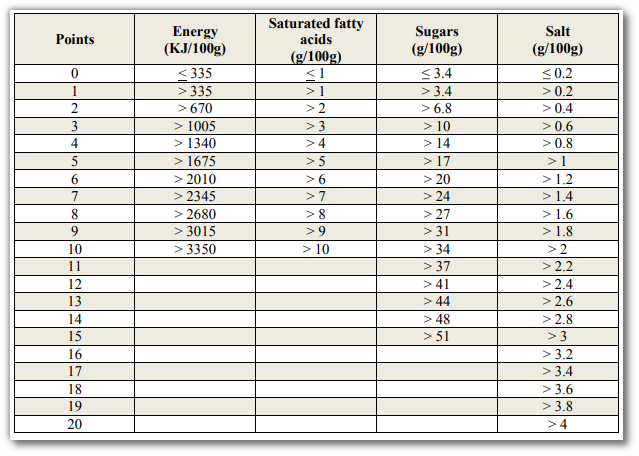
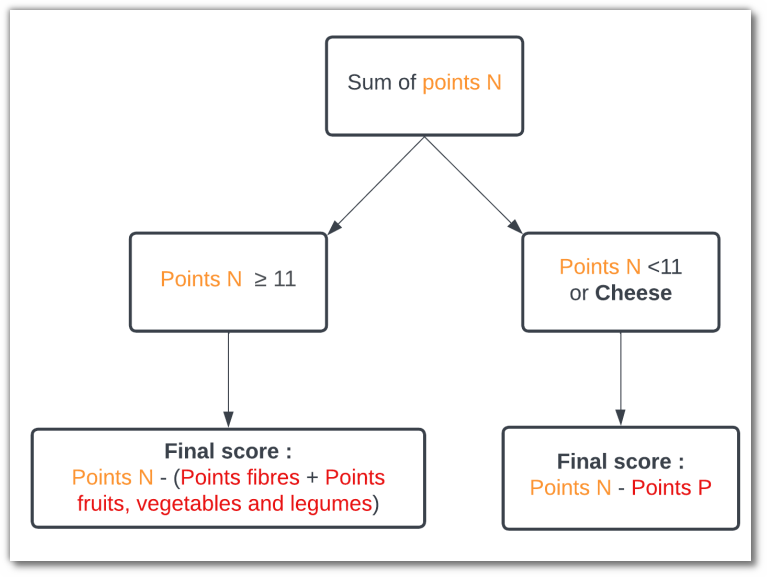
The P component is calculated based on the amount of fibers, proteins, and fruits, vegetables, and legumes in the food product. For each of these elements, points from 0 to 7 are awarded based on the content for 100 g of food product. The positive P component corresponds to the sum of these points and thus can range from 0 to 17.
For red meat and products thereof, the number of points for proteins is limited to 2. The positive P component can therefore vary from 0 to 12 points.
The list of fruits, vegetables and legumes included in this component is detailed in Annex 2 of the Santé publique France FAQ (https://www.santepubliquefrance.fr/content/download/150262/file/FAQ-updatedAlgo-FR_20231222.pdf).
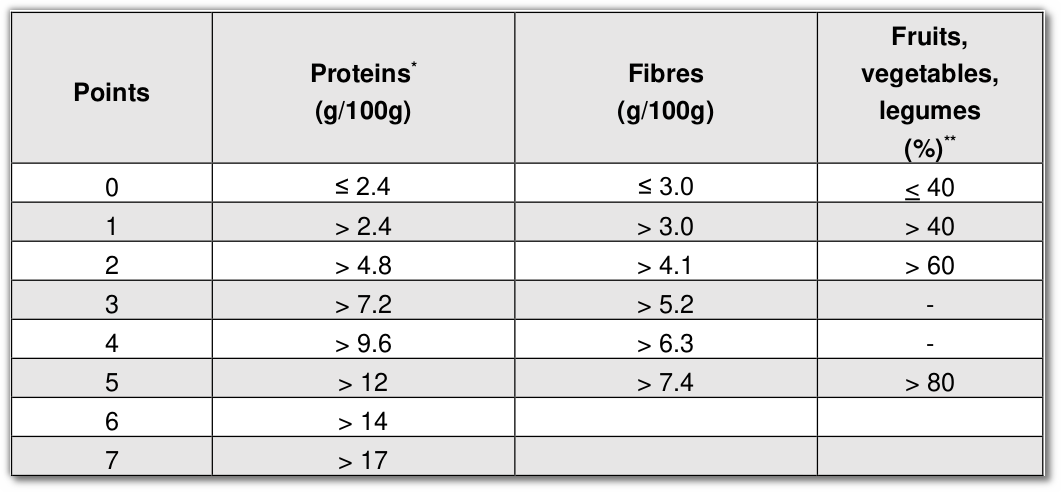
Depending on the score obtained for the N component, the final nutritional score is calculated as follows:
If the total of the N component is below 11 points or if the product is cheese, the nutritional score equals the total N component points minus the total P component points.
Nutritional score = total N points - total P points
If the total of the N component is greater than or equal to 11 points, the nutritional score equals the total N component points minus the sum of the “fibres” and “Fruits, vegetables, legumes” points.
Nutritional score = total N points - “fibres” points - “Fruits, vegetables, legumes” points
Specific cases
Animal and vegetable fats, nuts and seeds
Scores for animal and vegetable fats, nuts and seeds are calculated using the following point tables:
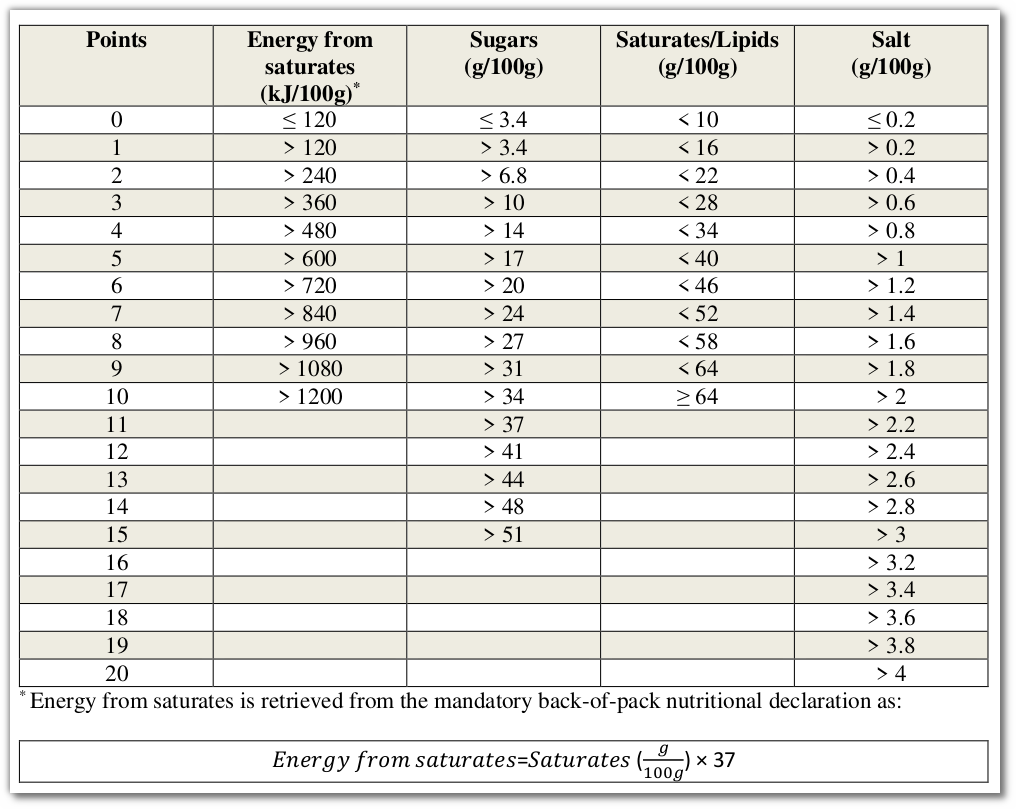
Energy from saturates = Saturates (g/100g) * 37
Points attributed to each of the elements of the positive P component in the specific case of animal and vegetable fats, nuts and seeds:
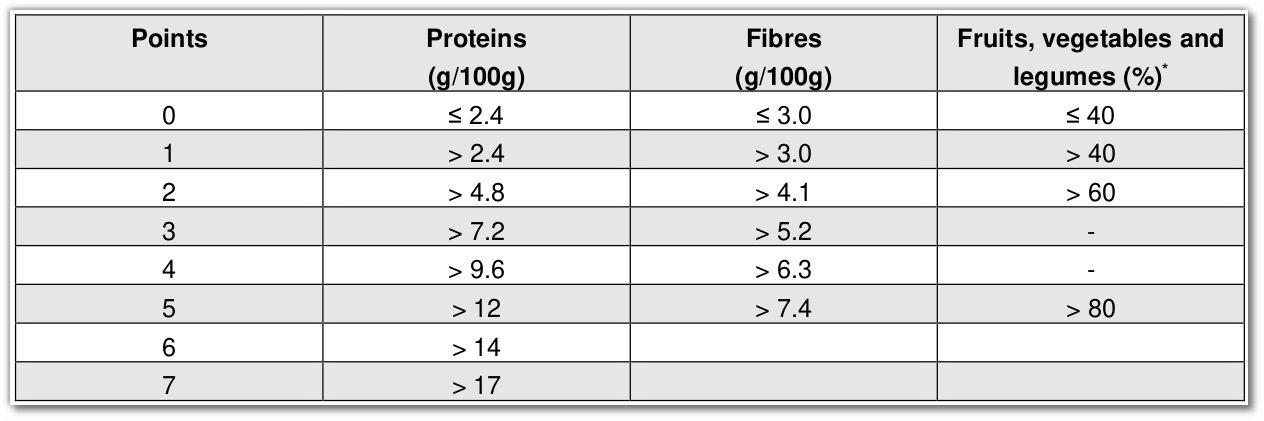
Calculation of the nutritional score for animal and vegetable fats, nuts and seeds
Depending on the score obtained for the N component, the final nutritional score is calculated as follows:
If the total of the N component is below 7 points, the nutritional score equals the total N component points minus the total P component points.
Nutritional score = total N points - total P points
If the total of the N component is greater than or equal to 7 points, the nutritional score equals the total N component points minus the sum of the “fibres” and “Fruits, vegetables, legumes” points. In this case, the protein content is therefore not taken into account in the calculation of the nutritional score.
Nutritional score = total N points – “fibres” points – “Fruits, vegetables, legumes” points
Beverages
Scores for beverages are calculated using the following point tables (see below). In this specific case, the negative N component also includes points for the presence of non-nutritive sweeteners:
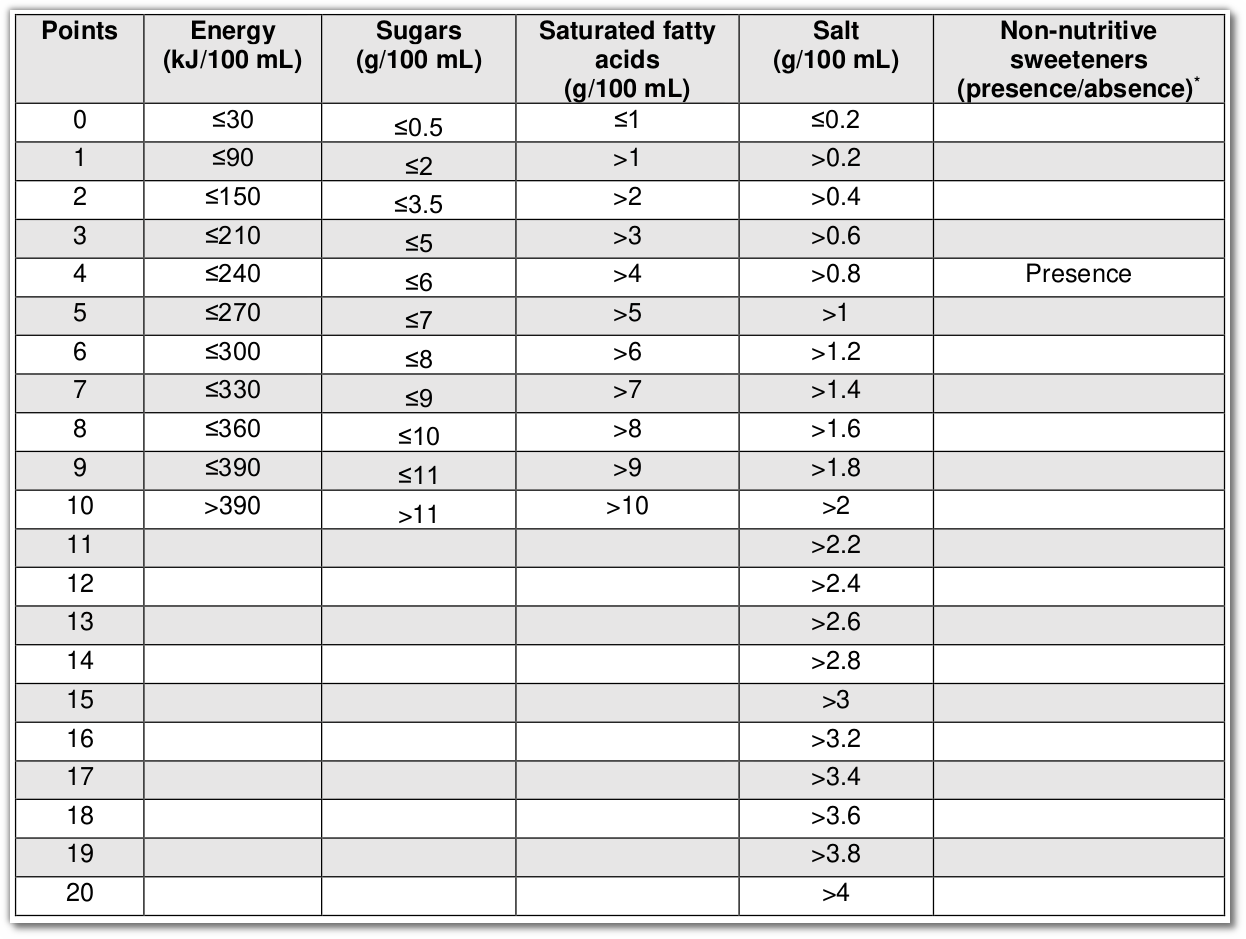
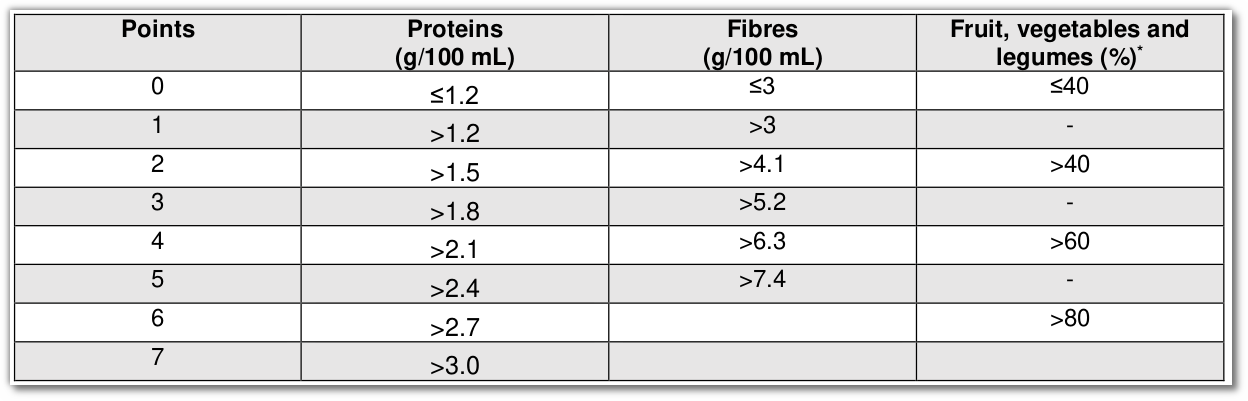
Calculation of the nutritional score for beverages
The final calculation of the nutritional score is reached by subtracting the positive P component from the negative N component:
Nutritional score = total N points - total P points
Logo attribution
The Nutri-Score logo is attributed based on the calculated nutritional score (see table below):
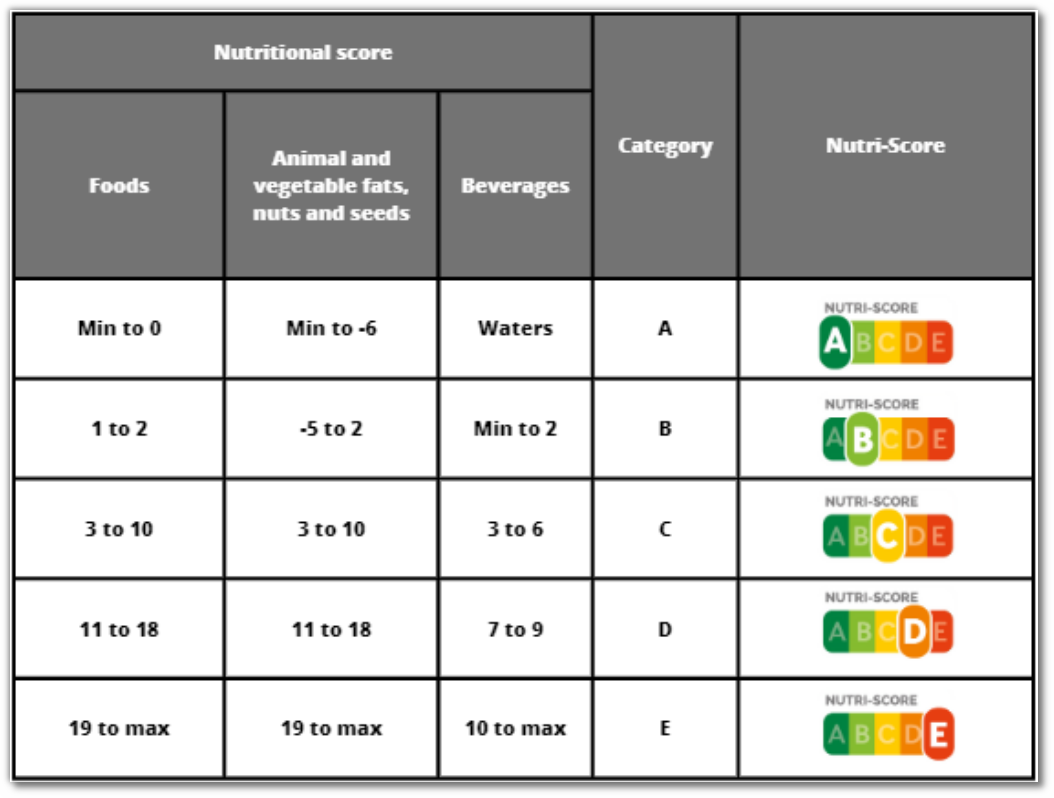
Determination of the 5C score in beCPG
How to add the nutrients required for the 5C score computation
The following nutrients are automatically displayed in the "Nutrients" list of the product:
- Salt (mg/100g);
- Energy value (kJ/100g);
- Sugar (g/100g);
- Saturated fatty acids (g/100g);
- AOAC fibers;
- Proteins (g/100g);
- Total lipids (g/100g).
On the other hand:
- Fruits and vegetables content is a physicochemical characteristic (Code = FRUIT_VEGETABLE), to add to the corresponding list if necessary;
- NSP fibers is a nutrient, to add to the corresponding list if necessary;
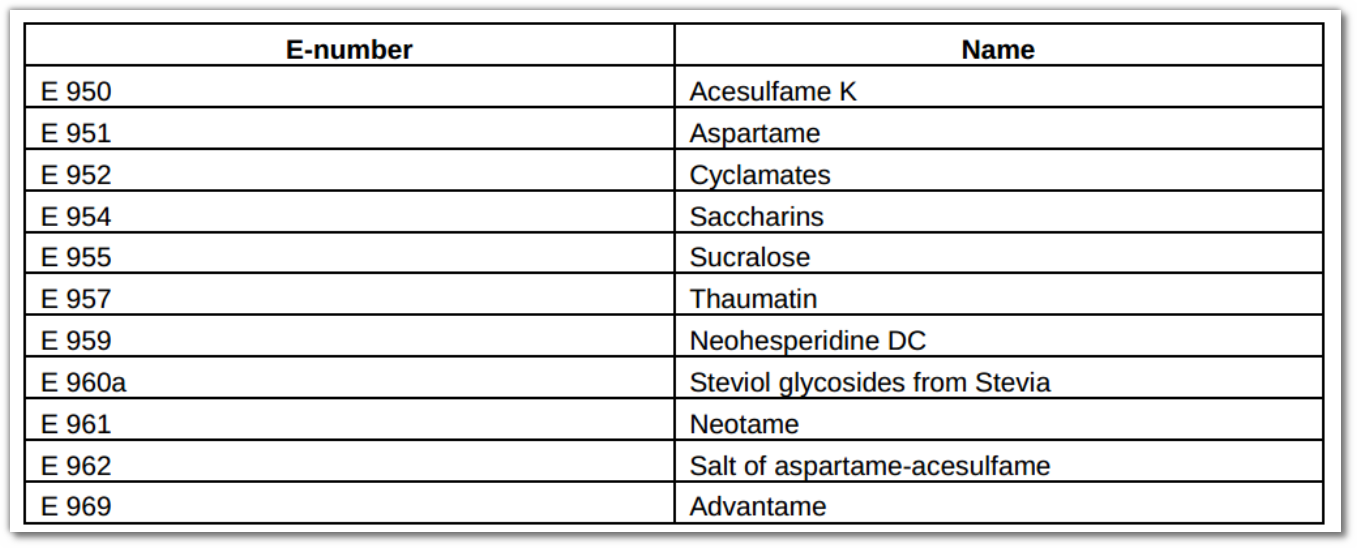
- The sweeteners taken into account in the beverages category come from the ingredient list. The list of additives taken into account is shown below. The codes must be set up correctly in the administration for the calculation to work.
Determination of the food category
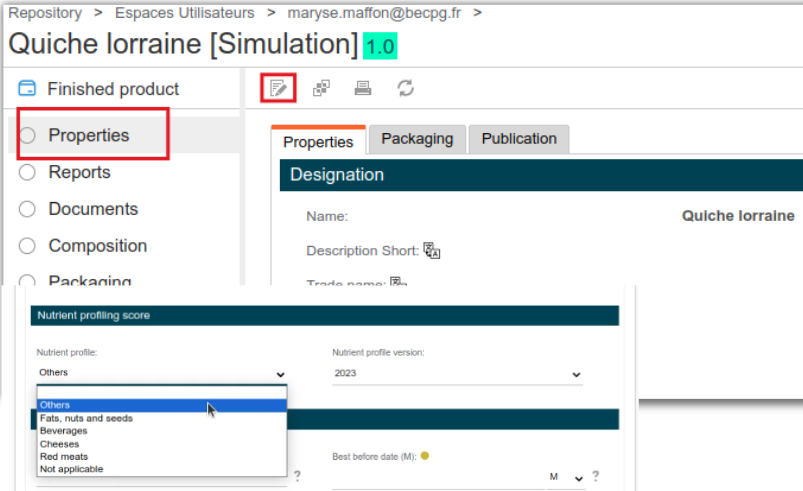
To compute the 5C score of your product, open your product and go to "Properties" > "Edit properties". In the "Nutrient profiling score" section, choose the category of your product. You can also choose the old version of the Nutri-Score (2017).
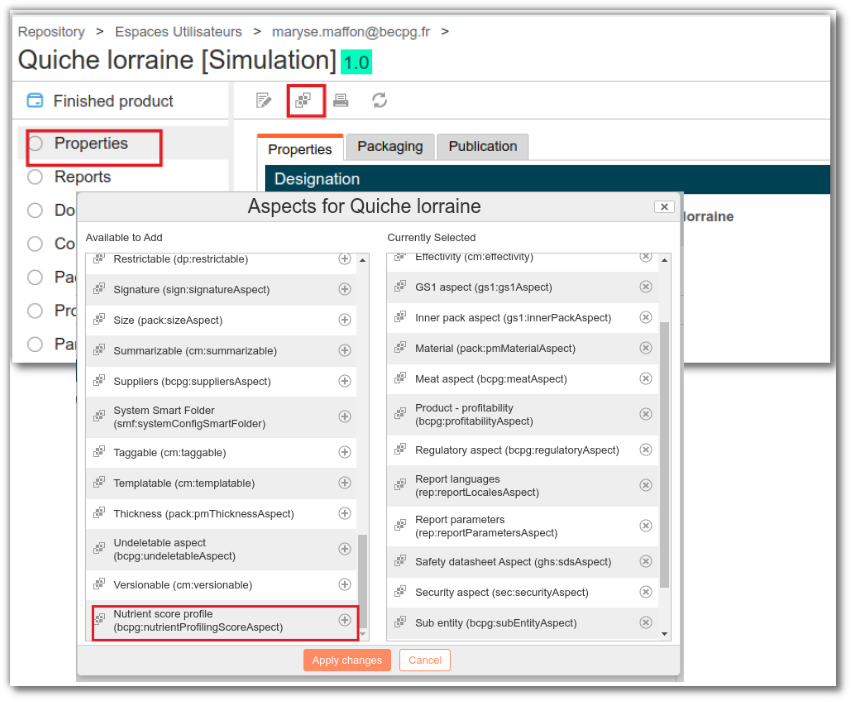
If the section does not appear, go to "Properties" and click "Add an aspect" to choose "Nutrient score profile".
Presentation of the final score in beCPG
Properties
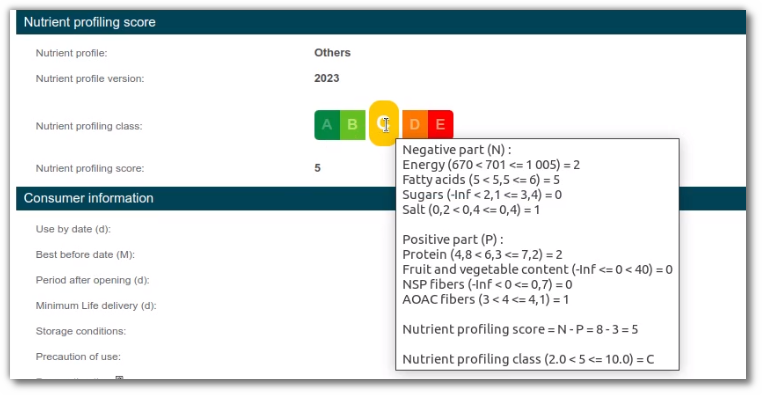
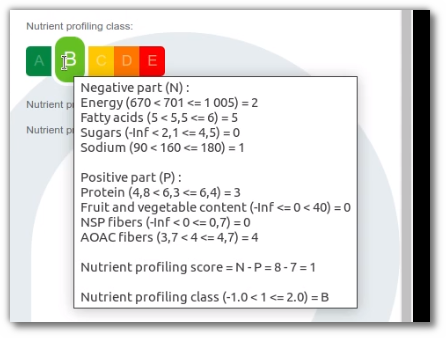
Once you have saved your properties, the score appears in the properties. Hover over the logo to see the calculation details.
Nutrients
You can also check the "Nutrients" list. As in the properties, hover over the logo to see the calculation details.
Composition
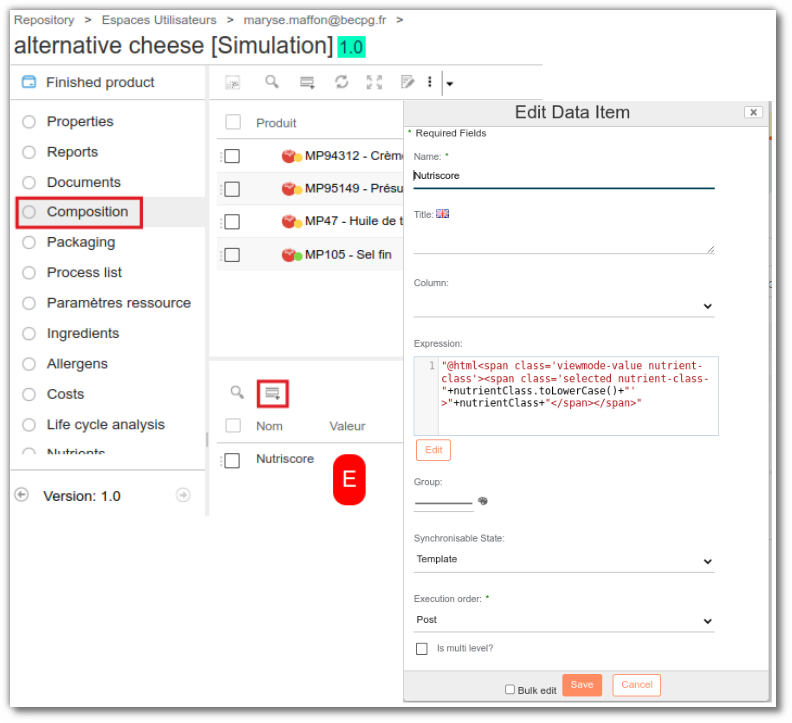
You can also add dynamic characteristics to the Composition list, with the formula.
Here is the formula with the logo and the corresponding letter:
"@html"+nutrientClass+"</span>"
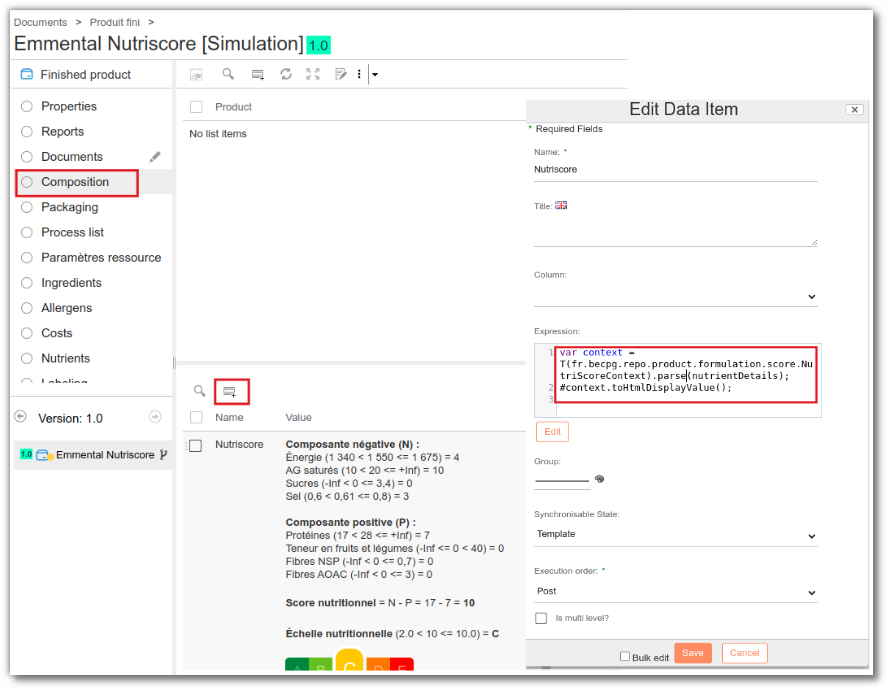
Here is the formula for the Nutri-Score details and the corresponding letter:
var context =T(fr.becpg.repo.product.formulation.score.NutriScoreContext).parse(nutrientDetails);#context.toHtmlDisplayValue();
Note:
- For fibers, there are two scales, one per analysis
method:
- NSP method: does not measure lignin and resistant starch (no information on the acquisition method);
- AOAC method: measures more or less significant fractions of resistant starch (content obtained with the AOAC method).
Source: Santé publique France 2023, https://www.santepubliquefrance.fr/media/files/02-determinants-de-sante/nutrition-et-activite-physique/nutri-score/q-a-en